Library
Agares
DukeSpirit #2 of the Ars Goetia · 31 legions
Description
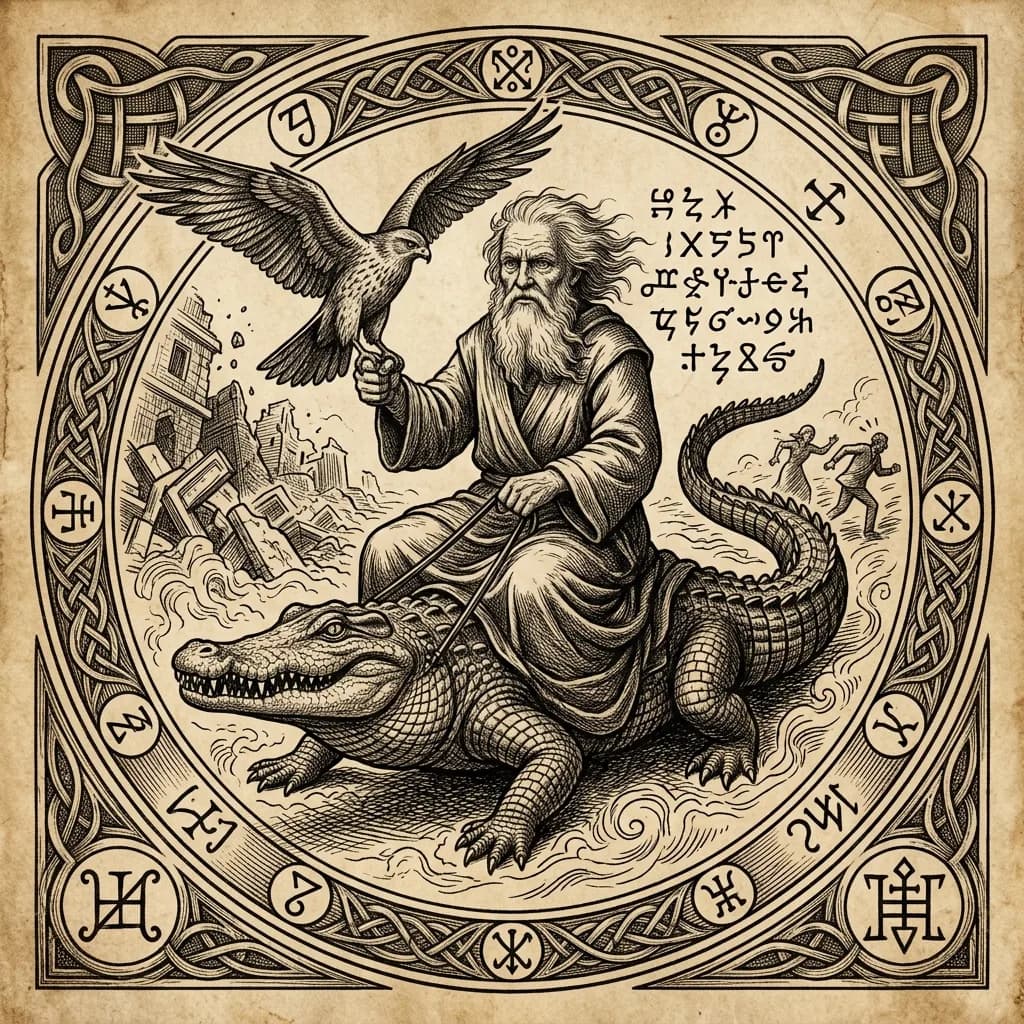
Agares is the 2nd Spirit of the Ars Goetia, a Duke of Hell commanding thirty-one legions of spirits. He appears as an old fair man riding a crocodile, carrying a goshawk upon his fist. He makes those who run stand still. He brings back those who have run away. He makes the earth tremble and shake where enemies are. He destroys dignities. He teaches all languages.
Symbolic interpretation
The power to make those who run stand still is the capacity to arrest momentum - specifically the momentum of flight. This is not merely physical immobilization but the structural interruption of escape as a strategy. Whatever force drives a person to flee - fear, guilt, tactical retreat, self-preservation - Agares nullifies it. The operative mechanism is the removal of forward motion as an available option: the fleeing party cannot exit the situation. What the target experiences is the collapse of evasion as a viable response, which forces a confrontation with whatever they were running from. This is consequential because avoidance is one of the primary tools by which individuals maintain psychological and situational control; removing it strips that control entirely and exposes the person to the full weight of what they sought to escape.
The power to bring back those who have run away extends the first capacity across time and distance. Where the first power arrests flight in the present tense, this one reverses flight already completed. The operative mechanism here is the annulment of achieved distance - a person who has already escaped, already reorganized their life around absence, is nonetheless returned. The target experiences the undoing of what they believed to be a settled outcome. The psychological consequence is profound: the belief that one can permanently exit a situation, a relationship, or an obligation is revealed to be false. The return is not voluntary, which means the psychological defenses constructed around departure - justification, forgetting, reframing - are made irrelevant.
The power to make the earth tremble and shake where enemies are is the capacity to destabilize the ground beneath an opponent. The operative mechanism is environmental - the terrain itself becomes unreliable under the feet of the adversary. This is not a direct assault on the enemy's body or mind but on the substrate that all action depends upon: stable footing, a reliable base of operations, the assumption that the world will hold still while one acts within it. The enemy experiences disorientation and the loss of the fundamental platform from which coordinated action is possible. This is consequential because military, political, and social power all depend on stable ground - literal or metaphorical - and a force that removes ground removes the precondition for organized resistance.
The power to destroy dignities targets social structure at its load-bearing points. Dignity, in the classical sense, means rank, title, and the legitimacy that accompanies social position. The operative mechanism is the dissolution of the recognized authority that attaches to a person's role. When dignity is destroyed, the person retains their physical existence but loses the social recognition that made their commands binding, their presence respected, and their identity coherent within a hierarchy. What the target experiences is the collapse of the social self - a stripping away not of life but of standing. This is among the most disorienting experiences available within a social order, because the self as others recognize it simply ceases to exist in its prior form.
The power to teach all languages is the capacity to eliminate the structural barrier between any two communicating parties. Language is not merely vocabulary; it is the entire architecture of meaning-making, cultural encoding, and negotiated reference that makes coordinated understanding possible between people. The operative mechanism is the acquisition of this architecture across all its variants simultaneously. What the practitioner gains is not just the ability to be understood in foreign tongues, but access to the interior logic of every culture that language encodes - how its speakers categorize the world, what they consider self-evident, what remains unspeakable. The consequence is the dissolution of the primary barrier between any person and any other, rendering the practitioner capable of operating within any human social system without the friction of foreignness.
The appearance of an old fair man riding a crocodile and carrying a goshawk on his fist is not ornamental - each element functions as a specific signal about Agares's operational nature. The old man signals accumulated authority, the kind that comes not from aggression but from time and knowledge; this is power that has been established, not seized. The crocodile is an apex predator that is simultaneously armored, patient, and explosive - it does not pursue but waits and then strikes with overwhelming force, which maps exactly onto Agares's power to arrest and return: the prey is not outrun but caught when it believes itself safe. The goshawk on the fist is a trained hunting bird, an instrument of directed force under perfect control - a raptor that is simultaneously wild and commanded, capable of striking at a distance, and reliably returned to the hand. The combination describes a figure whose power is layered: old authority riding ancient predatory patience while holding directed aerial force in hand. Nothing about this configuration suggests chaos or impulse; it describes precision, control, and the capacity to strike across any terrain or distance at will.
Archetype
The derived sign is Aquarius - Fixed Air - and both axes are demonstrable from Agares's operative mechanism rather than inferred from surface content. The Air element follows from the Direct à — Collective derivation: each of Agares's operations names a specific, locatable act (arrest of flight, forced return, destruction of dignity, destabilization of ground) that runs not on a targeted individual but on whoever occupies the relevant structural position - the one who fled, the enemy on the field, the dignitary holding rank. The front door exists: you can name the act, point at it, contest it in principle. But the targets are positional, not personal; the mechanism activates against whoever stands in the relevant relation to the invoker, making the operation collective in the technical sense. This is the Direct + Collective combination that produces Air as medium. The Fixed modality is the more consequential axis: every power Agares holds is a power to hold a state in place or restore one that was disrupted. Making the fleeing stand still is the enforcement of an existing confrontation against an attempted exit. Bringing back those who have already run is the restoration of a prior relational or situational state - achieved distance is simply annulled. Destroying dignities is the fixed removal of a social standing, not a dynamic escalation but a settled stripping. Teaching all languages permanently removes the barrier rather than negotiating it on each occasion. None of these operations initiate new conditions or adapt fluidly between them; each one either locks a state down or returns to a prior one. The crocodile in the iconography is mechanically precise here: it does not pursue, it holds position until the prey re-enters its range, then closes. Fixed Air produces the operator that holds structural conditions in place across an openly nameable field of collective positions, and the specific mechanical claim that follows is this: Agares's power over language is not translational fluency but the permanent collapse of the linguistic barrier as a structural feature - the condition of foreignness is fixed into absence rather than repeatedly overcome.