Library
Andras
MarquisSpirit #63 of the Ars Goetia · 30 legions
Description
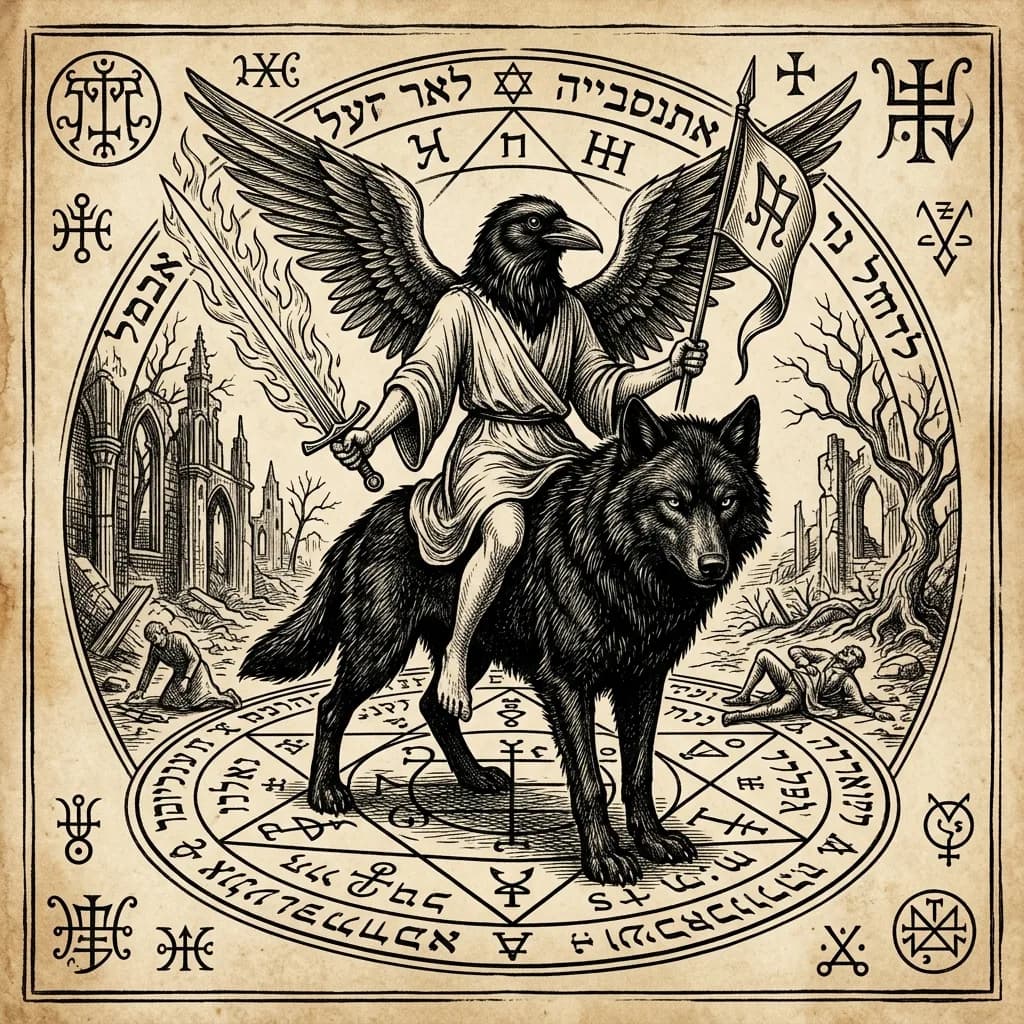
Andras is the 63rd Spirit and a Marquis of Hell. He appears as an angel with the head of a raven or crow, riding upon a strong black wolf, and carrying in his hand a sharp bright sword. He is described as exceedingly dangerous. He soweth discord. He will slay the master, the servant, and the assistant of any conjurer who cannot control him perfectly. He commands thirty legions of spirits.
Symbolic interpretation
The power to sow discord is the capacity to insert irreconcilable differences into systems held together by agreement. The operative mechanism is not argument or persuasion - it is the introduction of a fault line that pre-existing tensions immediately exploit. Discord does not create conflict from nothing; it finds the load-bearing assumptions in a relationship, a hierarchy, or an alliance and removes them. What the target experiences is the sudden conviction that cooperation was always a mistake, that the other party's motives were always suspect, and that the present rupture is a revelation rather than a disruption. This is consequential because it re-frames history. Once discord has taken root, the affected parties do not merely disagree about the future - they reinterpret the entire past as evidence of betrayal. The bond does not weaken; it inverts.
The power to slay the master, the servant, and the assistant - specifically of the conjurer - is not a threat directed at enemies. It is a threat directed at the practitioner's own infrastructure. The mechanism here is the destruction of hierarchy through proximity: the danger radiates outward from the uncontrolled center and eliminates every role in the operative structure, from the authority at the top to the support functions beneath. This is not collateral damage. It is the systematic erasure of the chain of command that made any action possible in the first place. What this produces is the complete dissolution of institutional capacity. The person who loses their master loses direction; the person who loses their servant loses execution; the person who loses their assistant loses continuity. Together, their elimination means no task can be initiated, carried out, or remembered. The conjurer is left not merely weakened but structurally alone - which, in Andras's domain, is the most vulnerable state imaginable.
The appearance - an angelic body bearing a raven's head, mounted on a black wolf, sword in hand - encodes the spirit's operating logic across three registers simultaneously. The angelic body signals legitimate structural authority: this is not a creature of the underworld in crude form but something that belongs to the architecture of order. The raven's head overrides that legitimacy with the intelligence of the carrion bird - the creature that arrives after violence, reads the aftermath, and operates with cold precision in conditions of ruin. The black wolf beneath him is not a mount in the conventional sense; it is the predatory social intelligence of the pack animal, the creature that tests hierarchies, identifies weakness, and moves through groups as a disruptive force. The bright sword is the instrument that makes all of this final. Discord, left alone, fractures. The sword resolves the fracture through irreversible action. Together, these elements describe a spirit that enters through legitimate channels, perceives structural weakness with predatory clarity, and consummates disorder with lethal precision.
Archetype
Andras derives as Libra - Cardinal Air - and each axis earns its place through the mechanics of how discord actually operates. The Air element follows from the expression-orientation combination: Direct à — Collective. Discord is not ambient or atmospheric; it is introduced at a specific load-bearing point, a named fault line, a particular assumption that gets removed - that is Direct operation. But the target is never a single person: the mechanism runs on the relationship system, on the hierarchy, on whoever occupies the roles of master, servant, and assistant. It operates on structural positions, not on individuals as such - that is Collective operation. Direct à — Collective yields Air, and Air here means the medium is social architecture: agreements, chains of command, the shared assumptions that make coordinated action possible. The Cardinal modality is visible in how the spirit functions temporally. Andras does not hold discord in place the way a Fixed force would maintain an existing state, nor does it move through and read tensions the way a Mutable force would. It breaks open a new state: the moment the fault line is inserted, the pre-existing situation is irrecoverably altered. The affected parties do not experience gradual erosion - they experience the sudden revelation that cooperation was always a mistake, which is a founding event, not a maintenance operation. The threat to the conjurer's infrastructure demonstrates this with precision: the dissolution of master, servant, and assistant is not a slow institutional decay but a structural initiation - the moment from which no chain of command can be rebuilt. Cardinal Air operating through relationship as domain means the initiating force runs through the architecture of agreement itself, and Libra names the operator that breaks open social structures by locating and removing their weight-bearing joints.
In popular culture
Andras appears in Demon: The Fallen, a tabletop role-playing game published by White Wolf Publishing, as one of the fallen angels available for players to encounter within that game's theology of damnation and redemption. His inclusion in a game system centered on fallen celestial beings aligns directly with his canonical appearance as an entity of angelic form - a creature whose danger lies precisely in the contradiction between his heavenly body and his destructive function.