Library
Barbatos
DukeSpirit #8 of the Ars Goetia · 30 legions
Description
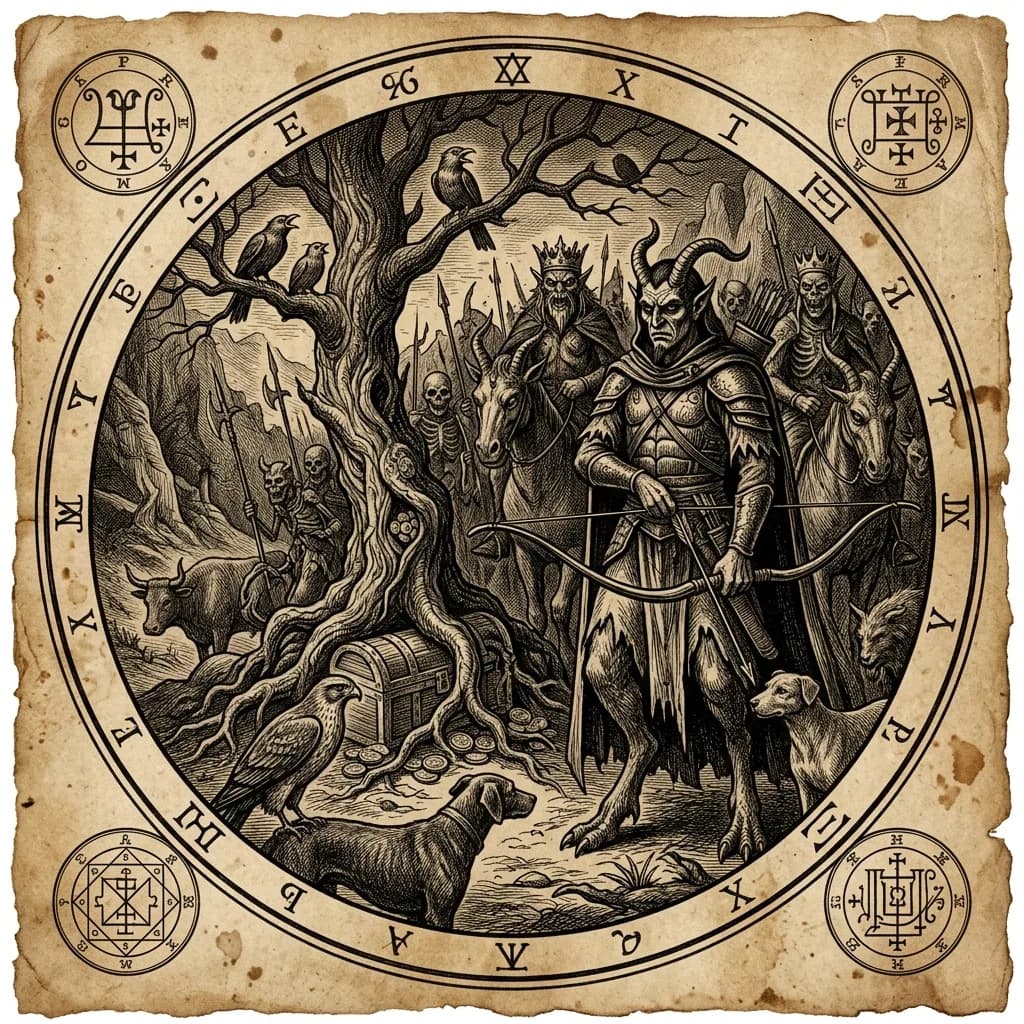
Barbatos is the 8th Spirit and a Duke of Hell. He appears as an archer with four kings and their companies of soldiers. He understands the singing of birds, the barking of dogs, the lowing of bullocks, and the voice of every living thing. He reveals hidden treasures that lie under enchanted trees. He knows things to come. He can reconcile friends and those in power. He commands thirty legions of spirits.
Symbolic interpretation
The capacity to understand the singing of birds, the barking of dogs, the lowing of bullocks, and the voice of every living thing is the structural ability to decode signal from noise across every register of communication that falls below the threshold of human linguistic convention. The operative mechanism is translation: Barbatos does not simply hear these sounds but processes them as coherent, meaningful utterances with specific informational content. What this produces in practice is an encyclopedic model of the world derived not from formal speech but from its biological substrate - the involuntary, unguarded communications of creatures who cannot deceive. Animals do not perform for observers; they emit authentic behavioral data at all times. A practitioner who gains access to this register possesses a surveillance network of unlimited reach that no counterintelligence can shut down. Every ecosystem becomes a reporting apparatus, and the information it produces concerns real conditions on the ground - predators, resources, boundaries, threats - unfiltered by human agenda.
The revelation of hidden treasures lying under enchanted trees describes a specific capacity to locate value that has been deliberately concealed and warded against discovery. The mechanism here is twofold: first, the perception of something hidden, meaning Barbatos cuts through obfuscation that would defeat ordinary search; and second, the ability to neutralize whatever enchantment guards the concealment, meaning the warding itself is not an obstacle. This is not general treasure-finding but a targeted competence in penetrating guarded stores - hoards that someone or something has actively protected. The effect on those who benefit is access to accumulated wealth or power that has been deliberately kept out of circulation, often for strategic reasons. The political and material implications are significant: enchanted concealment implies institutional or magical investment in keeping the treasure hidden, meaning its revelation disrupts existing power distributions that depended on that concealment remaining intact.
Knowing things to come is prophetic cognition - not a probabilistic assessment but a direct epistemic relation to future states. The operative mechanism is the compression of temporal distance: future events are available as information before they manifest in the present. This matters because decision-making under ordinary human conditions is always degraded by uncertainty about consequences. Access to foreknowledge eliminates that degradation entirely. The person who receives this information is no longer gambling on outcomes; they are executing from a position of certainty. The chain of effect transforms every strategic or personal decision from a risk-weighted calculation into a guaranteed optimization. This is the most absolute form of competitive advantage that exists - not better information about the present, but correct information about what has not yet happened.
The capacity to reconcile friends and those in power names a very specific interpersonal mechanism: the restoration of broken alliances between parties who already share some relational or institutional bond. This is not the Creation of new relationships but the repair of severed ones. The operative distinction matters: reconciliation presupposes prior connection, rupture, and residual interest in restoration. Barbatos works on this specific structural condition - parties who should be aligned but are not, whose estrangement creates downstream dysfunction for everyone dependent on their cooperation. The targets are also named with precision: friends and those in power. These are two categories that frequently overlap at the top of social hierarchies, where personal loyalty and political authority intertwine. Restoring these bonds does not merely heal private grievances; it repairs the operational capacity of power structures that have seized up due to personal conflict. The social consequence is the reactivation of networks and institutions that had been paralyzed.
Barbatos appears as an archer with four kings and their companies of soldiers. The archer's fundamental attribute is the capacity to act at distance - to project force across space without closing the gap between self and target. This is a precise description of how Barbatos's powers operate: he understands remote communications, locates hidden and distant treasures, perceives future events not yet present, and repairs relationships from a position outside the conflict. All of his capacities involve reaching across a gap - temporal, spatial, linguistic, or social - without requiring direct contact. The four kings and their armies augment this image with a structural claim about authority: Barbatos does not arrive alone but at the center of a formation of hierarchically organized power. Four is a number of cardinal completeness - the four directions, the four corners - meaning the power arrayed behind him is oriented in every direction simultaneously. The overall figure is one of centralized command over comprehensive reach, a single intelligence coordinating forces that extend outward in all directions at once.
Archetype
Barbatos derives as Gemini - Mutable Air - and the derivation holds when each term is tested against what the spirit actually does. The Air element comes from the Direct à — Collective matrix: Barbatos's operations have a specifiable act at their center (translation, revelation, reconciliation, foreknowledge), and they run on whoever occupies the relevant position within a system rather than targeting a named individual - the bird that calls is not selected, the power structure that needs its broken alliance repaired is engaged as a structure, not as a specific person. The mechanism is legible and impersonal simultaneously, which is precisely what Direct + Collective produces. The Mutable modality appears in the temporal posture: Barbatos initiates nothing and holds nothing. He reads. The capacity to decode animal communications is not the Creation of a new signal regime or the preservation of an existing one - it is the competence to move through existing signal environments and extract meaning already present in them. The prophetic function operates identically: future events are not manufactured or locked in place, they are read. The reconciliation of broken alliances is not the founding of a new relationship or the enforcement of an existing bond but a diagnostic and corrective translation between parties who have lost communicative access to one another. Every operative mechanism Barbatos possesses is an act of passage through an existing structure - linguistic, temporal, social - rather than the installation or maintenance of one. Gemini, as Mutable Air, names a force that moves through legible, collective systems for the purpose of reading and transmitting what is already there. Barbatos does not build the network; he is the function that makes the network's information available.
In popular culture
In Umineko: When They Cry (07th Expansion), Barbatos appears as one of the seventy-two demons summoned by the witch Beatrice, functioning as a distinct character within the visual novel's layered, puzzle-box narrative about truth, testimony, and the violence of interpretation. In Obey Me! (NTT Solmare Corporation), Barbatos is rendered as the butler to the demon prince Diavolo, a role that places him structurally close to sovereign power in a position of organized, loyal service - an adaptation that resonates with his canonical capacity to reconcile those in power and his appearance as a figure who commands organized forces on behalf of higher authority.