Library
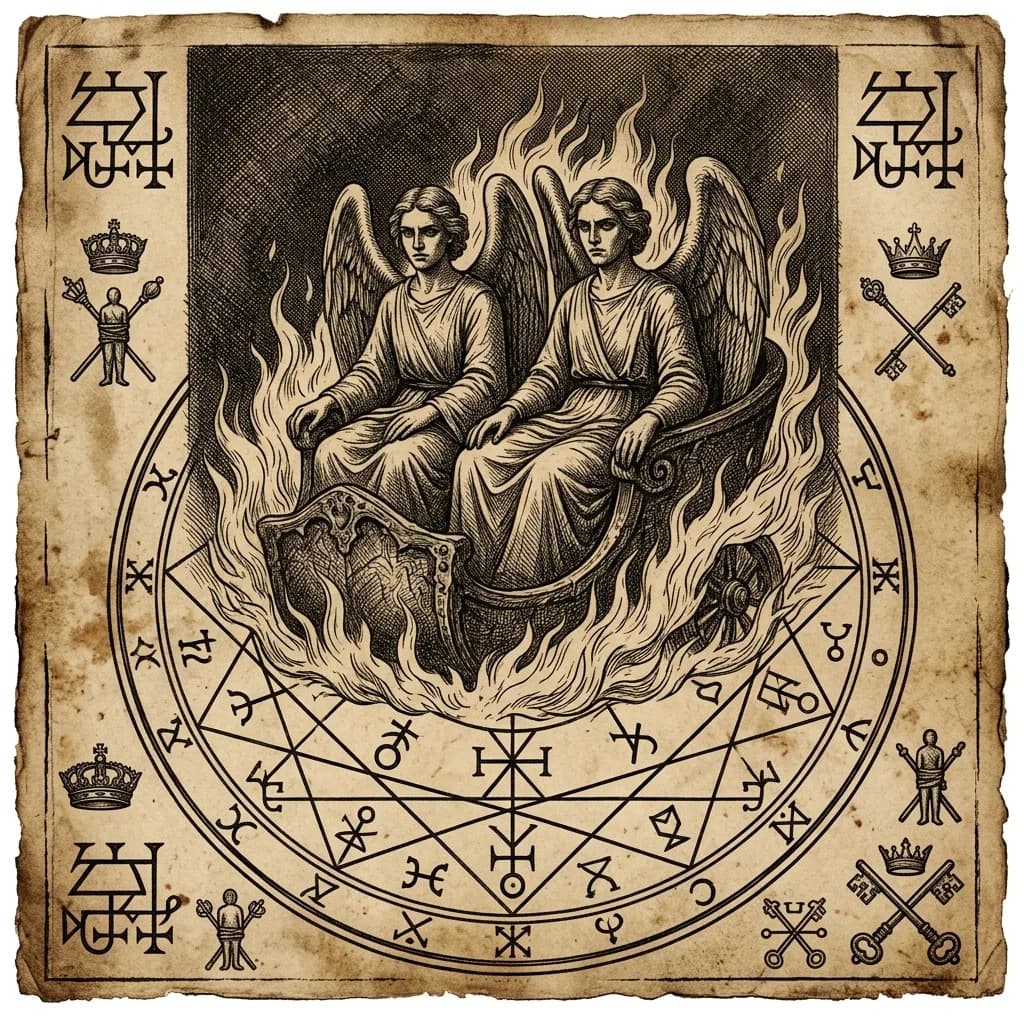
Belial
KingSpirit #68 of the Ars Goetia · 80 legions
Description
Belial is a King of Hell, the 68th Spirit. He appears as two beautiful angels sitting in a chariot of fire, and speaks with a comely voice. He was created next after Lucifer, and claims that proximity to establish his own authority. His powers are the distribution of senatorships, the conferral of political presentations and favor, and the binding of political loyalty. He requires a binding before he tells truth; left unbound, he deceives entirely. He is wholly given to wickedness behind his beautiful presentation. He commands 80 legions of spirits.
Symbolic interpretation
The distribution of senatorships is the power to assign institutional standing - not merely to recognize who deserves rank, but to confer rank itself. The operative mechanism is the control of legitimacy's source: Belial does not evaluate existing merit and reward it; he determines which persons become the kind of persons whose merit is taken seriously. Whoever receives a senatorship from Belial enters a structure where their authority appears earned, historical, and self-evident. The people who interact with such a figure experience his elevation as natural, because institutional standing carries the appearance of having always been appropriate. The consequence is that the actual origin of the authority - Belial's arbitrary conferral - disappears from view entirely, leaving only the credential.
The conferral of political presentations and favor operates one step below formal title and one step closer to perception. A political presentation is access to the right rooms, the right introductions, the right moments of public visibility. Favor is the disposition of those in power toward a particular person before that person has spoken. Belial's capacity here is to shape the social preconditions of influence: he determines not just who holds power but who is perceived as belonging near power. The target of this conferral is received differently - doors open, speech is heard as credible, rivals are pre-dismissed - not because anything about the person changed, but because the framing around them shifted. This is consequential because most political outcomes are decided before deliberation begins, in the moment of first reception.
The binding of political loyalty is a structural capacity to make commitments adhesive. Ordinary loyalty fluctuates with interest; bound loyalty persists against interest. What Belial operates here is a mechanism that converts provisional alliance into an obligation the bound party cannot exit without cost. The bound party experiences this as duty, as identity, as allegiance too deep to examine - what was an instrumental relationship becomes a constitutive one. This is consequential because it transforms the political landscape around any figure Belial favors: that figure's base of support cannot be peeled away by rivals offering better terms, because the support is no longer a transaction. It is a fixed feature of those who hold it.
Deceiving entirely when unbound is not simply a tendency toward dishonesty. It is the default state - the condition that obtains unless an external constraint is applied. The mechanism is the absence of any internal orientation toward truth: Belial's speech, when unregulated, produces whatever is most instrumentally useful for Belial's purposes, with no friction from accuracy. What the interlocutor experiences is a conversation that feels coherent, persuasive, and referential to reality while describing nothing real. The full chain of effect runs as follows: the person who engages Belial without binding receives a complete representation of a world that does not exist, makes decisions based on that representation, and acts in ways that advance Belial's interests while believing they advance their own.
The appearance of two beautiful angels seated in a chariot of fire, speaking with a comely voice, is not aesthetic flourish - it is the description of a functional mechanism of pre-emption. Beauty and angelhood are both categories that disarm scrutiny before it begins: angels are not suspected, and the beautiful are not interrogated. The duality - two figures, not one - introduces an effect of corroboration. Where a single voice might invite doubt, two voices occupying the same vehicle and speaking in agreement produce the sensation of Confirmation. The chariot of fire signals authority in motion, legitimacy that arrives rather than waits, power that commands its environment. The comely voice completes the circuit: even the medium of communication is engineered to be received as trustworthy. Belial's form is a delivery mechanism for the condition in which deception cannot be detected, because every available signal says: this is safe, this is true, this is good.
Archetype
Belial's derived sign is Leo, the product of Fixed modality operating through Fire - where Fire names the medium (Direct à — Individual) and Fixed names the temporal posture of the force. The Fire element is visible in exactly the mechanism the tradition specifies: each conferral of a senatorship is a discrete, targeted, nameable act - there is a specific person who receives standing, a specific moment when rank is conferred, a specific front door through which the operation runs. The recipient can be identified; the transaction can, in principle, be located. This is the Direct signature, and because each instance operates on a specific individual rather than on whoever occupies a structural position, it is Individual - Fire confirmed at both axes. The Fixed modality appears in what happens after conferral: Belial does not initiate instability and withdraw. He perpetuates the states he creates. The senatorship, once granted, reproduces itself - the recipient's authority appears historical and self-evident, the bound loyalty resists exit against interest, the elevated figure continues to be received as someone who belongs near power. Belial holds conditions in place; he is not a disruptor who starts the fire and leaves, but an institutionalist who ensures the fire does not go out. The requirement for binding before truth-telling reinforces this: the deceptive default is not a transition state but a stable one, the equilibrium that persists unless externally constrained. Leo names the operator that results when force is Fixed in posture and Fire in medium - a mechanism that locks its outputs in place through the same targeted, legible acts that created them.
In popular culture
In Diablo III by Blizzard Entertainment, Belial appears as a major antagonist and boss known as the Lord of Lies, who deceives and manipulates the people of Caldeum, rendering his traditional character as an unbound deceiver directly as gameplay. In the Darksiders: Warmastered Edition DLC, published by THQ Nordic, Belial is featured as a demon lord boss character that players must defeat, positioning him as a figure of demonic hierarchy consistent with his rank. In Hellboy: The Wild Hunt, published by Dark Horse Comics, Belial is depicted as a demon prince and one of the antagonists Hellboy confronts across the comic series.
Testament of Solomon
In the Testament of Solomon, Belial appears as Beliar. He reveals to Solomon that he was once a powerful angel who fell due to his pride. Solomon binds Belial with his magical ring and assigns him the task of transporting stones for the Temple.