Library
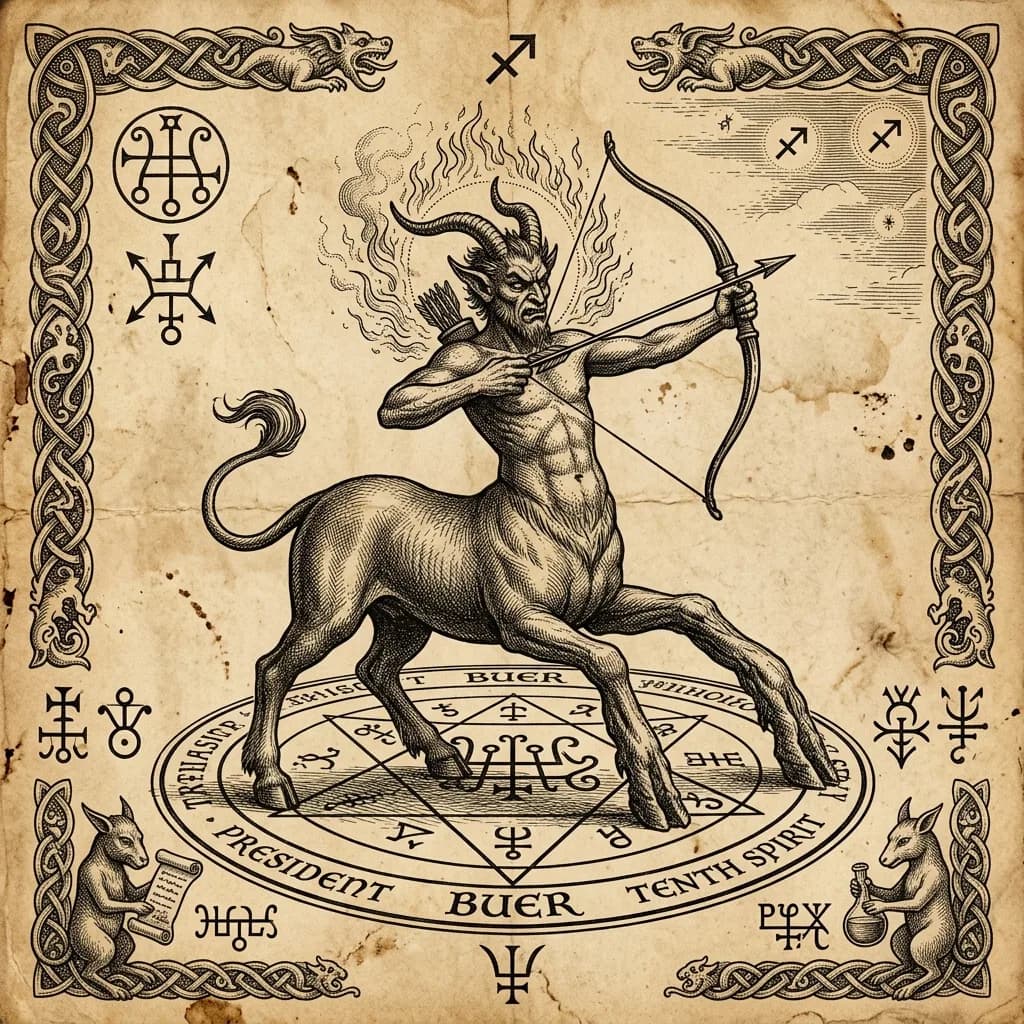
Buer
PresidentSpirit #10 of the Ars Goetia · 50 legions
Description
Buer is the 10th Spirit and a President of Hell. He appears in Sagittarius. He teaches philosophy and the Logical and Moral sciences. He heals all distempers in man. He gives good familiars. He commands fifty legions of spirits.
Symbolic interpretation
The capacity to teach philosophy and the Logical and Moral sciences is not the transmission of information but the installation of a framework for reasoning about existence. Philosophy as Buer teaches it is the structural capacity to ask questions that do not have empirical answers and to pursue those questions with rigor rather than collapse them into superstition or sentiment. Logic provides the architecture of valid inference - the rules that determine when conclusions are actually entailed by premises, and when they merely feel as though they are. Moral science extends this apparatus into the domain of conduct, applying disciplined reasoning to questions of obligation, harm, and value. What this produces in those it acts on is a fundamental reorganization of how knowledge itself is processed. The person who has genuinely received this teaching no longer operates on received belief alone; they have been given the machinery to evaluate claims, to trace contradictions, and to construct positions with defensible foundations. That is consequential because it makes a person harder to deceive and harder to manipulate, and simultaneously makes them responsible for their own conclusions in a way they were not before.
The power to heal all distempers in man is total-spectrum medical authority over the human organism. The word "all" carries exact weight here - this is not specialization in one condition or one system but comprehensive command over whatever goes wrong in the body and mind. The operative mechanism is the elimination of imbalance: a distemper is a disruption of right proportion, whether in the humors of the body or the dispositions of the psyche, and Buer's capacity is to restore the correct ratio. What the healed person experiences is the return of function - the body doing what a body is for, the mind no longer distorted by illness into distorted perception or distorted feeling. This is consequential because disease is not merely physical suffering but epistemological corruption: a body in severe distemper cannot think clearly, cannot fulfill obligations, cannot pursue anything. Healing restores the platform upon which all other capacities depend.
The giving of good familiars is the provision of a reliable auxiliary intelligence bound to serve the recipient's purposes. A familiar is not a companion in the sentimental sense; it is an operative agent - an entity with its own perceptual range and capabilities that extends the reach of the person it attends. The word "good" here functions as a quality specification: these familiars are effective, trustworthy, and aligned with the recipient's interests rather than with competing agendas. What this produces is an expansion of the practitioner's effective capacity beyond what any single human being can perceive or accomplish alone. A good familiar notices what the human misses, operates in registers the human cannot access, and provides intelligence that changes the quality of decisions. This is consequential because the fundamental limitation of human cognition is its confinement to one embodied point of view, and a reliable auxiliary breaks that confinement.
Buer appears in Sagittarius - the sign of the archer, the centaur, the creature that is half animal and half man. The centaur form describes a specific structural condition: the junction of instinct and reason within a single body, not transcending one in favor of the other but operating both at full capacity simultaneously. The archer's posture is one of Aim - distance collapsed into precision, force channeled through calculation toward a specific point. This appearance encodes the central mechanism of Buer's operation: philosophical teaching, healing, and the provision of familiars all require the same dual competence that the centaur embodies. Diagnosis requires both the empirical reading of symptoms and the theoretical framework for interpreting what they mean. Philosophy requires both the animal vitality to care about existence and the rational discipline to reason about it. The centaur is not a compromise between beast and man; it is the assertion that the highest capacity requires both, unified and mobile.
Archetype
Buer's derived sign is Pisces, produced by the combination of Mutable modality and Water element. The Water element follows from Diffuse expression operating at Collective orientation: Buer's mechanisms - philosophical framework installation, total-spectrum healing, familiar provision - do not announce themselves as discrete interventions on named individuals. They enter whoever occupies the relevant position (student, patient, practitioner) through atmospheric saturation rather than targeted confrontation. The philosophical teaching does not hand someone a conclusion; it restructures the ambient conditions of how reasoning happens, so that the recipient is already inside a different epistemic architecture before they can locate the moment of change. The healing operates across "all distempers" without specifying a front door - it restores systemic proportion rather than attacking a named condition at a named site. The Mutable modality is visible in the operational posture throughout: Buer does not initiate a new state nor hold an existing one in place, but reads across states and bridges them. Philosophy bridges the gap between received belief and defensible inference. Healing reads the disruption in the body's ratio and translates it back toward equilibrium. The familiar extends perception across registers the human organism cannot access directly - it is a Mutable instrument, a reader of terrain the practitioner cannot occupy. What the Mutable-Water combination produces mechanically is a force that does not impose a structure but flows through existing structures, reorganizing their internal ratios without declaring the reorganization. The specific claim this generates: Buer's power is not detectable at the moment of entry because nothing is ever directly declared - the change in the recipient's reasoning capacity, physical condition, or perceptual range manifests as an internal shift whose origin cannot be located or contested.