Library
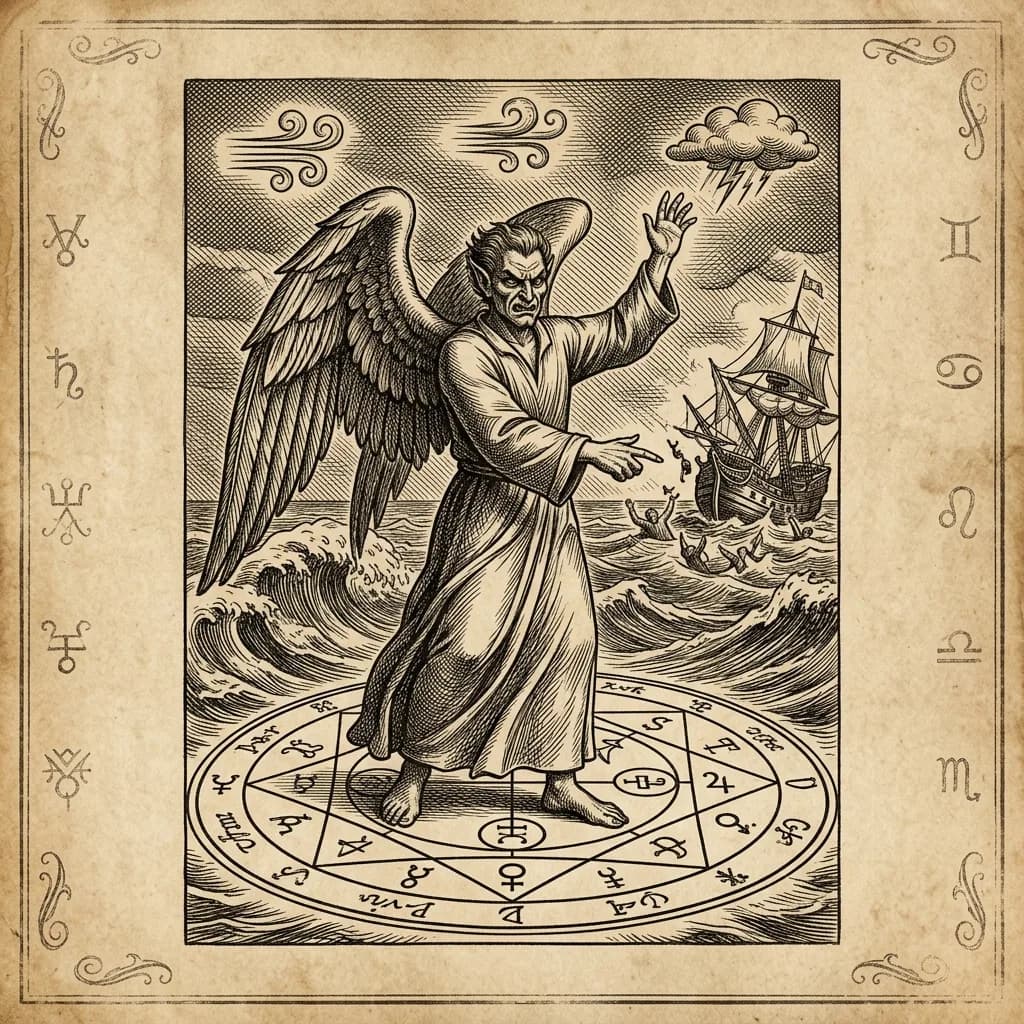
Focalor
DukeSpirit #41 of the Ars Goetia · 30 legions
Description
Focalor holds the rank of Duke of Hell and commands thirty legions of spirits. He appears as a man with griffin's wings. He drowns men and overturns ships of war. He has power over winds and the sea. If commanded by the conjurer, he will not hurt any man. He hopes that after one thousand years he will return to the seventh throne. The Duke rank governs execution at massive operational scale inside a King's frame. Effects are measurable, traceable, and removable.
Symbolic interpretation
The power to drown men and overturn ships of war is the capacity to collapse organized force at the point of its deployment. Ships of war are not incidental vessels - they are concentrated power projection, coordinated logistics, and institutional will made physical. To overturn them is to strike at the mechanism of collective force rather than the individual soldier. Drowning is a specific mode of destruction: it is total, it leaves no battlefield, and it denies the victim any surface to stand on. What this produces in those who witness or survive it is not simply fear of death but the erasure of strategic confidence - the understanding that the medium itself, the operational theater, has become hostile. Armies and commanders who lose ships do not merely lose materiel; they lose the assumption that their power can be transported and sustained. Focalor operates at the infrastructure of conflict, not its edge.
The power over winds and the sea is the governance of the conditions under which all maritime action becomes possible or impossible. Wind and sea are not obstacles within an environment - they are the environment itself. To hold power over them is to control the preconditions of movement, supply, communication, and retreat across vast distances. This is not a reactive capacity but a structural one: it sets the terms before any human decision is made. The effect on those subject to it is a kind of enforced passivity, a stripping away of initiative. Even the most disciplined fleet becomes inert when the winds refuse and the sea turns. Focalor's dominion over these elements means he does not need to fight anyone - he simply determines what is possible before the fighting begins.
The constraint that if commanded by the conjurer Focalor will not hurt any man is not a limitation in the ordinary sense - it is a demonstration of the precision with which this power operates. The capacity for mass destruction is fully present and fully suspendable on instruction. This describes a force that is not autonomous or chaotic but calibrated and directional. The operative mechanism is hierarchical obedience: the conjurer's command becomes an active parameter that redirects the spirit's destructive potential away from human targets entirely. What this produces for the practitioner is a reliable instrument rather than an unleashed catastrophe - the ability to wield naval-scale destructive force as a tool rather than a weapon that cannot be aimed. This restraint is consequential because it means Focalor's power can be deployed selectively, making him useful in operations requiring precision alongside magnitude.
The hope that after one thousand years Focalor will return to the seventh throne is a statement about temporal position and trajectory. This is not nostalgia - it is an orientation toward restoration, a maintained awareness of original rank and the expectation of reinstatement. The seventh throne locates Focalor within a specific hierarchy that predates his current station. What this means structurally is that Focalor operates with a long horizon and an identity not fully defined by his present function. For those who work with him, this is significant: a spirit that regards its current role as provisional and its future as ascendant operates with a particular kind of disciplined patience. He is not invested in the permanence of his infernal position. That detachment from his current station is itself a form of power - it insulates his judgment from the distortions of attachment.
The appearance of a man with griffin's wings reads as a precise functional description of Focalor's operative mode. The griffin combines the body of a lion - terrestrial apex predator, symbol of concentrated ground-level force - with the wings of an eagle, which govern aerial dominion, elevation, and the sovereign view from above. As a man with griffin's wings rather than as a full griffin, Focalor retains human cognition and intentionality while bearing the mobility and reach of a creature that crosses between domains. Wings on a human form signal a power that operates across registers - between the surface world and the elements above it, between the tactical and the strategic, between the one who acts and the one who surveys. In the context of a spirit whose primary domain is wind and sea, the wings are not ornamental: they are the mechanism by which he moves through and commands the aerial medium that drives all maritime action. He does not merely control the sea from within it - he commands it from above.
Archetype
Focalor derives as Fixed Water - the modality is Fixed, the element Water, yielding Scorpio as the operative sign. The Fixed posture is visible not in stubbornness or entrenchment but in the specific mechanical function of holding conditions in place: Focalor's power over winds and sea does not initiate weather events or translate between atmospheric states - it sustains a set of preconditions that deny movement to whoever is subject to them. A fleet becalmed is not struck; it is held. The storm does not pass through; it persists until the conjurer instructs otherwise. That is Fixed force: the perpetuation of a state that others cannot escape by waiting it out. The Water element derives from the Expression à — Orientation combination - Diffuse and Collective. The mechanism is Diffuse because there is no front door to contest: wind and sea do not declare hostility, they simply become inhospitable, and the target is already inside that condition before recognizing it as force. It is Collective because the operation runs on whoever occupies the relevant position - any fleet, any ship of war, any organized maritime power that enters the affected theater. Individual identity is irrelevant; the sea does not differentiate. The constraint that Focalor will not hurt any man if commanded confirms the Fixed precision: the destructive state can be held off a specific category of targets just as readily as it is held on them, demonstrating that the mechanism is a sustained parameter, not a released phenomenon. Focalor is an operator who controls not what his targets do but what remains possible for them to do - and holds that constraint in place indefinitely.