Bible study / Biblical figures / Goliath

Old Testament

Goliath

United Monarchy (c. 1010 BC)

pridedivine power against human strengthfearfaith

The Story of Goliath

Goliath of Gath emerges from the ranks of the Philistines as a towering figure, his stature and weaponry casting a long shadow over the Valley of Elah. This strategic valley marks the battleground between the Israelites under King Saul and the Philistines, who continually threaten the stability of the young Israelite kingdom. Goliath, described in 1 Samuel 17:4 as standing at "six cubits and a span," embodies the very essence of intimidation, clad in bronze armor and brandishing formidable weapons. His challenge — a call for single combat to decide the fate of the conflict — reverberates through the Israelite camp, sowing fear and doubt among Saul's men. This bold taunt, mocking not only the Israelites but their God, disrupts the tenuous status quo and sets an unexpected chain of events into motion.

Into this charged atmosphere steps David, a youthful shepherd sent by his father to deliver supplies to his brothers at the front. David's arrival coincides with one of Goliath's daily provocations, and unlike the seasoned soldiers around him, David is more incensed than intimidated. His decision to volunteer to face Goliath is met with skepticism, not least from his eldest brother Eliab, who scorns him (1 Samuel 17:28). Yet David's resolve is unshaken. He cites his past triumphs over lions and bears while tending his father's sheep as evidence of divine favor and protection (1 Samuel 17:34-37). This decision, fueled by a steadfast faith rather than martial prowess, stands in stark contrast to Saul's inaction, reflecting the king's waning faith and foreshadowing his decline.

The confrontation between David and Goliath unfolds with dramatic swiftness. Declining Saul's offer of armor, David approaches the giant with only a sling and five smooth stones, a seemingly laughable arsenal against a veteran warrior. As Goliath advances, David runs to meet him, declaring in 1 Samuel 17:45, "You come to me with a sword and with a spear and with a javelin, but I come to you in the name of the LORD of hosts." With a single stone, David strikes Goliath on the forehead, felling the giant instantly. The Philistine's reliance on physical might and armament is undone by David's unyielding faith and precise aim, turning the tide of the battle in an instant.

The aftermath is both swift and decisive. David seizes Goliath's sword to behead the fallen giant, a vivid act that sends the Philistine troops into a panicked retreat. The Israelites, emboldened by this unexpected victory, pursue and defeat their foes, securing a significant triumph over their adversaries. The repercussions of this encounter extend far beyond the battlefield. David's victory over Goliath not only cements his reputation as a hero of Israel but also sets the stage for his future ascent to the throne. His lineage, firmly rooted in this moment of divine favor, will eventually lead to the birth of Jesus, as chronicled in the genealogies of the New Testament, underscoring the enduring impact of this ancient clash.

Who Was Goliath

The Hebrew word "גִּבּוֹר" (gibbor), meaning "champion" or "mighty man," encapsulates the essence of Goliath, the towering Philistine warrior from Gath. This term appears in 1 Samuel 17:4, where Goliath is described as a "champion," emphasizing his role as the foremost warrior representing Philistine strength against Israel. His imposing presence is underscored by his height — six cubits and a span — and the weight of his armor, detailed meticulously in 1 Samuel 17:4-7. Yet, Goliath's might is not merely physical; it is also psychological, as his taunts and defiant challenges (1 Samuel 17:10) instill fear across the Israelite camp. Despite this intimidating exterior, his narrative is one of vulnerability, as evidenced by his ultimate downfall when a single stone from David's sling finds its mark (1 Samuel 17:49).
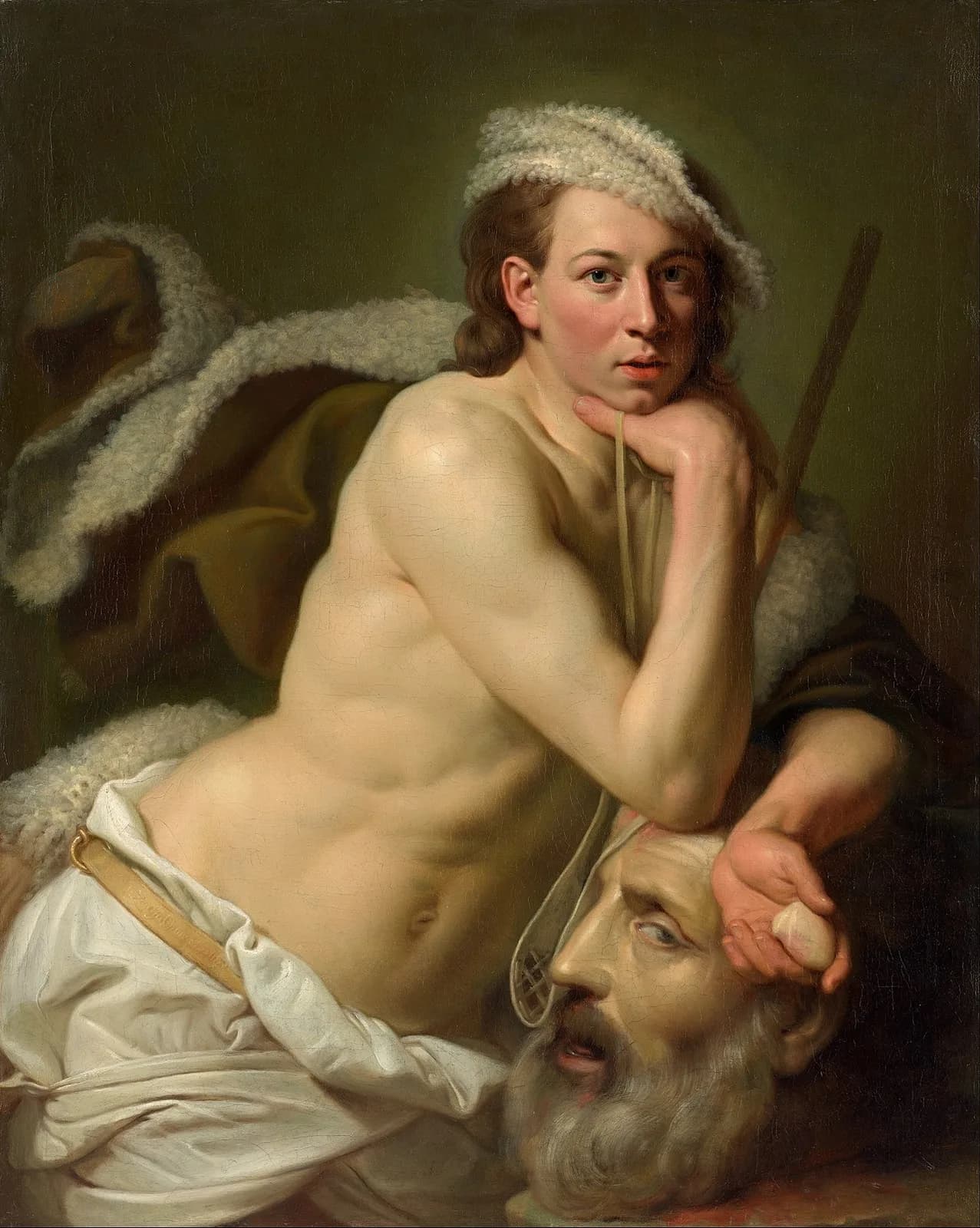
Goliath's decisions reveal much about his character. His acceptance of the role of champion, stepping forward to propose single combat (1 Samuel 17:8), displays his embodiment of Philistine pride and reliance on brute force. This choice positions him as the physical embodiment of his people’s military might. Goliath's mocking dismissal of David, whom he views as a mere boy unworthy of serious combat (1 Samuel 17:42-44), underscores his overconfidence and reliance on traditional warfare. In stark contrast, David, his foil, approaches the battle with faith in divine power rather than physical strength, declaring, "I come to you in the name of the LORD of hosts" (1 Samuel 17:45). This highlights the narrative’s central theme: divine power triumphs over human might.

Popular depictions often reduce Goliath to a mere brutish giant, overshadowing the subtle complexities of his portrayal in the biblical text. This simplification overlooks the tragic dimension of Goliath as a figure whose dependence on physical prowess and conventional warfare leads to his demise. The text subtly portrays him not only as a formidable adversary but also as a pawn in the Philistine challenge to Israel, lacking true autonomy in his actions. Goliath's story, far from being merely a cautionary tale of hubris, also reflects the limitations of relying solely on human strength in the face of divine will. Instead of a one-dimensional antagonist, Goliath emerges from the pages of scripture as a nuanced character, a mighty warrior undone by his own overconfidence and the unexpected faith of a young shepherd.

The Significance of Goliath

Goliath's defeat in 1 Samuel 17 demonstrates that divine power can overturn human expectations of strength and victory. The narrative unfolds during the era of the United Monarchy, around 1010 BC, when Israel faced the Philistines. Goliath, a giant from Gath, stands as the formidable enemy of Israel, described as "six cubits and a span" tall (1 Samuel 17:4). His presence symbolizes the might of human strength, but the story pivots on the theological theme of Divine Sovereignty, or מַלְכוּת אֱלֹהִים (Malkhut Elohim). Despite Goliath's intimidating stature and weaponry, it is David's reliance on God that tips the scales. David confronts Goliath not with sword or spear but with the declaration, "I come to you in the name of the LORD of hosts" (1 Samuel 17:45). This pivotal moment underscores that it is God's will, not human might, that determines the outcome.

The story also explores themes of pride, humility, and faith. Goliath's arrogance and dependence on physical might starkly contrast with David's humble faith, highlighting the biblical principle that God opposes the proud but gives grace to the humble. The text vividly portrays the Israelites' fear as they shrink from Goliath, while David's courage, rooted in his faith, reveals the transformative power of trust in God. "You come to me with a sword and with a spear and with a javelin," David tells Goliath, "but I come to you in the name of the LORD" (1 Samuel 17:45). This confrontation becomes a typological foreshadowing of Christ's victory over sin and death, where an unlikely savior triumphs over a seemingly invincible foe, drawing a line to 1 Corinthians 15:57, which celebrates victory through God.

In a broader context, Goliath represents the Gentile nations opposing Israel, and his defeat signifies God's supremacy over all nations. This dimension foreshadows the inclusion of Gentiles in God's redemptive plan, a theme that will unfold more fully in the New Testament. Goliath, as a Philistine, stands as a tangible reminder of the external threats facing Israel, yet his downfall through David, an unexpected hero, illustrates the unexpected ways in which God chooses to work. As the dust settles on the battlefield, the concrete image of a young shepherd holding the giant's severed head serves as a stark testament to the narrative's central claim: divine power defies human expectations.

The Legacy of Goliath

In Jewish tradition, Goliath of Gath is often portrayed as the embodiment of brute force and arrogance. The Talmud, specifically Sotah 42b, discusses his downfall as a cautionary tale about the perils of pride. Goliath's towering presence, described in 1 Samuel 17:4 as "six cubits and a span," becomes a symbol of overwhelming human strength that ultimately crumbles before divine intervention. Midrashic texts, such as Midrash Tanchuma, amplify this interpretation by focusing on David's faith and divine support as the true sources of his victory. Although Goliath himself does not feature prominently in Jewish liturgical readings, the narrative of David and Goliath often finds its way into educational and cultural settings like Purim, where it serves to highlight themes of triumph over adversity through faith and divine assistance.

Christian interpretations of Goliath have similarly cast him as a symbol of worldly might and opposition to God's will. Early Church Fathers, such as Augustine, saw in Goliath a representation of sin and evil, with David prefiguring Christ's victory over these forces. Augustine argued that just as David conquered Goliath with faith, so too does Christ conquer sin. During the Reformation, theologians like Martin Luther used the story to emphasize the power of faith over earthly power, viewing Goliath as the embodiment of challenges believers face, which can be overcome through divine grace. Typologically, Goliath is seen as a metaphor for the trials that test faith, underscoring the Christian belief in the ultimate triumph of good over evil through God's intervention.

Beyond religious texts, Goliath has left an indelible mark on culture, particularly as a metaphor for seemingly insurmountable challenges. This is evident in artwork such as Caravaggio's "David with the Head of Goliath," which captures the dramatic moment of victory. In literature, the story has been adapted in various contexts, with Malcolm Gladwell's "David and Goliath" using the narrative to explore how underdogs can prevail against formidable odds. The phrase "David vs. Goliath" has become a ubiquitous expression in sports and business, describing scenarios where a smaller, weaker opponent triumphs over a giant, more powerful adversary. In modern secular culture, Goliath resonates as a symbol of the formidable challenges that can be overcome with courage and resolve, tapping into the universal appeal of the underdog story. This narrative continues to inspire, highlighting the enduring human fascination with the idea that faith and determination can topple even the mightiest of foes.