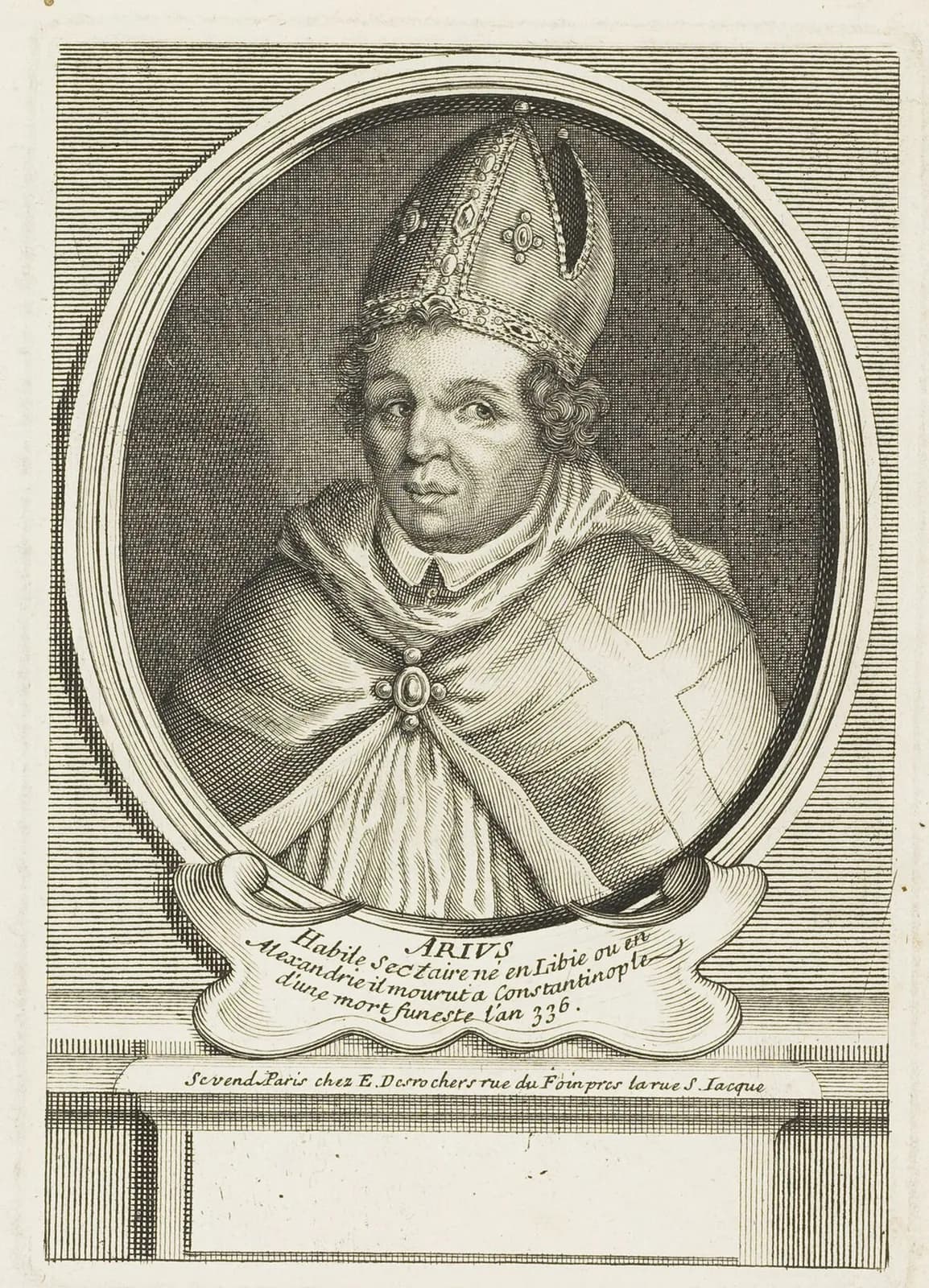
Arius
hereticNicene Era (4th C) · c. 256-336 CE · Updated April 9, 2026
Biography
Arius was a presbyter in Alexandria during the Nicene Era of the 4th century, known for his role in the Arian controversy regarding the nature of Christ. Serving in a city that was a major hub of early Christian thought, Arius became a central figure in a theological debate that would shape the future of Christianity. His teachings challenged prevailing views about the relationship between God the Father and Jesus Christ, sparking intense debate and conflict.
Born around 256 CE, likely in Libya, Arius rose to prominence in Alexandria, where he served as a presbyter. In 321 CE, a synod of bishops excommunicated him due to his controversial teachings, which argued that the Son of God was a created being and not co-eternal with the Father. His ideas, known as Arianism, gained both followers and fierce opponents, leading to significant tension within the church. This controversy culminated in his teachings becoming a central issue at the First Council of Nicaea in 325 CE. Despite his excommunication, Emperor Constantine later readmitted Arius to communion, but Arius died in 336 CE, shortly thereafter.
The early 4th century was a period of intense theological debate as the Christian church sought to define its core beliefs. The Arian controversy emerged in a context of differing interpretations of scripture and the influence of Greek philosophy, which questioned the divine nature of Christ. The First Council of Nicaea was convened to resolve these disputes, ultimately condemning Arianism and affirming the belief in the consubstantiality of the Son with the Father. This decision marked a pivotal moment in establishing orthodox Christian doctrine.
What is the nature of Christ? Is the Son co-eternal with the Father, or a created being?
The question
Arius, a priest from Alexandria, found himself wrestling with the complex nature of Christ within the framework of monotheism. Trained under Lucian of Antioch, Arius embraced the idea that the Son was distinct from the Father, emphasizing the Son's subordination. He read Scripture and saw a clear hierarchy. Passages suggested a Father who commands and a Son who obeys. The idea that there was a time when the Son did not exist seemed to Arius to protect God's oneness. Here was a sincere man, striving to preserve a coherent understanding of God as singular and supreme. For Arius, the notion that the Son was a created being resonated with both his theological education and his dedication to a strict monotheism.
Arguing for the Son's co-eternity with the Father meant accepting a mystery that defied simple logic. It required believers to embrace the idea that God could exist as three distinct persons sharing one divine essence. This belief defied common sense and muddied the waters of monotheism. The cost was significant: it asked believers to accept a God who was both one and three, a paradox that stretched the limits of human understanding. Yet, this position had its allure. It affirmed the full divinity of Christ, placing Him on equal footing with the Father and reinforcing the unity of the Godhead. For those who embraced this stance, Christ's eternal nature was essential for the completeness of salvation.
On the other side, Arius's view held that the Son was a created being, distinct and subordinate to the Father. This position offered clarity and preserved the singularity of God. It portrayed the Father as the sole uncreated being, emphasizing His supremacy. However, this view came with a cost as well — it risked diminishing the Son's divinity. A created Christ might seem less capable of bridging the gap between God and humanity. This perspective suggested a demoted Christ, one who, while important, was not the equal of the Father. Such a view altered the traditional understanding of Christ's role in salvation and reshaped His relationship with believers.
The debate boiled down to a central trap: the commitment to monotheism while acknowledging Christ's divinity. Believers struggled to reconcile God's oneness with the notion of a co-eternal Son. Rejecting the Son's eternal nature threatened the foundation of Salvation and worship, yet accepting it challenged the simplicity of monotheism. For the average Christian, this was more than an abstract theological dispute. It shaped how they prayed, how they understood Salvation, and how they related to God. The nature of Christ influenced liturgy and worship, as believers sought to understand their place in a divine plan that hinged on who Christ was.
The teaching
Arius, a Christian presbyter from Alexandria, taught that Jesus Christ, the Son, was not co-eternal with God the Father. He believed that the Son was a created being, brought into existence by the Father. For Arius, this meant there was a time when the Son did not exist, highlighting the Father's unique and unshared divinity. This teaching directly challenged the idea that the Father and the Son were of the same eternal substance, a concept that was gaining traction in early Christianity.
Arius's reasoning stemmed from his interpretation of scripture and his desire to maintain God's singular supremacy. He argued that if the Son was begotten by the Father, then the Son must have had a beginning. This logic aimed to preserve Christianity's monotheistic principle. Arius found support for his views in passages like John 14:28, which states, "the Father is greater than I," suggesting a hierarchy between Father and Son. Proverbs 8:22 and Colossians 1:15 further reinforced his belief in the Son's created nature. Arius articulated these ideas in his poetic treatise, "Thalia," and defended them in his "Letter to Eusebius of Nicomedia," seeking support from influential bishops.
Many early Christians found Arius's teachings convincing because they aligned with a strict monotheistic view and respected the transcendence of God the Father. This appeal resonated with those who preferred a clear hierarchy within the divine, seeing it as a simpler and more logical framework. Arius's ideas spread widely, particularly in the eastern regions of the Roman Empire. His beliefs triggered significant theological debates, leading to the First Council of Nicaea in 325 CE, which sought to address the controversy and define orthodox Christian doctrine.
The counterargument
The decisive argument against Arius centered on the doctrine that the Son shares the same substance as the Father. This idea, known as homoousios, was critical because it affirmed that the Son is truly divine and co-eternal with the Father. Without this divine nature, the Son could not achieve salvation for humanity. A created being would lack the capacity to bridge the infinite gap between God and man. Athanasius of Alexandria, a key figure in this theological battle, articulated this argument in his work "Orations Against the Arians." He contended that if the Son were anything less than fully God, He could neither reveal the Father completely nor offer genuine salvation. Only God can save, Athanasius insisted, and thus the Son must be God.
Arius supported his position with specific biblical texts, but orthodox theologians countered them effectively. He pointed to Proverbs 8:22, interpreting it as evidence that God created the Son. The orthodox response, however, argued that this passage personifies Wisdom and does not literally describe the creation of the Son, emphasizing instead the eternal nature of the Son's existence. Arius also cited John 14:28 to claim the Son's inferiority to the Father. The orthodox interpretation clarified that this referred to the Son's incarnate state of voluntary submission, not His divine essence. Finally, Arius used Colossians 1:15 to argue that the Son was the first creation. The orthodox answer was that "firstborn" indicates preeminence and authority, not temporal origin. Furthermore, Arius's argument contained a trap: if the Son was a created being, He could not fully know the Father. This contradicted the Christian belief that the Son is the perfect revelation of God, undermining Arius's claim that his Christ could mediate between God and humanity.
The counter-argument against Arius introduced its own complexities. Affirming that the Son is of the same substance as the Father required Christians to develop a more nuanced understanding of the Trinity. This led to intricate theological debates about how the Father, Son, and Holy Spirit relate to one another. While orthodox Christians maintained the Son's full divinity, they also faced the challenge of explaining His full humanity. This dual nature of the Son, both divine and human, became a theological puzzle that demanded careful articulation. The Council of Nicaea in 325 CE, where the doctrine of homoousios was affirmed, marked a turning point in these debates, but it also left open questions that theologians would wrestle with for centuries.
The resolution
In 325 CE, the First Council of Nicaea convened in Nicaea, Bithynia, under the watchful eye of Emperor Constantine I. About 300 bishops from across the Christian world gathered to tackle a theological dispute threatening the unity of Constantine's empire. Constantine, aiming for religious and political stability, sought to end the discord that the Arian controversy had sparked. At stake was not just doctrinal clarity but the cohesion of an empire that required peace among its diverse religious communities.
The heart of the debate centered on the nature of the relationship between the Son and the Father. Arius, a priest from Alexandria, contended that the Son was not co-eternal with the Father, implying he was a created being. His use of the term 'heteroousios' underscored this belief. Opposing him, Athanasius and his supporters argued the Son was 'homoousios' with the Father, meaning of the same substance, thus co-eternal and fully divine. The council ultimately adopted the Nicene Creed, affirming the 'homoousios' position, and declared Arius's teachings heretical, leading to his exile.
Despite the council's decisive ruling, the controversy did not end. Arianism continued its spread, particularly in the eastern regions of the Roman Empire and among several Germanic tribes. Figures like Eusebius of Nicomedia kept the Arian flame alive, leading to further theological battles. The struggle persisted for decades, necessitating additional councils, including the Council of Constantinople in 381 CE, which sought to reaffirm the Nicene stance. Only after years of conflict did the Nicene Creed's interpretation gain widespread acceptance, though Arian ideas lingered in various pockets of the Christian world for centuries.
Legacy
After the First Council of Nicaea in 325 CE condemned Arius, Emperor Constantine exiled him. Yet, despite this official rejection, Arius's influence lingered. Constantine later softened his stance, allowing Arius to return to Alexandria. But before Arius could fully reintegrate into the Christian community, he died under suspicious circumstances in 336 CE. His death left questions unanswered and did little to quell the theological storm he had unleashed.
Arianism, the belief that Christ was a created being and not co-eternal with God, persisted long after Arius's death. It found fertile ground among the Germanic tribes, including the Visigoths and Ostrogoths, who converted to this version of Christianity. In the Eastern Roman Empire, debates over the nature of Christ continued, with Arian beliefs influencing various factions and councils for centuries. This persistence highlighted the resonance of Arius's ideas and the complexities within early Christian theology.
Today, echoes of Arianism appear in some non-Trinitarian Christian groups, such as Jehovah's Witnesses, who maintain a similar view of Christ as distinct from God the Father. This belief continues to shape discussions about the historical evolution of Christian doctrine. The debate over Christ’s nature remains a vibrant part of both religious and secular discourse, illustrating the enduring legacy of Arius's challenge to early Christianity.
Continue reading with a Scholar plan
Upgrade to ScholarCommon questions
- Why was Arianism considered dangerous?
- Arianism was considered dangerous because it challenged the core Christian doctrine of the Trinity, suggesting that Jesus Christ was not divine in the same way as God the Father. This threatened the unity of the Church by creating theological divisions and undermining the belief in the full divinity of Christ, which was central to salvation and worship practices.
- What exactly did Arius teach?
- Arius taught that the Son of God, Jesus Christ, was not co-eternal with God the Father and was instead a created being. He argued that there was a time when the Son did not exist, emphasizing the Father's supremacy and the Son's subordinate status.
- Why did Arianism spread so widely?
- Arianism spread widely due to its appeal to those who found the concept of the Trinity difficult to understand, as well as its support from influential bishops and political leaders. Additionally, its emphasis on the Father's supremacy resonated with certain theological and philosophical traditions of the time.
- Who opposed Arius, and what was their argument?
- Arius was opposed by figures such as Athanasius of Alexandria, who argued that if Christ were not fully divine, He could not offer salvation to humanity. They maintained that the Son was of the same substance as the Father, co-eternal and co-equal, which was essential for the doctrine of the Trinity.
- Was Arius excommunicated, exiled, or executed?
- Arius was excommunicated by a synod in Alexandria around 318 CE and later exiled after the First Council of Nicaea in 325 CE. He was not executed but faced significant opposition and was eventually reinstated before his death.
- Which council condemned Arianism, and what did it decide?
- The First Council of Nicaea in 325 CE condemned Arianism. It decided that the Son was 'of the same substance' (homoousios) as the Father, affirming the full divinity of Christ and establishing the Nicene Creed as a statement of orthodox Christian belief.
- Did Arius ever recant?
- Arius did not formally recant his views, but he did sign a statement of faith that was ambiguous enough to allow for his reinstatement into the Church. This was seen as a political move rather than a genuine change in belief.
- What is the difference between Arianism and orthodox Christianity?
- The primary difference is that Arianism denies the co-eternity and co-equality of the Son with the Father, viewing the Son as a created being. Orthodox Christianity, as defined by the Nicene Creed, holds that the Father, Son, and Holy Spirit are of the same substance and equally divine.
- Are there modern versions of Arianism?
- Yes, modern versions of Arianism exist, most notably among some Unitarian and Jehovah's Witnesses groups. These groups similarly emphasize the distinct and subordinate nature of Christ compared to God the Father.
- Is there anything Arius got right?
- Arius correctly emphasized the distinctiveness of the Father and the Son, which is a valid concern in maintaining the personal distinctions within the Trinity. However, his conclusions about the nature of the Son's divinity were rejected by orthodox Christianity.
- Why does Arianism still matter today?
- Arianism matters today because it highlights ongoing debates about the nature of Christ and the Trinity, which continue to influence theological discussions and denominational differences. It also serves as a historical example of how theological disputes can shape the development of Christian doctrine.
- Why did Arius sincerely believe his position was correct? What was he actually defending — and why did he see the alternatives as worse?
- Arius believed his position was correct because he wanted to preserve the uniqueness and transcendence of God the Father. He was defending the idea that God is one and uncreated, fearing that equating the Son with the Father would compromise monotheism and lead to polytheism.