Library
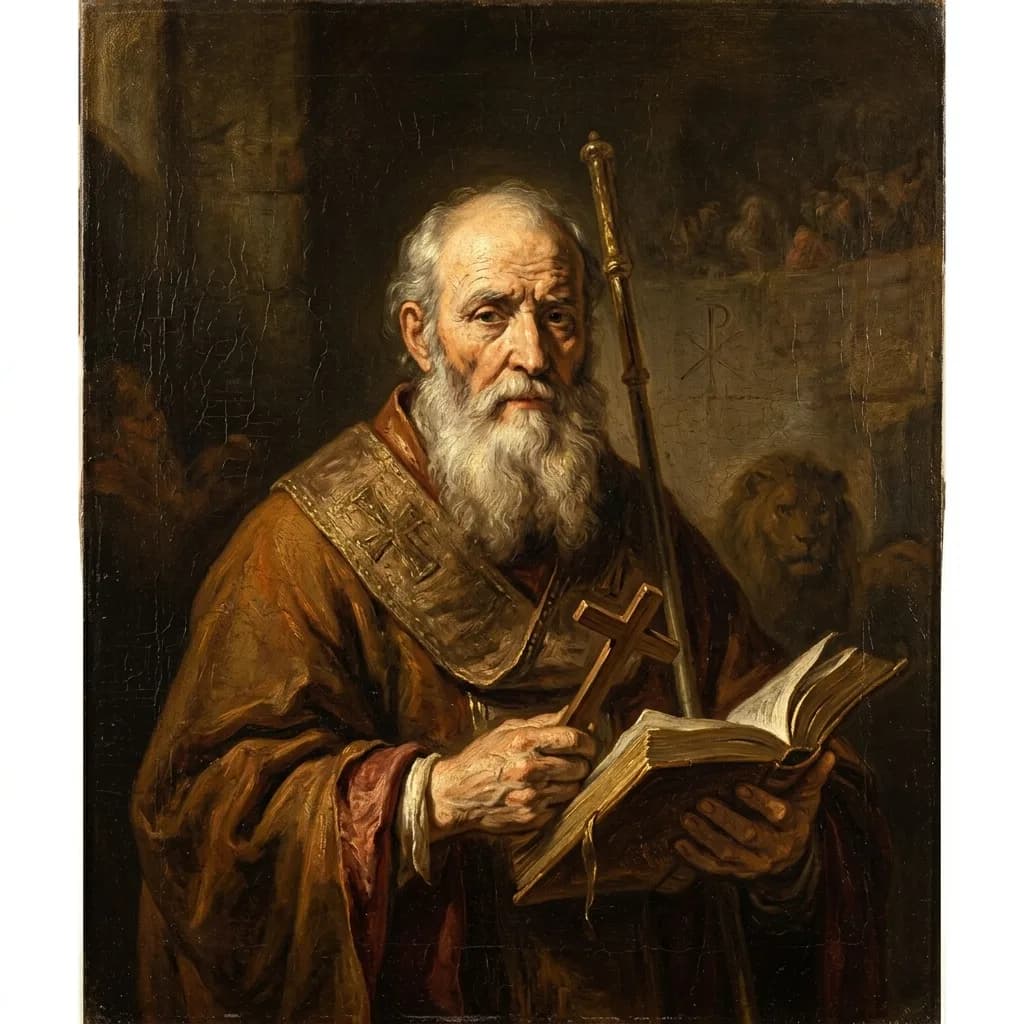
AI-generated illustration
Library
Apostolic Fathers (1st-2nd C) · c. 35-108 CE · Updated April 9, 2026
Ignatius of Antioch was a prominent early Christian bishop and martyr, serving as the bishop of Antioch in the late 1st and early 2nd centuries CE. He played a crucial role in shaping the early Christian church's identity and structure. Antioch was a major center for early Christianity, and Ignatius's leadership there placed him at the heart of theological and ecclesiastical development. He is best known for his letters written to various Christian communities while he was en route to his execution in Rome.
Ignatius's journey to martyrdom began when he was arrested during the reign of Emperor Trajan around 108 CE. As the second or third bishop of Antioch, following in the footsteps of the apostle Peter, Ignatius held a position of considerable influence. He penned seven letters while traveling to Rome, addressing churches in Ephesus, Magnesia, Tralles, Rome, Philadelphia, Smyrna, and to Polycarp, the bishop of Smyrna. These letters emphasized the importance of church unity and the authoritative role of the bishop. He insisted on a structured three-fold ministry of bishop, priest, and deacon, which became foundational for church governance. Ignatius also offered a profound insight into the Eucharist, describing it as the "medicine of immortality."
Ignatius lived during a tumultuous time for Christians, as they faced both external persecution and internal theological disputes. The early church grappled with challenges such as Docetism, which denied the true humanity of Christ. Ignatius's emphasis on the authority of the bishop and the unity of the church aimed to combat such divisive teachings. His writings reflect the early Christian valorization of martyrdom as a powerful testament to faith. Despite historical debates over the authenticity of his letters, scholars now largely agree they are genuine, preserving his legacy as a pivotal figure in early Christianity.
What is the relationship between the bishop, the Eucharist, and the unity of the church — and is martyrdom a completion of baptism or a form of spiritual pride?
Ignatius of Antioch faced a fractured early Christian community. Heresies threatened its unity, and divergent beliefs jeopardized its cohesion. Amid this turmoil, Ignatius sought to establish a unified, orthodox church structure. His life's work aimed to solidify the church's foundation against the chaos of differing doctrines and interpretations. He saw the church's unity as vital for preserving the true faith, emphasizing that a solid structure was necessary to withstand internal and external threats.
Ignatius proposed a clear hierarchical structure with the bishop at the helm, supported by priests and deacons. This three-fold ministry aimed to ensure doctrinal purity and organizational coherence. He addressed the challenge of Docetism, which denied Christ's physical incarnation, by affirming Christ's real flesh and suffering. This was crucial for maintaining orthodox beliefs about Jesus' divine and human natures. Ignatius also emphasized the Eucharist as the "medicine of immortality," arguing that it was essential for spiritual life and salvation. This stressed the importance of the Eucharist in worship and its role in connecting believers to Christ's real presence.
Beyond these ideas, Ignatius passionately wrote about martyrdom as the completion of discipleship. Facing his own execution, he viewed martyrdom as the ultimate expression of faith, a fulfillment of baptismal vows, and a path to union with Christ. His writings during Roman persecutions inspired countless Christians to endure suffering for their faith. Through letters like those to the Ephesians and Romans, Ignatius articulated these beliefs, leaving a lasting impact on the church's understanding of suffering and sacrifice.
Ignatius's signature argument declared that the bishop embodied the church's unity. He famously stated that where the bishop is, there the church is also. This argument positioned the bishop as the core of ecclesiastical cohesion, countering the fragmentation that threatened early Christian communities. By emphasizing the bishop's role as a visible symbol of unity and orthodoxy, Ignatius laid the groundwork for the church's hierarchical structure. His reasoning helped shape the future of church governance and safeguarded the Christian faith from fragmentation and heretical influences.
Before Ignatius of Antioch stepped onto the stage, early Christian communities were like a patchwork quilt of beliefs and practices. Each community had its own way of organizing, often with leaders who emerged naturally rather than through a structured process. Theological ideas about Christ's nature and the meaning of the Eucharist varied widely. Some groups questioned whether Christ truly took on human flesh or merely appeared to do so, a belief known as Docetism. The Eucharist was celebrated, but its deepest meanings and implications were still up for debate. Martyrdom was seen as noble, but no unified theology explained why it mattered beyond personal sacrifice.
Ignatius of Antioch changed all this. He championed a clear, hierarchical structure for church leadership with a single bishop at the top, supported by priests and deacons. This model provided a blueprint that spread throughout early Christianity. He articulated a powerful vision of the Eucharist as the "medicine of immortality," elevating it to a central role in the spiritual life of believers. Ignatius also redefined martyrdom, presenting it as the ultimate completion of a Christian's journey, a final act that fulfilled one's baptismal promises. He forcefully countered Docetism by insisting on Christ's real, physical incarnation, laying the groundwork for later orthodox beliefs.
The ripples of Ignatius's influence extended far beyond his lifetime. His hierarchical church structure became a lasting model in both Eastern and Western Christianity. Theologians later delved into the Eucharist's mysteries, leading to doctrines like transubstantiation. His vision of martyrdom inspired early Christian hagiographies and the cult of saints. Ignatius's fierce defense of Christ's true humanity set the stage for the Christological debates that culminated in the Councils of Nicaea and Chalcedon. Without Ignatius, the church's path to these foundational developments would have looked very different. His legacy lives on in every church that follows the structure he so ardently advocated.
Ignatius of Antioch, an influential early Christian bishop, left a legacy marred by contentious ideas. His zealous support for martyrdom has drawn criticism for glorifying death and fostering a reckless disregard for life. This troubling stance potentially promoted a dangerous martyr complex among early Christians. Ignatius also championed a rigid hierarchical structure in the church, emphasizing the authority of the bishop. This model, while providing stability, has faced backlash for encouraging authoritarianism within the church. Furthermore, his opposition to Docetism, which denied the physical reality of Christ, inadvertently fueled later theological disputes about Christ's nature. Finally, the authenticity of Ignatius's letters was questioned, casting doubt on his theological contributions and highlighting the challenges of verifying historical documents.
The most difficult aspect of Ignatius's legacy is his fervent desire for martyrdom. In his letters, he expressed a longing for martyrdom that borders on spiritual pride, suggesting a preference for death over life in faith. This attitude could have encouraged others to seek martyrdom, valuing death as the ultimate witness to faith. Such a perspective diminishes the intrinsic value of life and risks promoting a distorted view of Christian sacrifice. Ignatius's writings may have inadvertently inspired a generation of believers to pursue death rather than live their faith, a troubling consequence that remains hard to defend.
Some scholars defend Ignatius's views on martyrdom by pointing to the context of persecution in which he lived. They argue that his emphasis on martyrdom was a necessary witness to faith, shaping a resilient Christian identity under Roman oppression. While this perspective adds context, it does not erase the potential harm his ideas caused. The criticisms of his approach to martyrdom, church hierarchy, and Christological emphasis largely stand. Today, Ignatius's letters are considered authentic, a fact that underscores the enduring impact of his influence on early Christianity.
Ignatius of Antioch faced a grim fate after his condemnation. Roman authorities transported him from Antioch to Rome, where he was sentenced to die in the Colosseum. Along this journey, he penned seven letters to Christian communities in places like Ephesus, Magnesia, and Rome itself. These letters, written with urgency and fervor, addressed issues of unity, church authority, and the nature of Jesus Christ. Ignatius's final act of faith culminated when he was thrown to wild beasts, a spectacle meant to serve as a public warning against defying Roman rule. Instead, his martyrdom inspired generations of Christians.
Ignatius's writings laid the groundwork for key aspects of Christian belief and practice. His insistence on the authority of bishops became a cornerstone for church structure, influencing both the Orthodox and Roman Catholic traditions. Early church fathers like Polycarp and Irenaeus championed his ideas, advocating for a unified church under a single bishop in each city. This hierarchical model extended across the Mediterranean and helped solidify the organizational framework of early Christianity. Ignatius also emphasized the Eucharist as a central element of worship, a belief that underscored the importance of communal participation in the faith.
Today, the impact of Ignatius's teachings is evident in the hierarchical structures of major Christian denominations. The Roman Catholic, Eastern Orthodox, and Anglican Churches all maintain a three-tiered ministry of bishops, priests, and deacons, a concept rooted in Ignatius's vision. His thoughts on the Eucharist continue to shape liturgical practices, focusing on the sacrament as a vital expression of faith. Moreover, his views on martyrdom resonate in the ongoing veneration of saints and martyrs, with churches commemorating them in annual liturgical calendars. In Rome, the Colosseum stands as a silent witness to Ignatius's sacrifice, a concrete reminder of his enduring legacy in the Christian faith.
Continue reading with a Scholar plan
Upgrade to ScholarAI-generated illustration