Library
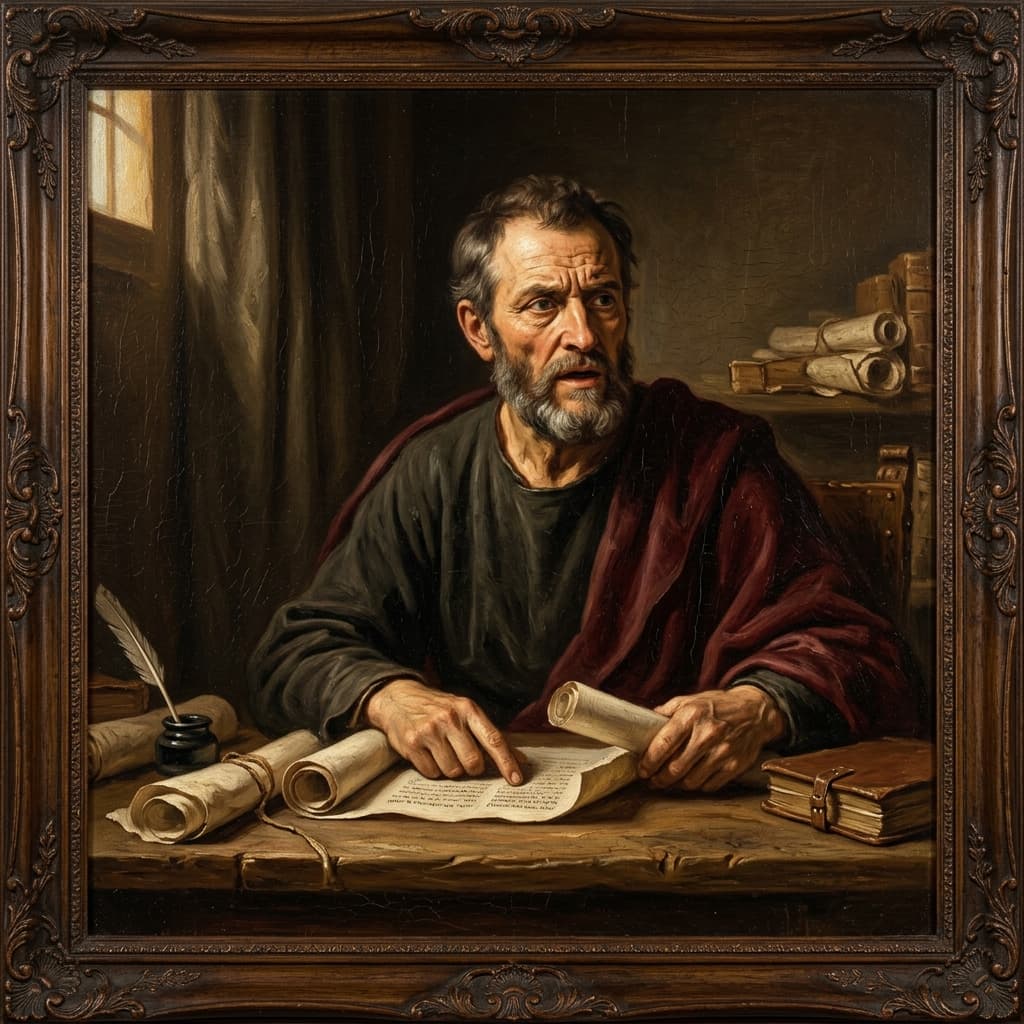
AI-generated illustration
Library
Early Church (2nd-3rd C) · c. 85-160 CE · Updated April 9, 2026
Marcion of Sinope was a ship-owner and theologian from Sinope in Pontus, active during the Early Church era in the 2nd century CE. He became known for founding the first large-scale alternative Christian church that had its own set of scriptures. His teachings challenged the early Christians by rejecting the Old Testament and proposing a distinct separation between the God of Israel and the God revealed by Jesus.
Born around 85 CE, Marcion grew up in a world where Christianity was still forming its identity. He moved to Rome, where his radical ideas took shape. By around 144 CE, he had developed a theology that centered on the belief that the Apostle Paul was the only true apostle who understood Jesus's message. Marcion's rejection of the Old Testament and his creation of a new canon led to his excommunication by the Roman church. Church fathers like Justin Martyr, Irenaeus, and Tertullian condemned his teachings, which they saw as heretical.
Marcion lived in a time of intense theological debate as early Christians tried to reconcile Jesus's teachings with Jewish scriptures. His ideas forced the early church to clarify its doctrines and solidify its canon. The controversy surrounding Marcionism underscored the struggle to define Christianity's identity. The opposition he faced highlighted the early church's commitment to maintaining a connection with Jewish roots. Despite his excommunication, Marcion's influence pushed the church to consider what texts and teachings would form the core of Christian belief.
Is the God who gave the Law to Israel the same God revealed in Jesus — and if the Old Testament God commanded violence and demanded justice, how can he also be the God of love?
Marcion delved into the letters of Paul and saw a radical message of grace that seemed to clash with the harsh legalism of the Old Testament. He could not reconcile the God of justice and vengeance who demanded sacrifices with the God of love and forgiveness revealed through Jesus. For Marcion, Paul's writings illuminated a gospel that stood apart from Jewish tradition. This conviction drove him to strip away what he perceived as incompatible with the teachings of Jesus. He acted in good faith, believing he was preserving the true message of Christianity.
Accepting that the God who gave the Law to Israel is the same God revealed in Jesus requires reconciling contradictory depictions. This means holding together stories of divine wrath and punishment with messages of compassion and redemption. It demands a view of God whose nature encompasses both justice and mercy. This position costs believers a straightforward understanding of a singular divine narrative. They must navigate a complex tapestry of divine action and intention, which often seems contradictory. The result is a multifaceted vision of God that can be hard to grasp and unsettling for those seeking clarity.
Alternatively, Marcion's view posited that the God of the Old Testament and the God revealed in Jesus were distinct, leading him to reject the former entirely. This position demanded a new canon, purged of any elements that did not align with the loving and forgiving God of the New Testament. The cost was the loss of the Jewish scriptures and severing Christianity from its historical roots. Believers adopting this view faced a fragmented faith, disconnected from the rich heritage and continuity that the Old Testament provides. It created a version of Christianity that stood alone, lacking the depth and history that had shaped its early followers.
The unyielding belief in one God trapped both sides. Neither could accept the idea of two separate deities without abandoning monotheism, a cornerstone of their faith. For the ordinary believer, this debate was not just theological nitpicking. It had real implications for their faith and practice. It determined the scriptures they read, the nature of the God they prayed to, and their understanding of salvation. They had to wrestle with these profound questions, seeking a cohesive faith that honored both the justice and love of God without tearing apart the very fabric of their belief system.
Marcion of Sinope taught that the God of the Old Testament, who gave the law to Israel, was not the same as the God revealed in Jesus. He described the Old Testament deity as a lesser, flawed being focused on justice and cruelty. Marcion believed that Jesus came from a higher, supreme God of love, sent to rescue humanity from this inferior creator. Because of this, Marcion argued for the complete rejection of the Old Testament, seeing it as irrelevant to the teachings of Jesus.
Marcion’s logic hinged on the stark differences between the Old Testament and the teachings of Jesus. He saw the Old Testament God as violent and legalistic, while Jesus preached love and forgiveness. This contrast led Marcion to conclude that they could not be the same entity. He found support for his views in the writings of Paul, particularly Galatians, where Paul warns against turning to a “different gospel.” Marcion believed Paul alone captured the true message of the supreme God, emphasizing grace over law. In his treatise "Antitheses," Marcion systematically contrasted the Old Testament God with Jesus' teachings, using passages like Luke's parable of the new garment to illustrate the incompatibility of the old laws with Jesus’ new message.
Marcion’s teachings attracted those disturbed by the contradictions between the Old Testament and Jesus' message. His emphasis on a God of love appealed to converts looking for a more compassionate faith. His ideas gained significant traction, sparking the formation of Marcionite communities across the Roman Empire. At its peak, Marcion's movement rivaled the early Christian church, forcing church leaders to address his claims and define orthodox beliefs more clearly.
The decisive argument against Marcion of Sinope centered on the continuity of God's revelation from the Old Testament to the New Testament. Marcion proposed that the God who delivered the Law to Israel was inferior and separate from the God revealed in Jesus. The early church fathers, led by Tertullian, dismantled this view. In his work "Adversus Marcionem," Tertullian argued that the God of both Testaments is the same. He explained that the seeming differences in God's actions are due to a progressive revelation, where God's nature and purposes unfold gradually, culminating in Jesus Christ. This continuity is crucial because it provides a complete picture of God's character, combining justice with mercy, and law with grace.
Marcion's interpretation of specific biblical texts aimed to showcase a divide between the Old and New Testament depictions of God. For Genesis 6:6, where God appears to regret creating humanity, Marcion saw imperfection. The orthodox response was that this regret is an expression of God's sorrow over human sin, not a literal change of mind, thus highlighting God's relational nature. Marcion viewed Exodus 21:24's "eye for an eye" as proof of a vengeful deity, but church fathers contended this was a means to limit retribution, with Jesus' teachings on forgiveness fulfilling its intent. Marcion misunderstood Isaiah 45:7 as depicting a God who creates moral evil. The orthodox interpretation clarified that it refers to calamity as divine judgment, not moral evil. Marcion's position trapped him into rejecting large portions of scripture, resulting in a fragmented canon without a consistent interpretive method. This inconsistency was a critical flaw that undermined his theological claims.
In countering Marcion, the church faced the challenge of articulating a nuanced understanding of the continuity between the Testaments. This required ongoing reflection on how to reconcile difficult Old Testament passages with the revelation of God’s love in Christ. Some questions about divine justice and mercy remained open. Yet, this approach preserved the integrity and coherence of scripture as a whole. Despite these complexities, the orthodox position maintained a unified canon, with the Old Testament providing essential context for the New. This defense against Marcion solidified the early church’s commitment to a comprehensive understanding of scripture, a commitment that continues to influence Christian theology today.
In 144 CE, the Roman Church convened a pivotal meeting to address the teachings of Marcion, a prominent Christian thinker. This gathering in Rome brought together church leaders to tackle Marcion's controversial views, primarily his claim that the God of the Old Testament differed fundamentally from the God revealed in Jesus Christ. The stakes were high, as the church sought to preserve its doctrinal unity and authority. While the Roman Empire refrained from direct involvement, the church's decision to excommunicate Marcion aligned with the broader Roman interest in maintaining social stability and cohesion.
Marcion's argument centered on the belief that the God of the Old Testament was a Demiurge, a lesser deity obsessed with justice and law. In contrast, he saw Jesus as revealing a Supreme God of love and grace. This distinction threatened the continuity of Christian scripture and tradition. The Roman Church leaders, committed to maintaining the integrity of both the Old and New Testaments, condemned Marcionism as heretical. By excommunicating Marcion, they affirmed the unity of scripture under a single, consistent God, rejecting any division between the Old Testament's God and the God of Jesus.
Despite the formal condemnation, Marcionism did not vanish. Its followers persisted, particularly in the Eastern Roman Empire, for several centuries. Prominent figures like Tertullian and Irenaeus continued to combat Marcion's influence through their writings, highlighting the ongoing struggle to interpret the Old Testament in light of the New. The controversy lingered, and Marcion's ideas found pockets of support long after his excommunication. It wasn't until the eventual decline of Marcionite communities in the fifth century that the church could claim a more definitive resolution to this theological dispute.
After his excommunication by the Roman church around 144 CE, Marcion of Sinope did not retreat quietly into obscurity. Instead, he actively led his followers and spread his teachings throughout the Roman Empire. Marcion established a network of communities that adhered to his belief in a stark division between the God of the Old Testament and the God revealed in Jesus Christ. This movement, known as Marcionism, thrived despite fierce opposition from orthodox Christian leaders. Marcion died around 160 CE, but his followers continued to promote his ideas, which challenged the early church's developing orthodoxy.
Marcionism's influence spread particularly through the Eastern Roman Empire, with strongholds in regions like Syria and Asia Minor. These areas became fertile ground for various Christian sects that embraced elements of Marcion's teachings. Although the mainstream church worked tirelessly to suppress Marcionism, its echoes persisted in later religious movements. Manichaeism, for instance, adopted a dualistic worldview that resonated with Marcion's rejection of the Old Testament deity. While Marcionism eventually faded, its impact lingered, shaping the theological debates of its time.
Today, Marcion's legacy surfaces in some unexpected places. Certain branches of Unitarianism, for example, emphasize the New Testament's teachings over those of the Old Testament, a stance reminiscent of Marcion's focus. In broader cultural contexts, secular critiques of the Old Testament often mirror Marcionite themes, questioning how a just and loving God aligns with the harsh depictions found in those ancient texts. This enduring influence underscores Marcion's lasting imprint on both religious and secular thought, revealing his ideas' resilience across centuries.
Continue reading with a Scholar plan
Upgrade to ScholarAI-generated illustration