Library
Library
Post-Nicene Patristic (4th-5th C) · c. 386-450 CE · Updated April 9, 2026
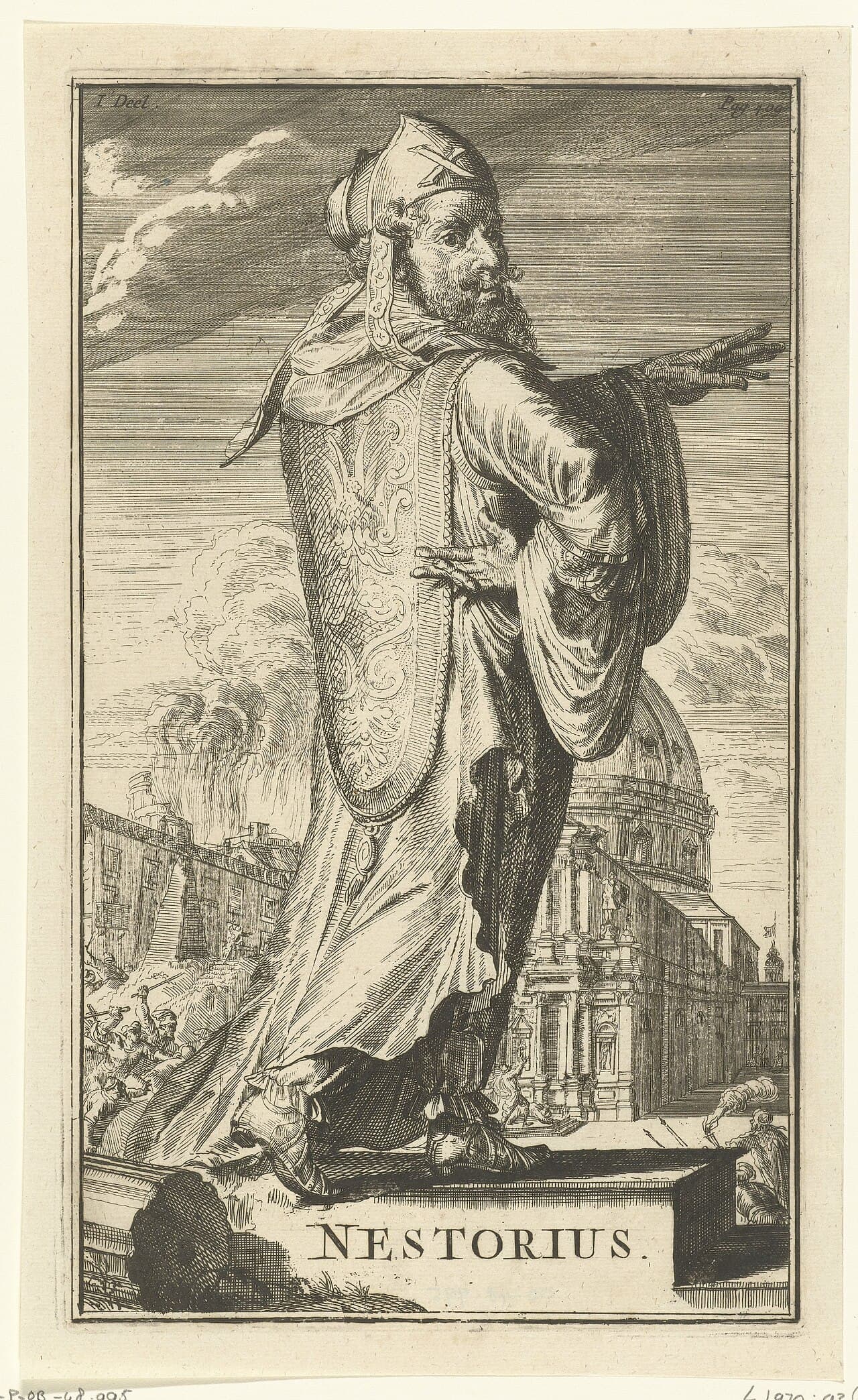
Nestorius was the Archbishop of Constantinople during the Post-Nicene Patristic era in the 4th-5th century CE. This period was marked by intense theological debates about the nature of Christ. Nestorius became known for his controversial teachings that sparked a significant religious dispute. His ideas about Christ's divine and human natures led to the development of what became known as Nestorianism, which challenged the established views of the time.
Nestorius was born around 386 CE in Germanicia, a region in the Roman province of Syria. In 428 CE, he rose to prominence when he was appointed as the Archbishop of Constantinople, a position of great influence both politically and religiously. His tenure as archbishop, however, was short-lived. In 431 CE, the Council of Ephesus addressed the uproar caused by his teachings. The council concluded with his deposition, stripping him of his title. Afterward, Nestorius faced exile to a monastery in Egypt, where he spent his remaining years.
The era Nestorius lived in was rife with theological controversies, primarily concerning the nature of Christ. The question of how Christ's divine and human aspects coexisted captivated and divided church leaders. Constantinople, as a powerful center of the Christian world, amplified the impact of Nestorius's teachings. The controversy prompted the Council of Ephesus to define orthodox beliefs more clearly. Nestorius's deposition marked a critical moment in church history, as it set the stage for future theological developments and divisions. His teachings continued to influence Christian thought long after his exile.
How are Christ's divine and human natures related? Are they united in one person, or do they remain two distinct persons?
Nestorius observed a growing trend that alarmed him. The term 'Theotokos' was being used widely to refer to Mary, emphasizing her role as the Mother of God. To him, this term threatened the crucial distinction between Christ’s divine and human natures. He believed that if Mary bore God, it blurred the lines between the divine and the human, risking a theological collapse where Christ's human experience was overshadowed by his divinity. His position stemmed from a sincere commitment to preserve the integrity of both natures in Christ, ensuring that neither was compromised or conflated. Nestorius acted out of a conviction that clarity in Christology was essential for faith and doctrine.
If Christ's divine and human natures are united in one person, it suggests that God can suffer and die. This challenges the very nature of God as unchangeable and incapable of suffering. Such a union risks erasing the clear distinction between divine and human, potentially leading to a belief where Christ's humanity is absorbed by his divinity. This position could morph into monophysitism, where Christ's human nature is seen as insignificant or merely a facade. It costs the church the full humanity of Christ, diminishing his role as a relatable, suffering savior. People risk losing a God who truly understands human frailty and suffering.
If Christ's divine and human natures remain as two distinct persons, it leads to a duality that fractures his identity. This division risks portraying Christ as two separate beings who do not fully integrate in purpose and work. Such a split undermines the unity essential for the atonement, as only a united Christ can effectively mediate between God and humanity. It costs the coherence of Christ's salvific role, casting doubt on the sufficiency of his redemptive work. In this view, believers face a Christ who might not fully bridge the gap between the divine and the human, weakening the foundation of their salvation.
The commitment to Christ's full divinity and full humanity left both positions untenable. The church needed a doctrine that maintained both natures without sacrificing unity or distinction. For ordinary believers, this debate was more than theological wrangling. It impacted their understanding of Christ's nature in prayer and worship. The hope in salvation hinged on a Christ who was both fully divine to overcome sin and fully human to relate to human struggles. The resolution of this controversy shaped the faith of millions, ensuring that Christ remained the bridge between God and humanity.
Nestorius taught that Jesus Christ possessed two distinct natures — divine and human — that existed as separate persons. He maintained that while Jesus was fully divine and fully human, these two aspects did not merge into a single person. Instead, they coexisted side by side. Nestorius believed this duality was necessary to uphold the integrity of both natures. For him, blending the divine and human natures into one person would undermine the completeness of each.
Nestorius used scripture to support his view. In John 1:14, "And the Word became flesh and dwelt among us," he saw a clear distinction between the divine Word and the human flesh. His interpretation of Hebrews 4:15 emphasized the need for a fully human Jesus to experience temptation, arguing that this required a distinct human person. Philippians 2:7, which describes Christ "emptying himself" and taking "the form of a servant," reinforced for Nestorius the separate roles of divine and human natures. He detailed these arguments in "The Bazaar of Heracleides" and his letters to Cyril of Alexandria, insisting that merging the natures would compromise the essence of both.
Nestorius's teachings resonated with those who prioritized clear distinctions in theological doctrine. His views gained traction among communities that valued the preservation of Christ's full divinity and humanity, seeing this separation as crucial for understanding salvation and the incarnation. His ideas spread primarily in the Eastern parts of the Christian world, especially among those who feared theological confusion. Despite the controversy surrounding Nestorius, his thoughts on the distinct natures of Christ influenced debates for centuries.
The decisive argument against Nestorius revolved around the unity of Christ's person. If Christ's divine and human natures were separate persons, it would fracture the Incarnation and undermine Christ's role as a mediator. This separation would mean that the divine and human could not fully interact in the redemptive act, compromising the doctrine of salvation. Cyril of Alexandria led this charge, emphasizing the necessity of a unified personhood in Christ. In his Third Letter to Nestorius in 430 CE, Cyril insisted on the "hypostatic union," where Christ's two natures coexist in one person without separation or confusion. Cyril's reasoning dismantled Nestorius's view by showing that a divided Christ could not bridge the gap between God and humanity.
Nestorius relied on certain biblical texts to support his view, but orthodox theology countered each point. In John 1:14, Nestorius saw "The Word became flesh" as a mere conjunction of natures. Cyril argued it meant the Word truly assumed human nature into one person. Philippians 2:7, according to Nestorius, indicated two separate persons through "taking the form of a servant." The orthodox answer emphasized the humility of Christ, who fully embodies both divine and human natures as one person. In Hebrews 2:14, Nestorius read "partook of the same" as a separation. Orthodoxy insisted it reflected the divine Word's full participation in human nature. Nestorius's position also trapped him in a contradiction: by implying human Jesus could not be worshipped as God, he divided the object of worship, effectively denying Christ's full divinity.
The orthodox counter-argument required embracing the mystery of The Incarnation, where two natures coexisted in one person without confusion or division. This nuanced understanding left theologians grappling with articulating how such a union worked. Yet, the church committed to this mystery to preserve the integrity of Christ's divinity and humanity. This commitment was not just theoretical. It had real-world impact: at the Council of Ephesus in 431 CE, Cyril's arguments led to Nestorius's condemnation and solidified the orthodox position on The Incarnation.
In 431 CE, Emperor Theodosius II convened the Council of Ephesus to address a theological dispute that threatened to fracture the Christian church and, by extension, the stability of the Roman Empire. The emperor, wary of the disruptive potential of religious disagreements, sought to enforce unity under the Nicene Creed. Bishops from across the Christian world gathered in Ephesus, including key figures like Cyril of Alexandria and representatives of Pope Celestine I. The council aimed to resolve the contentious issue of Christ’s nature, which had far-reaching implications not only for theology but also for imperial cohesion.
The central debate pitted Nestorius against Cyril of Alexandria. Nestorius argued that Christ's divine and human natures were so distinct that they amounted to two separate persons. He preferred to call Mary 'Christotokos', meaning 'Christ-bearer', reflecting this division. Cyril countered with the assertion that Christ's two natures were united in one person. He insisted on the term 'Theotokos', or 'God-bearer', for Mary, emphasizing the unity of Christ's personhood. The council condemned Nestorius as a heretic, affirming Cyril's position and the doctrine of hypostatic union — that Christ is one person with two natures, both divine and human. Nestorius was deposed and exiled, and his teachings were officially rejected.
Despite the council's clear verdict, the controversy over Christ's nature did not end. The debate continued, leading to the establishment of the Nestorian Church outside the Roman Empire, where Nestorius's teachings persisted. Theological disputes over Christ's nature evolved, contributing to further controversies like the Monophysite debate. This dispute culminated in the Council of Chalcedon in 451 CE, which sought yet another resolution. Even then, complete agreement eluded the church, leaving a legacy of division that influenced Christianity for centuries. The divisions initiated at Ephesus echoed through history, demonstrating that theological resolution on paper did not necessarily translate to unity in practice.
After the Council of Ephesus condemned Nestorius in 431 CE, his life took a drastic turn. Once the Archbishop of Constantinople, a prestigious post, Nestorius found himself deposed and exiled. Authorities banished him to a remote monastery in the Great Oasis of Hibis in Egypt. This isolated desert outpost became his home until his death around 450 CE. Stripped of power and influence, Nestorius spent his final years far from the theological debates that had previously defined his life.
Despite his personal downfall, Nestorian teachings lived on, especially through the Church of the East. This church refused to accept the Council of Ephesus's rulings, allowing Nestorian ideas to flourish beyond the Roman Empire's borders. The Church of the East spread these teachings throughout Persia and further into Asia. Regions such as Mesopotamia, India, and China became strongholds of this theological perspective. By adapting to local cultures and traditions, the church established a lasting influence, often serving as a bridge for cultural and intellectual exchanges along the Silk Road.
Today, the legacy of Nestorius endures in the Assyrian Church of the East. This church continues to emphasize the distinctiveness of Christ's human and divine natures, a core tenet of Nestorianism. Academic circles also revisit Nestorian ideas as part of broader discussions on Christ's nature. While theological landscapes have shifted dramatically since Nestorius's time, his influence persists in both religious practice and scholarly inquiry. The Assyrian Church of the East stands as a testament to the enduring nature of his teachings, bridging ancient controversies with modern faith communities.
Continue reading with a Scholar plan
Upgrade to Scholar