Library
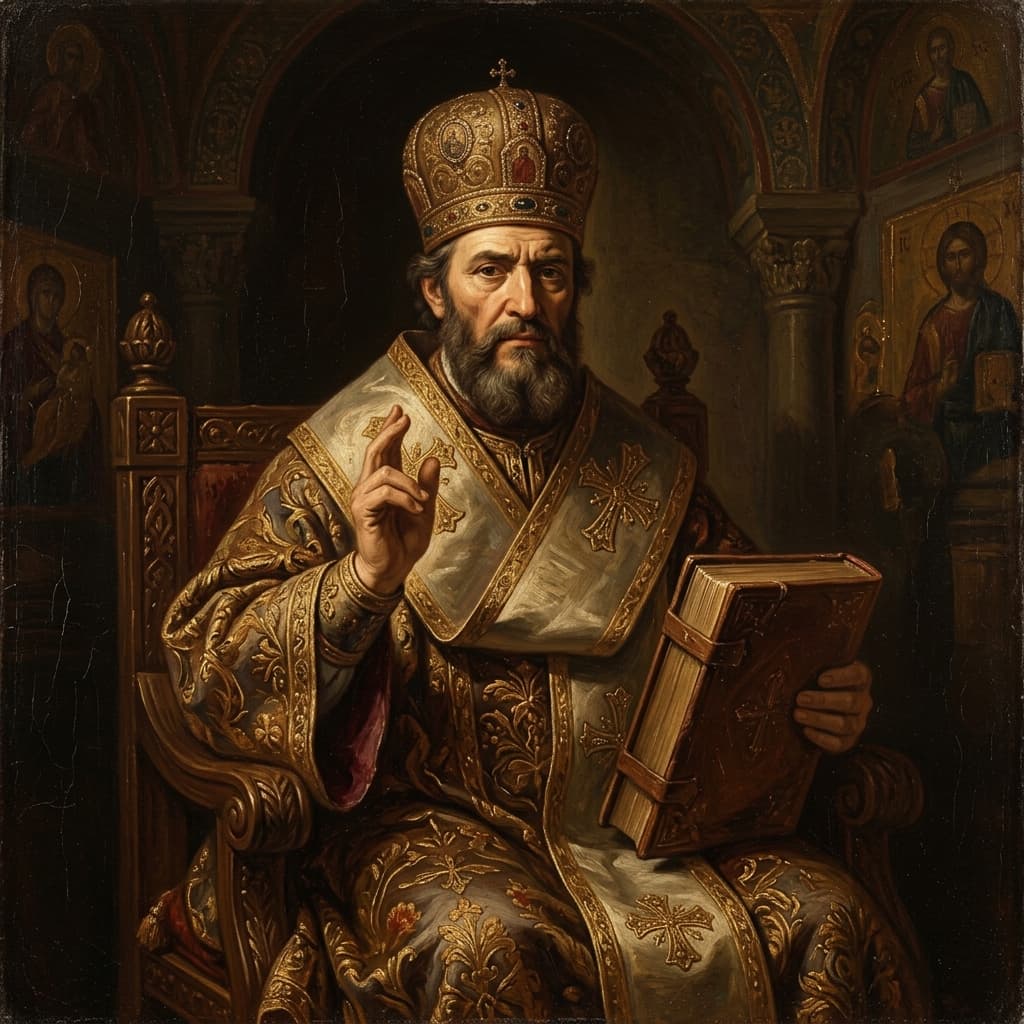
AI-generated illustration
Library
Medieval (9th-15th C) · c. 810-893 CE · Updated April 8, 2026
Photius of Constantinople was a prominent 9th-century Patriarch of Constantinople, known for his role in the Photian Schism and his scholarly contributions to Christian theology. He lived during a time when the Eastern Orthodox and Roman Catholic Churches were increasingly at odds, both theologically and politically. Photius's tenure as Patriarch was marked by his strong opposition to certain doctrines and practices of the Roman Church, making him a pivotal figure in the history of the Christian Church.
Born around 810 CE, Photius became Patriarch of Constantinople twice, first from 858 to 867 and then from 877 to 886. His appointment as Patriarch was initially contentious, as he was a layman who rapidly ascended to this high ecclesiastical position. During his time as Patriarch, Photius confronted the Roman Church's authority, leading to the Photian Schism. His scholarly works, including the 'Bibliotheca', 'Amphilochia', and 'Mystagogia', addressed complex theological issues, reflecting his intellectual prowess. His opposition to the Filioque clause — an addition to the Nicene Creed concerning the procession of the Holy Spirit — was a key point of contention. This stance led to his excommunication by Pope Nicholas I, underlining the deepening rift between East and West.
Photius lived in an era marked by significant tensions between the Eastern and Western Churches. The Filioque controversy was emblematic of broader disputes over papal authority and doctrinal differences. These disputes were rooted in political power struggles and differing theological interpretations. The Filioque clause, which stated that the Holy Spirit proceeds from the Father and the Son, was rejected by Photius, who argued for the traditional view that the Spirit proceeds from the Father alone. This conflict, among others, set the stage for the eventual Great Schism of 1054, which permanently divided Eastern and Western Christianity.
Does the Holy Spirit proceed from the Father alone, or from the Father and the Son — and what are the theological and political stakes of each answer?
Photius of Constantinople devoted his life to addressing the growing rift between the Eastern and Western branches of Christianity. He aimed to preserve the theological integrity and cultural independence of the Eastern Church while confronting the political and ecclesiastical overreach of the Western Church. Photius was deeply concerned with maintaining the original teachings and traditions of the early Church, which he believed were being threatened by changes imposed by the West, particularly the alteration of the Nicene Creed. This mission to safeguard tradition and authority in the Eastern Church defined his life's work.
Among Photius's most important ideas was his steadfast opposition to the Filioque clause, which the Western Church added to the Nicene Creed, suggesting that the Holy Spirit proceeds from both the Father and the Son. Photius insisted that the Holy Spirit proceeds from the Father alone, as originally stated in the Creed. This was not just a theological dispute; it was a statement against Western attempts to alter foundational doctrines without the consensus of the whole Church. Another significant idea was his belief in the equality of the Eastern patriarchates. Photius resisted the Roman Church's claims of supremacy, advocating instead for a model where Eastern patriarchates governed themselves without subordination to Rome. These ideas were driven by his desire to protect the Eastern Church's autonomy and theological purity.
In addition to his theological arguments, Photius played a crucial role in preserving classical learning. His work, the "Bibliotheca," was a massive compilation of summaries and critiques of ancient texts, ensuring that much of the classical knowledge was not lost to history. This endeavor highlighted his commitment to intellectual and spiritual development, as he believed that understanding the past was essential for the Church's future. His "Amphilochia," a collection of theological questions and answers, further showcased his breadth of knowledge and dedication to educating both clergy and laity on complex theological issues.
Photius's signature argument was his defense of the original Nicene Creed's formulation of the Holy Spirit's procession. His treatise "Mystagogia" presented a detailed theological argument against the Filioque, asserting that the Western Church's modification was an unauthorized and grave error. This argument was compelling because it was rooted in the decisions of ecumenical councils, which held significant authority in the early Church. By challenging the Filioque, Photius not only reinforced the Eastern Church's doctrinal positions but also highlighted the broader issue of unilateral actions by the Western Church, ultimately contributing to the growing divide that would lead to the Great Schism.
Before Photius of Constantinople, Christian thought in the East was largely focused on internal matters and the theological legacy of early ecumenical councils. The Filioque clause had not yet emerged as a major point of contention between the Eastern and Western Churches. The Roman papacy's authority went mostly unchallenged in the West, with the Eastern Church primarily concerned with its own theological debates. While occasional tensions existed between the Eastern and Western Churches, they remained in communion. The preservation of classical works was an ongoing but uncoordinated effort, risking the loss of much of ancient knowledge.
Photius of Constantinople changed this landscape profoundly. He argued vehemently against the Filioque clause, asserting that the Holy Spirit proceeds from the Father alone. This stance directly challenged the Western Church's addition of "and the Son" to the Nicene Creed, turning the clause into a central theological issue that would contribute to the East-West Schism. Photius also challenged the authority of the Roman papacy, promoting the equality of the Eastern patriarchates and resisting papal claims. This resistance established a precedent for future Eastern opposition to Roman authority. Additionally, Photius undertook the monumental task of summarizing and preserving 280 ancient works in his Bibliotheca, ensuring that classical knowledge survived for future generations.
The actions of Photius had far-reaching consequences. His challenges to the Filioque clause and papal authority directly influenced the theological and political landscape leading to the Great Schism of 1054. The Photian Schism highlighted deep-seated differences that would eventually lead to permanent division. His efforts in preserving classical texts laid the groundwork for the Renaissance, reviving classical learning in both the Byzantine and Western worlds. The debates Photius engaged in continued to shape Eastern Orthodox theology and its relationship with the Roman Catholic Church. Today, his legacy is evident in the enduring theological debates and the survival of classical texts that continue to influence modern scholarship.
Photius of Constantinople, a towering figure in the 9th century church, is often remembered for his contentious role in the East-West Schism. One of his most damaging ideas was his vehement opposition to the addition of the "Filioque" clause to the Nicene Creed by the Western Church. Photius argued that the Holy Spirit proceeds from the Father alone, while the Western Church believed it proceeds from both the Father and the Son. This theological dispute exacerbated tensions between the Eastern Orthodox and Roman Catholic Churches, contributing to a split that would deepen over the centuries. His rigid stance against the Western interpretation fostered division rather than dialogue.
The darkest chapter of Photius's career was the Photian Schism, a period of intense conflict between the Eastern and Western branches of Christianity. Photius was twice deposed and reinstated as Patriarch of Constantinople, partly due to his controversial election, which was seen as illegitimate by Rome. He excommunicated Pope Nicholas I and the Roman Church, a bold move that entrenched division. The schism he instigated had profound consequences, setting a precedent for further ecclesiastical rifts and weakening the unity of Christendom at a crucial time.
Critics of Photius have argued his actions were politically motivated, serving the interests of the Byzantine Empire over the unity of the church. While some historians have attempted to paint Photius as a misunderstood reformer, the evidence largely supports the view that his rigid theological positions and political maneuvering were detrimental. The verdict on Photius's role in church history remains largely negative, underscored by the fact that the East-West Schism persists to this day, a testament to the enduring impact of his divisive legacy.
After his condemnation at the Fourth Council of Constantinople in 867 CE, Photius of Constantinople faced exile, a common fate for religious figures deemed controversial. However, his story did not end there. In a dramatic reversal, he was reinstated as Patriarch of Constantinople in 877 CE after the death of Emperor Basil I, who had initially exiled him. Photius's return to power underscored his significant influence and the complex political landscape of the Byzantine Empire. Eventually, Photius chose a quieter life, retiring to a monastery where he lived out his final years until his death in 893 CE.
Photius's teachings, especially his opposition to the addition of the Filioque clause to the Nicene Creed, found a lasting home in the Eastern Orthodox Church. The Filioque, which means "and the Son," was a theological point of contention that contributed to the growing rift between Eastern and Western Christianity. Photius argued that the Holy Spirit proceeds from the Father alone, a stance that resonated deeply in the Eastern Church. This emphasis on theological independence reinforced the Eastern patriarchates' desire to maintain their own traditions and authority, setting the stage for the Great Schism of 1054, when the Eastern and Western Churches formally split.
Today, the Filioque controversy remains a significant doctrinal difference between the Eastern Orthodox and Roman Catholic Churches. The legacy of Photius is also visible in the Eastern Orthodox Church's dedication to preserving classical learning and theological traditions. This commitment is evident in the Orthodox Church's liturgies, teachings, and educational pursuits, which continue to reflect the influence of Photius's intellectual and spiritual contributions. His impact endures, particularly in how the Eastern Orthodox Church views its identity and theological heritage.
Continue reading with a Scholar plan
Upgrade to ScholarAI-generated illustration