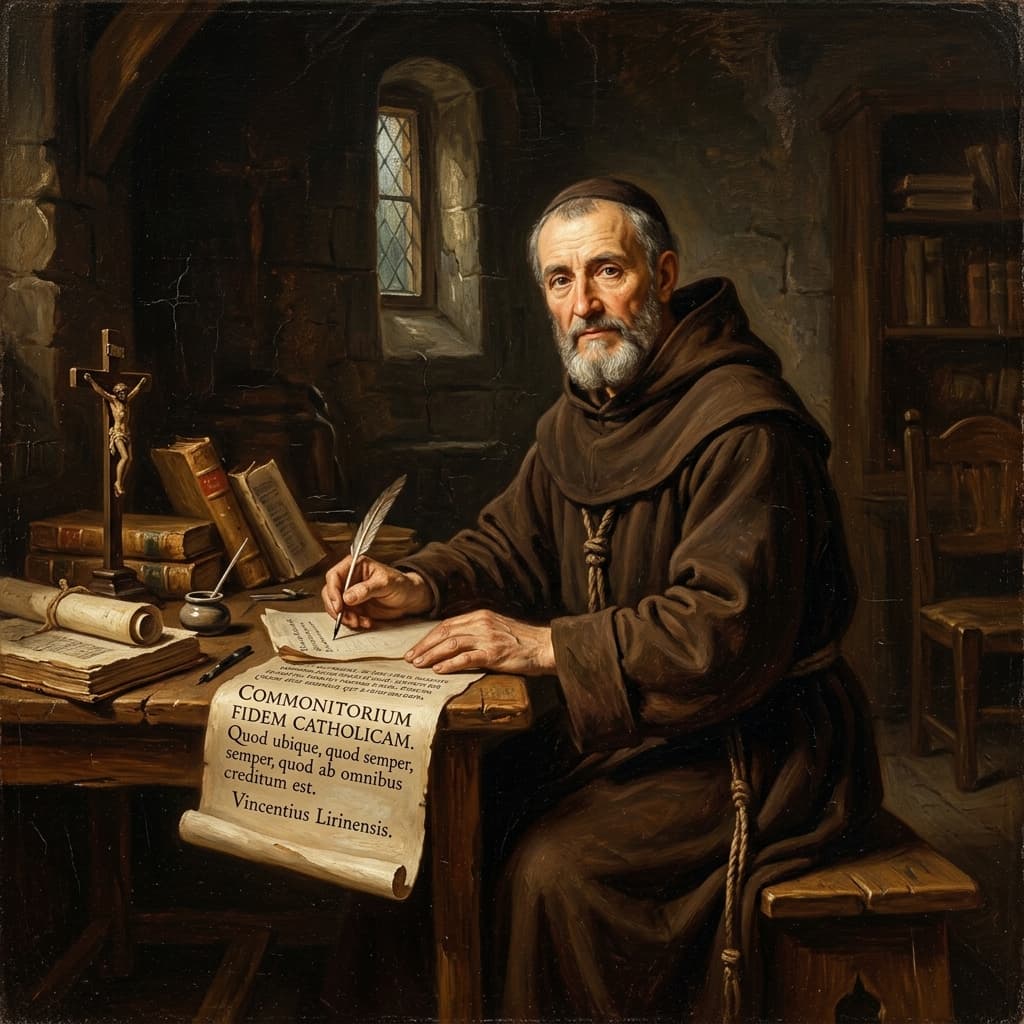
Vincent of Lerins
defenderPost-Nicene Patristic (4th-5th C) · d. c. 445 CE · Updated April 9, 2026
Biography
Vincent of Lerins was a monk at the monastery of Lerins on the French Riviera during the Post-Nicene Patristic era, known for authoring the Commonitorium, a foundational text on the development of doctrine. The monastery of Lerins served as a spiritual center, fostering theological reflection and debate. Vincent's work emerged as a guiding light for Christians seeking clarity amidst the swirling controversies of early Church doctrine.
Vincent died around 445 CE, leaving behind a legacy rooted in orthodox tradition. He wrote the Commonitorium in 434 CE, a text crafted to help distinguish genuine doctrinal development from heretical corruption. His most famous contribution, the "Vincentian Canon", asserted that true doctrine should adhere to what has been believed everywhere, always, and by all. Vincent stood firmly against theological innovations, particularly those propagated by Augustine, whose doctrine of predestination he found troubling.
Vincent lived in a time when the Christian Church grappled with defining orthodoxy amidst numerous theological controversies. Ideas like Augustine's predestination sparked heated debates, prompting Vincent to emphasize the importance of tradition and universality in Christian doctrine. His defense of continuity with apostolic roots highlighted the Church's struggle to maintain its foundational beliefs while addressing new theological challenges. Through his work, Vincent provided the Church with a framework to navigate these turbulent waters, leaving a lasting impact on how doctrine was evaluated and preserved.
How do you distinguish genuine development of Christian doctrine from heretical innovation — and is antiquity alone sufficient to establish orthodoxy?
The question
Vincent of Lerins watched with growing concern as Augustine's predestination doctrine spread through the church. He saw a departure from the teachings that had sustained Christianity for centuries. Augustine's view cast God as a sovereign who predetermined salvation and damnation, leaving little room for human agency. Vincent believed this undermined the church's long-held belief in free will. He saw Augustine's teachings as a radical break from the faith handed down by the apostles. To Vincent, the stability of the church depended on its adherence to what had been universally accepted and taught. His position was not born of stubbornness but of a deep commitment to preserving a faith that united generations of believers.
Strict adherence to historical consensus demands that doctrine never stray from what has been believed everywhere, always, by all. This approach roots Christianity in a continuous tradition, ensuring that nothing foreign contaminates its beliefs. But this rigidity comes at a cost. It risks making the church irrelevant in a rapidly changing world. It stifles the development of doctrine that could address new moral and social challenges. By locking itself into the past, the church might find itself unable to speak meaningfully to the present. The consequence is a faith that is preserved but not alive, a museum piece rather than a living tradition.
Allowing for new interpretations and understandings opens the door to growth within the church. This approach permits doctrines to evolve in response to new insights and discoveries. It encourages theologians to seek fresh understandings and adapt teachings to contemporary contexts. But this fluidity threatens unity. The risk is that the church fractures into factions, each claiming their own version of truth. In embracing innovation, the church may dilute its core tenets, leading to confusion and division. The consequence is a faith that is relevant but fragmented, lacking the cohesion that has historically been its strength.
Vincent's dilemma was the church's dilemma: how to remain true to its ancient roots while engaging with the world it found itself in. Both preserving tradition and embracing innovation had their appeals, but neither offered a complete path forward. For ordinary believers, this was not just an academic debate. It affected the very core of their faith experience. Would their salvation depend on their own choices, or was it already sealed by divine decree? The outcome of this debate shaped not just theological discourse but the daily prayers, liturgies, and lives of countless Christians seeking assurance and guidance. The struggle between these paths was not merely about doctrine — it was about the very heart of the faith they lived.
The orthodox answer
Vincent of Lerins taught that true Christian doctrine should be what has been believed everywhere, always, and by all. He tackled the challenge of distinguishing genuine development from heretical innovation. Vincent argued that true doctrine must align with the universal and ancient faith of the Church. For him, anything new that strayed from this collective belief signified a dangerous innovation. Antiquity alone did not establish orthodoxy in his view; it needed to be coupled with universality and consensus among the faithful.
Vincent reasoned that the Church’s teachings, rooted deeply across time and geography, marked their truth. In his treatise "Commonitorium" written in 434 CE, he laid out this argument. He drew from scriptures such as 2 Timothy 1:13-14 and Jude 1:3, urging the preservation of the apostles' original teachings as a safeguard against innovation. Vincent saw these teachings as a trust to be kept intact, warning against deviations he deemed "profane and vain babblings," as supported by 1 Timothy 6:20. His logic rested on the idea that apostolic doctrine should be a constant thread woven through the Church's history.
Vincent’s teaching resonated with those who valued stability and continuity in the Church. It spread because it offered a clear criterion for identifying orthodox doctrine, appealing to those wary of changes that threatened unity. Church leaders and theologians found his argument compelling, as it provided a solid foundation against the backdrop of theological debates. His idea of "everywhere, always, and by all" became a touchstone for many seeking to defend the faith against perceived threats. The influence of Vincent’s teaching endured, shaping discussions about orthodoxy for centuries.
The counterargument
Vincent of Lerins made a compelling case for maintaining orthodox Christian doctrine by introducing what is now known as the 'Vincentian Canon.' In his work, the "Commonitorium," written in 434 CE, Vincent argued that true Christian beliefs are those that have been universally accepted — believed everywhere, always, and by all. This principle created a standard that any new doctrine must meet to be considered legitimate. The core of his argument lay in the idea that heretical teachings failed to meet this criterion because they introduced novel ideas not rooted in the continuous and universal tradition of the Church. Vincent's logic was simple: if a doctrine lacked historical and widespread acceptance, it could not be considered true to the Christian faith. Heresies, by their nature, introduced changes or interpretations that had no grounding in this universal tradition, thereby disqualifying themselves.
Vincent supported his argument by drawing on specific biblical texts that emphasized the importance of holding onto the original teachings of Christianity. He cited 2 Timothy 1:13-14, which instructs believers to "hold fast the form of sound words," underscoring the need to preserve apostolic tradition. Jude 1:3 bolstered his case by urging the faithful to "contend for the faith which was once delivered unto the saints," reinforcing the idea that the core teachings of Christianity were delivered once and should remain unchanged. Additionally, 1 Timothy 6:20 warned against the allure of new doctrines, cautioning to avoid "profane and vain babblings." Through these texts, Vincent illustrated the internal contradiction of heretical positions, which relied on innovations that strayed from these established teachings, thereby undermining their claim to authenticity.
Vincent's firm stance against theological innovation came at a personal cost. While he was not exiled or imprisoned, his unwavering defense of tradition likely led to his isolation within circles that favored doctrinal change, particularly those sympathetic to Augustine’s views on predestination. This ecclesiastical and political isolation meant that Vincent's contributions were not immediately celebrated or widely recognized in his time. Yet his clear articulation of the Vincentian Canon continued to influence the Church long after his passing, providing a touchstone for evaluating the authenticity of Christian doctrine through the ages.
The resolution
In 434 CE, in the quiet monastic setting of Lerins, France, a theological debate unfolded with profound implications for the future of Christian doctrine. This was not a formal council or synod convened by emperors or church authorities but rather an intellectual gathering led by Vincent of Lerins and attended by Western theologians. The central question was how to distinguish genuine development in Christian doctrine from heretical innovation. This debate arose in response to Augustine's doctrine of predestination, which had stirred significant controversy. The political stakes were low, as secular rulers largely stayed out of the fray, allowing the focus to remain on the theological implications.
Vincent of Lerins proposed a guiding principle known as the 'Vincentian Canon.' He argued that true doctrine must be what has been believed everywhere, always, by all. This emphasis on universality, antiquity, and consensus sought to draw a clear line between legitimate development and corruption of doctrine. The language mattered greatly because it set the boundaries of orthodoxy, defining how the church could evolve without losing its foundational truths. The Commonitorium, a key text from this debate, did not issue any condemnations but provided a framework to assess theological claims, leaving room for interpretation.
The resolution in Lerins did not settle the heated debates over predestination and grace. Augustine's influence remained strong, and these issues would resurface in later theological movements, such as Jansenism in the 17th century. The Vincentian Canon itself faced challenges in its application, as differing interpretations led to ongoing disputes. The controversy over Predestination continued well beyond this event, with no clear closure even into modern theological discussions. Augustine's ideas persisted, marking a lasting tension within Western Christianity that has yet to be fully resolved.
Legacy
Vincent of Lerins lived out his days at the monastery on the island of Lerins, off the southern coast of France. He died around 445 CE, leaving behind a legacy rooted in his work, the Commonitorium. This text acted as a guide for distinguishing true Christian teaching from heresy based on the principles of universality, antiquity, and consensus. Vincent remained a respected figure within the monastic community and the broader Christian world. His ideas sparked conversations and debates but did not lead to any formal condemnation. Instead, his thoughts were absorbed into the ongoing theological discussions of the time.
Vincent's teachings, particularly the 'Vincentian Canon,' significantly impacted Western Christianity. His insistence on tradition and universality as measures of true doctrine became a touchstone for many Church leaders. Throughout the Middle Ages, his ideas influenced debates over orthodoxy and heresy, especially during periods of theological turmoil. Theologians and councils often turned to Vincent's criteria to evaluate new teachings. His influence extended beyond the borders of France, reaching into broader Catholic practice. Key figures and movements, such as the Scholastics and later Church reformers, found guidance in his emphasis on continuity with the past.
Today, Vincent's legacy endures. The Vincentian Canon remains a vital part of Roman Catholic theology, serving as a benchmark for assessing doctrinal development. It guides discussions in the Anglican and Orthodox traditions, where continuity and universality remain central to evaluating belief systems. Modern theologians and scholars often reference Vincent's work when addressing issues of tradition in contemporary religious thought. His principles echo in church documents and discussions, underscoring the enduring relevance of his insights. The Vatican, in particular, frequently cites the Vincentian Canon, illustrating its continued importance in shaping theological discourse.
Continue reading with a Scholar plan
Upgrade to ScholarCommon questions
- What did Vincent of Lerins actually believe about Christ — and why?
- Vincent of Lerins upheld the orthodox Christian belief in the full divinity and humanity of Christ, consistent with the Nicene Creed. He emphasized the importance of adhering to traditional interpretations of Christ's nature to maintain doctrinal purity. His views were shaped by the need to counter heretical teachings that threatened the unity and consistency of Christian doctrine.
- What heresy was Vincent of Lerins defending against, and what was at stake?
- Vincent of Lerins was primarily defending against the heresy of Pelagianism and what he perceived as the extreme predestinarian views of Augustine. The stakes involved maintaining the balance between divine grace and human free will, as well as preserving the continuity of traditional Christian teachings.
- What was Vincent of Lerins's decisive argument for the orthodox position?
- Vincent of Lerins's decisive argument was encapsulated in the 'Vincentian Canon,' which stated that true Christian doctrine is what has been believed everywhere, always, and by all. This principle was intended to safeguard the faith against innovations and ensure continuity with the apostolic tradition.
- How many times was Vincent of Lerins exiled or condemned — and by whom?
- There is no historical record of Vincent of Lerins being exiled or condemned. His work, the Commonitorium, was influential but did not lead to personal persecution or exile.
- Who were Vincent of Lerins's main opponents, and how did they fight back?
- Vincent of Lerins's main theological opponent was Augustine of Hippo, particularly regarding the doctrine of predestination. Augustine's followers continued to promote his teachings, which became dominant in Western Christianity, effectively countering Vincent's arguments by gaining broader ecclesiastical support.
- What happened at the council Vincent of Lerins attended or influenced?
- Vincent of Lerins did not attend any ecumenical council, but his work influenced later theological discussions. His Commonitorium provided a framework for evaluating doctrinal developments, which was used by theologians in subsequent councils to distinguish between legitimate development and heretical innovation.
- What did Vincent of Lerins write, and is any of it still read?
- Vincent of Lerins wrote the Commonitorium, a treatise on the development of Christian doctrine. It is still read today, particularly by those interested in the history of theology and the principles of doctrinal development.
- Is Vincent of Lerins considered a saint? By which traditions?
- Vincent of Lerins is considered a saint in the Roman Catholic Church and is commemorated on May 24. He is also recognized by some Eastern Orthodox Christians, although he is not universally venerated in the Orthodox tradition.
- Why did Vincent of Lerins refuse to compromise even when it cost everything?
- Vincent of Lerins believed that compromising on doctrinal purity would lead to the corruption of the Christian faith. He was committed to preserving the apostolic tradition and saw any deviation as a threat to the church's unity and truth.
- Why does Vincent of Lerins still matter to Christians today?
- Vincent of Lerins matters to Christians today because his principles for distinguishing true doctrine from heresy remain relevant in theological discussions. His emphasis on tradition and continuity provides a framework for addressing contemporary challenges to Christian orthodoxy.
- What is the most surprising or counterintuitive thing about Vincent of Lerins?
- The most surprising aspect of Vincent of Lerins is that despite his opposition to Augustine's views, his principles have been used by both sides of theological debates throughout history. His emphasis on tradition has been invoked by various Christian groups to support differing interpretations of doctrine.