Library
Egyn
Cardinal KingDescription
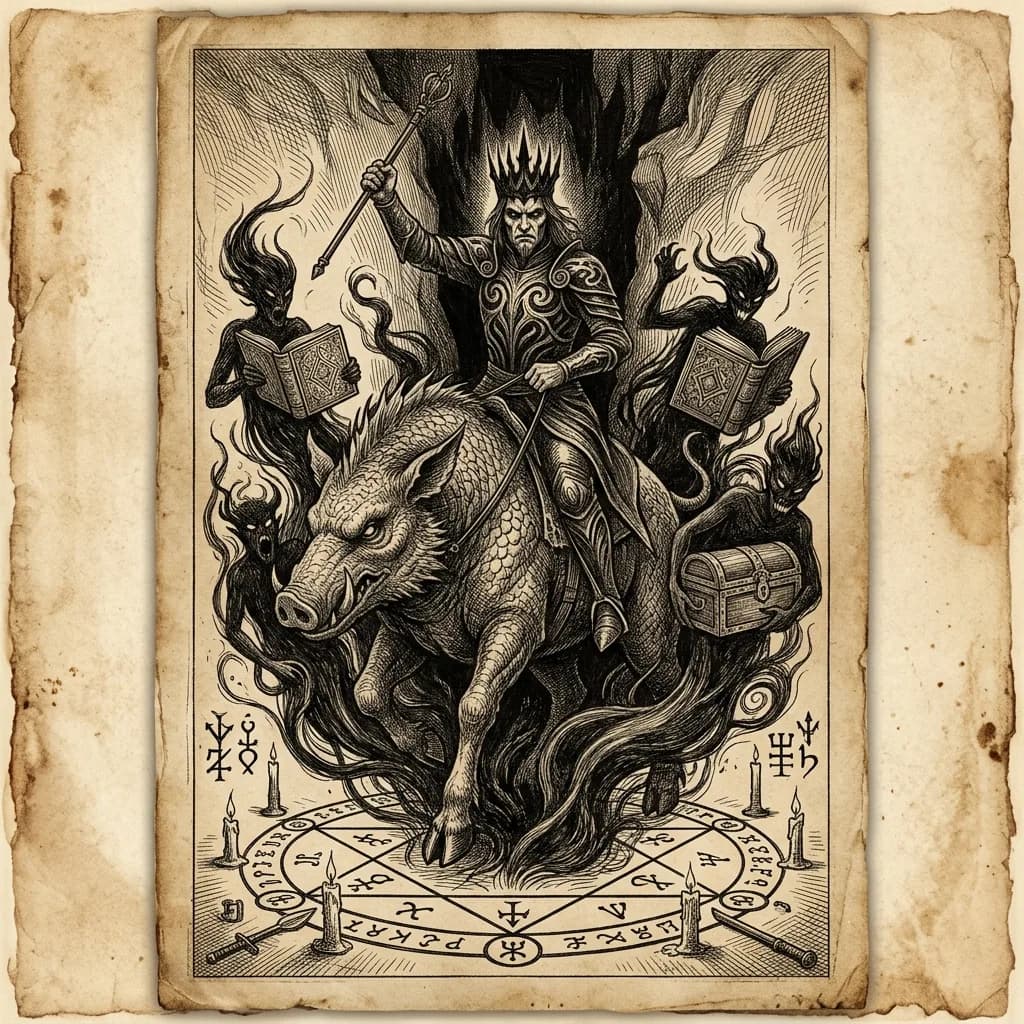
Egyn, also known as Ariton, is the Cardinal King of the North with dominion over water. His name possibly derives from Hebrew meaning "to delay" or "to hinder." He commands twenty-two servitors - significantly smaller than Oriens and Paimon. He appears as a serious king in human form with pale skin and sharp features; when he arrives, the temperature drops. He moves slowly and carefully with dark authority. His powers include discovering hidden treasure, knowing past, present, and future, causing visions, making spirits appear in any form, giving familiars, reviving the dead, revealing the identities of thieves, and gifting the power of flight. His power to corrupt lies in the stagnation of the soul. North is the direction of darkness, concealment, the underground. He operates from darkness, not spectacle.
Symbolic interpretation
Revives the dead. This power is the capacity to restore what has been sealed, finished, and consigned to stillness - not as an act of Creation but as an act of retrieval from a completed state. The operative mechanism is reversal of terminal closure: Egyn reaches into the final category of the irreversible and pulls something back across the threshold. What this produces in those who witness or experience it is a fundamental disruption of the framework by which human beings orient themselves in time. Death functions as the absolute guarantor of consequence - the thing that makes all outcomes final and meaningful. When that seal is broken, the logic of irreversibility dissolves, and with it the psychological scaffolding that makes decisions feel weighted. The revival of the dead does not comfort those it acts upon; it unsettles them at the root.
Gifts the power of flight. Flight as a bestowed capacity is not liberation from gravity alone - it is the granting of a relationship to space that bypasses the ordinary constraints of terrain, passage, and obstruction. The mechanism is the removal of the ground as a necessary medium of travel. One who moves through air no longer navigates obstacles; they simply ascend above them. What this produces is a severance from the tactile friction of the world: paths, borders, thresholds, and guards become irrelevant. This has a specific psychological consequence - the person granted flight loses the developmental texture that comes from encountering resistance. The journey without impediment produces a figure who has motion but no earned relationship to where they arrive.
Reveals the identities of thieves. This power operates as a targeted disclosure mechanism - the capacity to strip the anonymity that conceals transgression. Its mechanism is not detection of the act itself but identification of the actor, the specific mapping of hidden agency back to a named person. The effect on those exposed is the collapse of the social fiction that concealed them: thievery survives on the assumption of untraceable action, and this power annihilates that assumption categorically. But the broader effect operates on everyone who knows this power exists - it installs a permanent awareness that concealment is provisional, that hidden action has a sovereign witness. This is not reassurance. It is surveillance at the level of ontology.
Gives familiars. The bestowal of familiars is the assignment of a bound intermediary entity - a spirit tethered to a specific person for the purposes of service, information, or operational capacity. The mechanism is a transfer of a subordinate's loyalty and function from Egyn's own hierarchy to the recipient. The familiar is not a gift in the conventional sense; it is a delegation of a piece of Egyn's network, a node that becomes attached to the practitioner's operations. The effect on the recipient is an expansion of perceptual and operational range - access to information, influence, or capabilities they could not generate alone. The consequence, less visible, is that the practitioner now exists within Egyn's web of dependency. One who has been given a familiar has accepted something from the North.
Discovers hidden treasure and secret knowledge of all things. This is a dual capacity rooted in a single operative principle: the penetration of concealment as a general faculty. Hidden treasure is not merely buried gold - it is value that has been deliberately removed from circulation, placed beneath surfaces, and rendered inaccessible by geography or secrecy. The mechanism by which Egyn accesses it is the same mechanism that governs his Northern domain: dominion over what lies underground, beneath visibility, in darkness. Secret knowledge of all things extends this same faculty from physical concealment to informational concealment - the facts, histories, and states that have been hidden rather than lost. The effect on those who receive this knowledge is the erasure of the distinction between what is public and what is private. Nothing is hidden from the practitioner; everything that has been buried is surfaced. This produces not clarity but an overwhelming of the ordinary epistemological limits that structure how much reality any single agent can bear.
Dominion over water. Water as an elemental domain carries specific structural properties: it moves but without fixed direction, it conforms to every container, it accumulates in low places, it corrodes over time, it conceals its depths. Egyn's dominion over water is not metaphorical - it is sovereignty over the operating logic of those properties as forces. He governs accumulation, dissolution, patience, and the slow reshaping of surfaces through persistence. The effect on those subject to this dominion is immersion in a logic that does not break through force but through endurance. Water does not assault - it saturates. The people and situations under Egyn's water-domain find themselves changed not through dramatic confrontation but through prolonged contact, the slow penetration of moisture into stone.
Stagnation of the soul. This is Egyn's corrupting mechanism and the dark face of his element. Where water moves, it cleans; where it does not move, it corrupts. Stagnation of the soul is the arrest of interior motion - the condition in which development, change, and aspiration cease not through destruction but through stillness. The mechanism is the removal of pressure, urgency, and productive friction from a person's interior life. What it produces is not suffering but its absence: the subject of this power does not experience acute crisis but rather the slow disappearance of drive, direction, and becoming. The consequence is a life that remains technically intact while losing all forward momentum. This is Egyn's most dangerous operation precisely because it produces no identifiable wound - only the accumulated depth of nothing happening.
Appearance. Egyn presents as a serious king in human form, pale-skinned and sharp-featured, arriving with a drop in temperature and moving with deliberate slowness. Every element of this appearance is functional data about operational style. The pale skin and cold temperature mark him as a figure of the underground and the north - not the sun's warmth but the earth's interior cold, the temperature of caves and deep water. The sharp features signal precision over abundance: nothing soft, nothing decorative, nothing wasted. The slowness of his movement is not weakness - it is the movement of deep water, of glaciers, of forces that do not need to rush because they operate on timescales that outlast urgency. The serious demeanor communicates that Egyn does not perform. He arrives with the gravity of finality, not the energy of spectacle. His twenty-two servitors - a small court for a Cardinal King - reflect this same economy: authority consolidated rather than displayed, power held close rather than broadcast.
Archetype
Egyn derives as Mutable Water - Pisces - and the argument runs from his operational mechanics directly. The Mutable modality is visible in his most characteristic power: he reads across states rather than initiating or holding any single one. His knowledge of past, present, and future is not a capacity to create new conditions or lock existing ones - it is the capacity to move through all temporal registers simultaneously, bridging what has been with what is and what will be. He does not found; he perceives. His power to cause visions operates identically: he translates hidden states into perceptible form, serving as the medium through which concealed realities become readable. Even his revival of the dead is Mutable in posture - not Cardinal disruption of the natural order for its own sake, but a bridging operation that retrieves something from a completed state and passes it back across a threshold. The Water element derives from the Diffuse + Collective matrix: there is no front door to Egyn's operation, no specific act you can name and contest - his mechanisms work through atmosphere, through accumulation, through the slow saturation of surfaces, which is Diffuse; and his domain of water, his omniscient surveillance of thieves, his bestowal of familiars that quietly integrate recipients into his network, all operate on whoever stands in the relevant position within his system, which is Collective. The stagnation-of-the-soul corruption confirms this precisely - it leaves no identifiable wound because it never presented a locatable attack. What results from Mutable Water is an operator that moves through all states, reads all depths, and shapes through ambient persistence rather than declared force: the mechanism that reaches you through immersion, not confrontation, and through the dissolution of the boundary between what you contain and what surrounds you.
In popular culture
Egyn has no significant pop culture presence.