Library
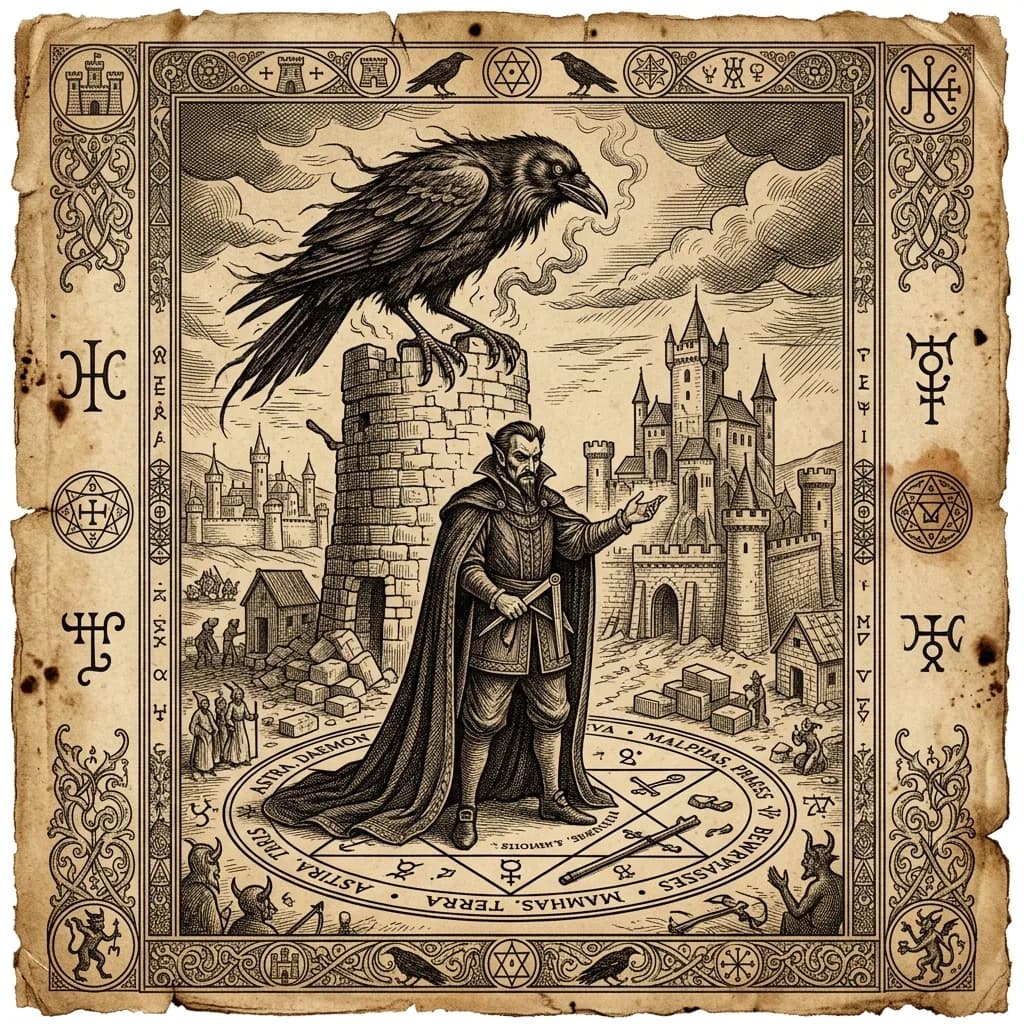
Malphas
PresidentSpirit #39 of the Ars Goetia · 40 legions
Description
Malphas is the 39th Spirit, a Great President of Hell. He first appears as a crow before taking human shape when compelled. He builds towers, castles, and cities with great speed. He brings to pass the desires of the conjurer concerning all things. He brings good familiars. He can bewray the counsels of enemies and reveal what they contain. His critical quality: he accepteth willingly any sacrifice offered to him, but he deceiveth him that doth it. He commands 40 legions of spirits.
Symbolic interpretation
The capacity to build towers, castles, and cities with great speed is not primarily about architecture. It is the capacity to instantiate structures of authority and defense at a pace that outstrips normal institutional timelines. What the power actually is, mechanically, is the compression of accumulation - the work of decades collapsed into moments. This operates through the rapid organization of material, labor, and spatial logic into defensible, hierarchical forms. What this produces in those who receive it is an unearned solidity: the conjurer inhabits fortifications they did not build through ordinary effort, which means they also do not understand the structural logic that holds those fortifications together. They possess the castle without comprehending its architecture, and that gap between possession and understanding becomes a persistent vulnerability.
The power to bring to pass the desires of the conjurer concerning all things is the broadest and most dangerous capacity Malphas holds. It is not wish fulfillment in the passive sense - it is the active alignment of circumstance, will, and outcome across every domain simultaneously. The operative mechanism is total subordination of contingency to desire: what the conjurer wants becomes what happens. What this produces is the dissolution of resistance as an educational force. Friction, delay, and failure are the mechanisms by which a person learns the difference between what they want and what is good for them. Remove all of them, and every desire is immediately ratified, regardless of its quality. The conjurer becomes incapable of distinguishing between their appetites and their genuine interests.
Bringing good familiars is the provision of reliable auxiliary intelligence - spirits assigned as personal companions and informants that extend the conjurer's perceptual and operational range. The mechanism is the Creation of a network of subordinate awareness that feeds back into the conjurer's decision-making. These familiars are described as good, which is a specific qualifier: they are effective, capable, and functional. What this produces is a form of expanded agency - the conjurer acts with more information and more reach than their own faculties would allow. The expansion is real, but it is also a dependency. The conjurer's competence becomes inseparable from access to these auxiliaries, and any power that provides them can also revoke or corrupt them.
Bewraying the counsels of enemies - revealing what those counsels contain - is intelligence penetration at its most direct. The operative mechanism is the removal of the adversary's epistemic cover: their plans, their internal disagreements, their strategic logic, all made transparent to the conjurer. What this produces in those it acts against is a form of strategic nakedness they cannot perceive or compensate for. They continue planning under the assumption of secrecy while that secrecy has already been voided. For the conjurer, it creates an asymmetric information advantage that makes conflict resolution appear simple - every opponent's move is known before it is made. This apparent simplicity is itself a trap, because a conjurer who never faces genuine strategic uncertainty never develops the capacity to handle it.
The final and governing capacity - accepting sacrifice willingly while deceiving the one who offers it - is not a power in the conventional sense. It is the operative principle that frames every other power Malphas provides. The mechanism is consent-extraction followed by outcome-inversion: the conjurer performs the ritual, makes the offering, and receives apparent fulfillment, while the actual terms of exchange have been silently altered. What Malphas accepts is real. What the conjurer receives is not what they contracted for. This places Malphas in a structurally unique position among Goetic spirits - his deception is not concealed within a loophole or a technicality. It is declared openly, in the text, as his characteristic quality. The conjurer who works with Malphas does so knowing, at some level, that the transaction is fraudulent. That knowledge, ignored in the pursuit of desire, is the mechanism by which the deception functions. The willingness to be deceived is the sacrifice.
The appearance as a crow, shifting to human form only under compulsion, encodes the fundamental operating logic of Malphas as a communicative and predatory entity. The crow is a carrion intelligence - highly social, capable of recognizing faces, known for hoarding and for mimicry. It is an animal that benefits from proximity to accumulation and death without causing either directly. It arrives after the decisive event, not before. The initial form of Malphas is therefore not threatening in any obvious way; it is observational, patient, and parasitic on existing structures. The shift to human form only when compelled tells us that Malphas does not naturally speak in legible terms - that legibility, that apparent negotiability and human reciprocity, is a posture adopted under pressure, not a genuine mode of relation. What presents itself as a person capable of contract is a crow that has been forced into a suit. The human form is the deception; the crow is the truth.
Archetype
Malphas derives as Capricorn - Cardinal Earth - and the derivation holds precisely because his mechanism is not atmosphere or gradual saturation but the abrupt installation of material structure. The Earth element emerges from the Diffuse-Individual combination: Malphas operates on specific targets (the conjurer who summons him, the enemy whose counsel is penetrated, the familiar recipient) but without a visible front door. The deception is the clearest demonstration - the conjurer cannot locate the moment the terms were altered because no moment existed; the fraud was structural from the first acceptance of sacrifice. That is Earth's operative medium: the infiltration of the solid, the slow compromise of load-bearing material that looks stable until it isn't. The Cardinal modality is visible in what Malphas actually does to circumstance: he does not sustain existing states or translate between them. He initiates new configurations of material reality - towers that didn't exist, intelligence networks that weren't there, desires that become outcomes where previously they were merely desires. Each operation breaks open a new state rather than holding or reading one. The compression of accumulation - decades of institutional construction collapsed into moments - is Cardinal force applied to Earth's medium: the rapid founding of solid, hierarchical, defensible structures. What makes this Capricorn rather than Aries or Cancer is that the initiation is always into material consolidation, not conflict or emotional territory. The Cardinal force here is not disruptive in the chaotic sense; it is disruptive in the sense that it bypasses the normal timeline by which authority becomes legitimate. The conjurer receives fortifications without earning the architectural knowledge those fortifications require - and that gap, between installed solidity and genuine structural understanding, is the specific vulnerability Malphas creates through Cardinal Earth operation.
In popular culture
Malphas has no significant pop culture presence.