Mary, Mother of Jesus · Updated August 15, 2026
The Dormition of the Theotokos is the Eastern Orthodox and Eastern Catholic teaching that Mary, the mother of Jesus, fell into a peaceful, sleep-like death before being assumed body and soul into Heaven. The word dormition comes from the Latin dormire, meaning "to sleep," and the doctrine is also called the Koimesis, from the Greek word for "falling asleep." The Dormition is the Eastern counterpart to what the Catholic Church calls the Assumption of Mary, and while both traditions teach that Mary's body was glorified and taken to heaven, they differ on one point: whether Mary died before this occurred.
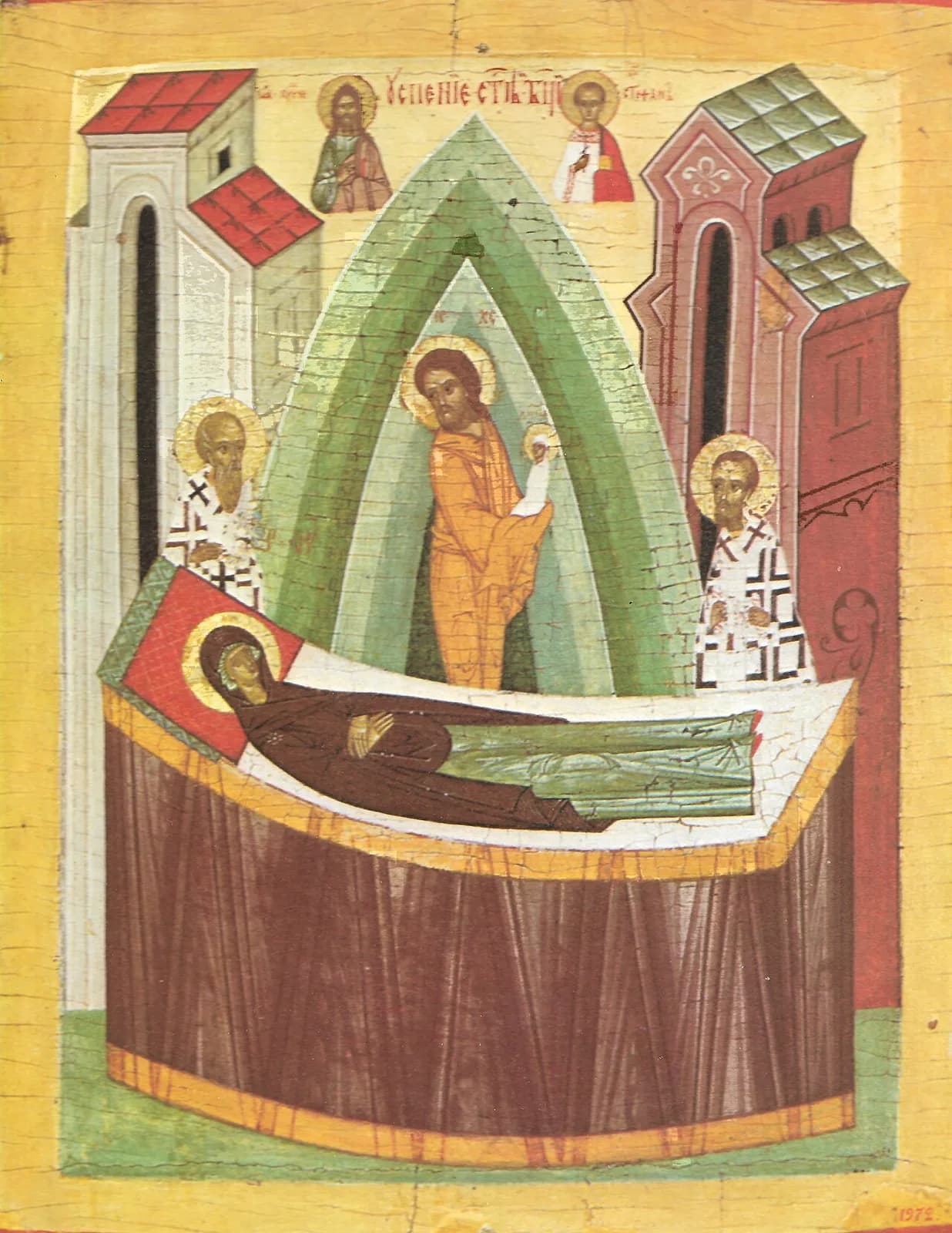
The Dormition tradition is primarily a liturgical and iconographic one. The Dormition icon showing Mary on a funeral bier, surrounded by the apostles, with Christ standing at the center holding her soul depicted as a small wrapped figure appears in
The theological difference between the Dormition and the Assumption concerns the mechanism rather than the outcome, since both affirm Mary's bodily glorification. Eastern theology insists on Mary's death as real and theologically necessary: she shared fully in human mortality because her son shared it, and her resurrection anticipates the general resurrection. To skip death would diminish the parallel with Christ. The 1950 Catholic definition of the Assumption deliberately left open whether Mary died, so the two traditions are not formally incompatible, but the Eastern tradition maintains death as integral, not optional. John of Damascus gave the Dormition its classic theological formulation in three homilies in the 8th century, establishing the patristic framework that Eastern Orthodoxy still uses.
The Dormition tradition poses the question of how doctrine develops without formal definition. Eastern Orthodoxy does not have an equivalent of the 1854 or 1950 papal definitions — the Dormition has never been defined as dogma in the Western sense. It is held as true, celebrated liturgically across fifteen centuries, encoded in icons, and embedded in hymnography — but it has not been subjected to the kind of doctrinal precision that Catholic theology applies. This matters because the Eastern approach to doctrinal development is itself a doctrinal position: the truth of the Dormition is shown by its continuous liturgical presence, not by a pope's definition. The epistemological gap between East and West on this question is as large as any formal doctrinal difference.
The deeper theological stakes concern the relationship between Mary's death and the general resurrection. Eastern theology holds that Mary's death was real — she shared fully in human mortality because Christ himself submitted to death. The Dormition icon does not shy away from this: Mary lies on a bier, visibly dead, while Christ stands at the center holding her soul. The icon is a theological argument in paint. The point it makes is eschatological: Mary's glorification is the first instance of what the resurrection promises to all the baptized. She is the first fruit of the redemption in the fullest sense — not just her soul in Heaven, but her body glorified ahead of the general resurrection.
This eschatological reading generates a pastoral and homiletic register in Orthodox Christianity that differs substantially from Western Mariology. In the East, the Dormition is preached primarily as a statement about human destiny, not about Mary's privileges. The one who bore the body of the Lord has her own body redeemed — and that redemption is the down payment on a universal promise. The Dormition is therefore not primarily about Mary. It is about what happens to bodies.
Continue reading with a Scholar plan
Upgrade to Scholar