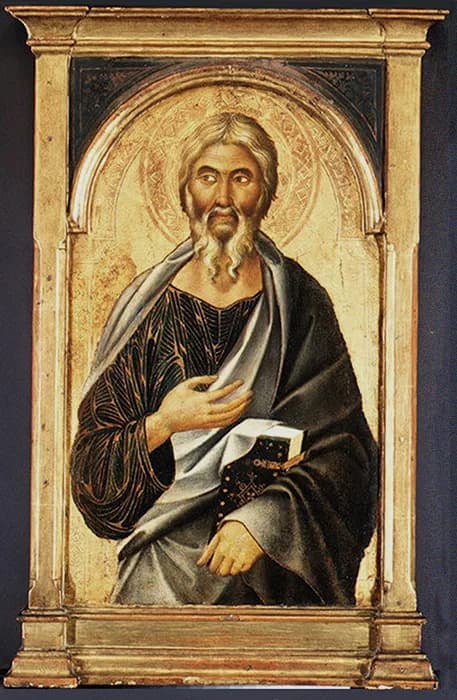
The Story of John the Apostle
John the Apostle, a Jewish fisherman from Bethsaida, lived during the turbulent first century AD, a period marked by Roman occupation and the nascent spread of Christianity. His father, Zebedee, and his brother James, were his companions in life and labor. On the shores of the Sea of Galilee, amidst political tension and religious expectation, John first encountered Jesus. According to Matthew 4:21-22, Jesus called John and James to leave their nets and follow him, a decision that would forever alter the course of John's life. This calling marked the rupture from a simple life of fishing to one of spiritual engagement and eventual prominence among Jesus' disciples.
John's close relationship with Jesus is both intimate and revealing. Known as the "beloved disciple," John 13:23 depicts him reclining next to Jesus during the Last Supper, a position of trust and affection. This close bond is also evident at the crucifixion, where Jesus entrusts the care of his mother, Mary, to John, as recorded in John 19:26-27. Mary's presence at this moment emphasizes John's integration into Jesus' family and inner circle, alongside figures like Peter, who shares key moments with him, including the discovery of the Empty Tomb. This deep connection with Jesus is central to understanding John's later writings, particularly the themes of love and identity.
John's life takes a dramatic turn with his exile to the island of Patmos, where he receives the apocalyptic visions described in the Book of Revelation. These visions, recounted in Revelation 1:9-11, reveal a starkly different tone from his earlier experiences of love and closeness with Jesus. Here, John becomes a visionary, tasked with conveying a message of judgment and the end times. The intensity and vivid imagery of Revelation contrast sharply with his role as the beloved disciple, illustrating a narrative irony: the apostle closest to Jesus is given the harshest vision of the future.
John's contributions extend beyond his personal experiences and revelations. He is traditionally credited with writing the Gospel of John, three epistles, and the Book of Revelation, leaving an indelible mark on Christian theology and literature. These texts, rich with themes of love, divinity, and eschatology, continue to influence Christian thought and doctrine. John's legacy is enshrined in the New Testament, where his writings convey both the intimacy of his relationship with Jesus and the broader, often terrifying, scope of his prophetic vision. The Greek word "ἀγάπη" (agapē), meaning "love," captures much of John the Apostle's essence, yet it fails to encompass the full complexity of his character. This term, central in 1 John 4:8, underscores John's theological focus on love as fundamental to the Christian life. However, John is not merely a figure of serene affection. He is also a man of action and intensity, as seen in Luke 9:54 when he and his brother James, the "sons of Zebedee," ask Jesus if they should call down fire from Heaven to destroy a Samaritan village. This episode reveals a zeal that coexists with his emphasis on love, painting a portrait of a man unafraid of righteous indignation. John was not only a beloved disciple, often seen reclining next to Jesus at the Last Supper (John 13:23), but also a visionary, who later documented the apocalyptic revelations he received on the island of Patmos (Revelation 1:1-2).