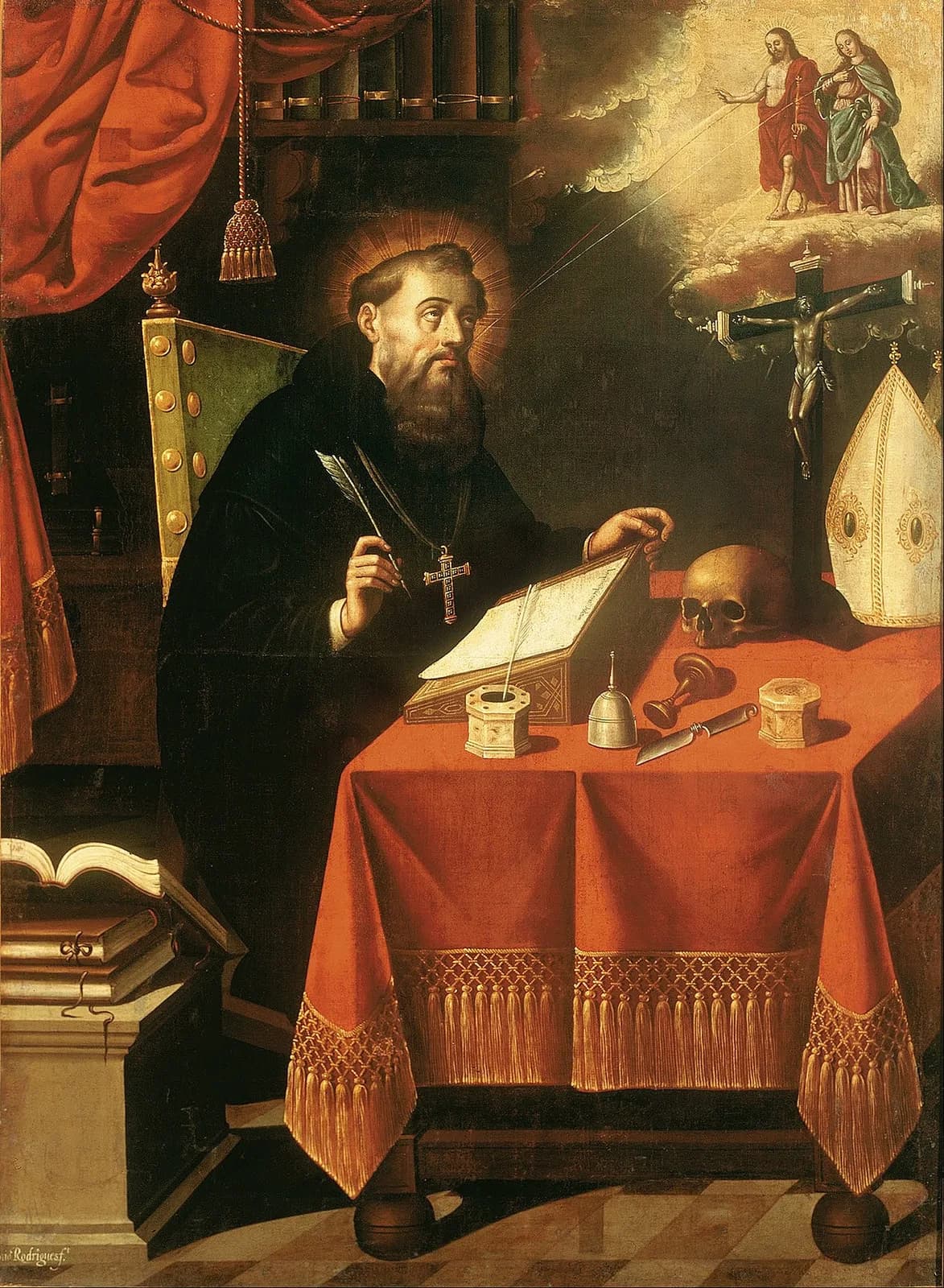
Augustine
theologianPost-Nicene Patristic (4th-5th C) · 354-430 CE · Updated April 9, 2026
Biography
Augustine was a North African bishop and theologian from the late Roman Empire, serving as the Bishop of Hippo from 395 to 430 CE. Known for his deep influence on Christian thought, Augustine's works continue to shape theology and philosophy. His tenure in Hippo, a bustling port city in present-day Algeria, placed him at the crossroads of theological and political change during a turbulent era.
Born in 354 CE in Thagaste, a Roman province in North Africa, Augustine grew up with a Christian mother and a pagan father. His early life was marked by intellectual curiosity and spiritual searching. After converting to Christianity in 386 CE, he was baptized by Ambrose of Milan in 387 CE. Augustine's rise to prominence began when he became the Bishop of Hippo in 395 CE. During his lifetime, he authored major works such as "Confessions," "City of God," and "On the Trinity," which remain central to Christian theology.
Augustine's era was rife with theological disputes and political transformation. The decline of Roman authority and the spread of Christianity fueled significant debates about doctrine. Augustine played a critical role in the Donatist controversy, arguing that the sacraments' power did not depend on the clergy's moral state. He also opposed Pelagianism, defending the necessity of divine grace for salvation against the belief in human self-sufficiency. His contributions during these controversies reflected the intense discussions that shaped the church’s role in a world where faith and politics were inseparable.
How does a perfectly good and sovereign God relate to a world full of sin — and what does that mean for human freedom, salvation, and the purpose of earthly life?
The ideas
Augustine of Hippo dedicated his life to unraveling the paradox of a perfect God overseeing a flawed world. His central question was how a benevolent, omnipotent deity could coexist with human sin and suffering. Augustine grappled with the nature of human freedom, the necessity of divine grace, and the purpose of mortal existence. He asserted that true goodness came from God, and human effort alone could not achieve salvation. This exploration of divine-human interaction led him to emphasize the critical role of God's intervention in human redemption, particularly against views that overestimated human autonomy.
Augustine's doctrine of Original Sin claimed that humanity inherited a corrupt nature from Adam's fall. This belief emerged as a counter to Pelagianism, which held that humans could achieve moral perfection through their own efforts. Augustine argued that without divine grace, humanity remained incapable of true righteousness. This laid the foundation for Western Christian teachings on salvation. Alongside this, Augustine's ideas on Grace and predestination declared that Salvation stemmed from God's grace, freely bestowed, rather than human merit. This notion, born from the Pelagian controversy, stressed divine sovereignty in determining human fate.
In addition to these doctrines, Augustine's vision of The Two Cities provided a framework for understanding human history as a struggle between those aligned with God's will and those driven by earthly desires. This perspective, articulated in his work "City of God" around 426 AD, responded to the sack of Rome, which had shaken Christian faith. Augustine also addressed the ethics of warfare with his Just War theory, asserting that war could be morally justified under certain conditions. This emerged from the tumultuous political landscape of the late Roman Empire. Furthermore, during the Donatist controversy, Augustine argued that the church's holiness was not contingent on the purity of its clergy, affirming the validity of sacraments despite the moral failings of those administering them.
Augustine's signature argument redefined freedom not as the ability to choose between good and evil, but as the ability to choose the good, made possible only through God's grace. This challenged the prevalent notion of human autonomy, insisting that genuine moral action required divine assistance. By asserting that true freedom lay in alignment with God's will, Augustine shifted the debate on human agency and divine intervention, influencing centuries of theological thought and shaping the Christian understanding of free will and grace.
What changed
Before Augustine, Christian thought was a swirling mix of early Church teachings and Greek philosophy. Believers wrestled with understanding sin, grace, and human freedom. There was no consensus on Original Sin. Many thought humans were born with a blank slate, free to choose good or evil. Salvation seemed within reach through human effort and free will. The Church was mainly seen as a gathering of believers, without a strong institutional framework. Christians leaned towards pacifism, lacking a coherent rationale for war.
Augustine changed everything. He articulated the doctrine of original sin, arguing that all humans inherit a sinful nature from Adam. This meant salvation could not come through human effort alone; divine grace was essential. Augustine also tackled the nature of Grace and predestination. He asserted that God predestines some for Salvation, diminishing the role of free will in achieving Salvation. He reshaped the Church's self-understanding, emphasizing its unity and authority as stemming from Christ, even as it contained both saints and sinners. Augustine also developed the concept of just war, providing a moral framework for when war could be justified.
Augustine's influence rippled through history. His ideas on Original Sin and Grace laid the groundwork for the Protestant Reformation, impacting figures like Martin Luther and John Calvin. The Council of Orange in 529 CE reinforced his views on Grace and predestination within the Church. His understanding of the Church as an authoritative institution became a cornerstone of Catholic doctrine. His just war theory shaped ethical discussions on war, influencing both religious and secular thought. Augustine's legacy endures, evident in the Church's ongoing debates over Free Will and grace.
Disputed legacy
Augustine's doctrine of original sin casts humanity in a grim light, asserting that all humans inherit guilt from Adam's transgression. This view strips away human agency, suggesting an inherent moral incapacity without divine intervention. Pelagius and his followers fiercely opposed this notion, advocating for the human ability to choose good independently. Augustine's stance on predestination, which claims God has already decided who will achieve salvation, raises issues of fairness and justice. Critics argue that it fosters a fatalistic worldview, dampening moral motivation. His development of just war theory has justified countless conflicts, often bending moral criteria to suit political needs. Finally, Augustine's views on church authority fortified hierarchical structures, paving the way for institutional corruption and stifling individual spiritual autonomy, much to the dismay of reformers like Martin Luther and John Calvin.
Augustine's most indefensible position involved his actions against the Donatists, a Christian sect he deemed heretical. He advocated for the use of state power to suppress them, setting a dangerous precedent for religious coercion. This approach contradicted the principles of religious tolerance and freedom of conscience, leading to a legacy of persecution. Augustine argued that such measures were necessary to maintain church unity and orthodoxy, but this opened the door for future abuses of power by religious authorities. The consequences were profound, embedding the notion that dissent could be quashed through force, a practice difficult to reconcile with the core tenets of Christianity.
Some scholars attempt to rehabilitate Augustine by placing him within his historical context, arguing that his challenging environment shaped his ideas. They claim that his contributions to theology and philosophy outweigh these problematic aspects. Others propose that his ideas can be reinterpreted positively when viewed through the lens of his time. Yet, these criticisms persist. The consequences of his doctrines on original sin and predestination have left enduring marks on Christian thought, and his stance against the Donatists remains a stark reminder of the dangers of intertwining religion with state power. Augustine's legacy is a complex tapestry, but the criticisms of his more controversial ideas remain potent and difficult to dismiss.
Legacy
Augustine died in 430 CE as a revered figure in the Church, not as a condemned heretic. His work against heresies like Donatism and Pelagianism solidified his status as a theological heavyweight. Augustine’s writings, especially "Confessions" and "The City of God," became foundational texts for the Western Church. His thoughts on grace and human nature influenced the Church’s doctrine long after his death. He was celebrated for his intellectual rigor and his ability to articulate complex theological ideas in a way that resonated with both clergy and laypeople.
Augustine's teachings did not fade with his passing. Medieval theologians, particularly Thomas Aquinas and the Scholastics, drew heavily from his work. Aquinas integrated Augustine's ideas, especially concerning faith and reason, into the broader Christian doctrine. During the Reformation, Augustine's influence surged anew as both Protestant reformers like Martin Luther and Catholic defenders revisited his writings on grace, free will, and predestination. His ideas traversed regions and movements, shaping theological debates across Europe.
Today, Augustine's legacy endures in the doctrines of many Christian denominations. Roman Catholicism still reflects his teachings on original sin and Grace. Various Protestant traditions, particularly those in the Reformed tradition, grapple with his ideas on predestination. His concept of the 'two cities' remains relevant in discussions about the relationship between church and state. Augustine's impact is undeniable, with his thoughts continuing to provoke discussion and reflection. Even now, his works are studied in seminaries and universities worldwide, a testament to their enduring relevance.
Continue reading with a Scholar plan
Upgrade to ScholarCommon questions
- What is Augustine most known for in Christian history?
- Augustine is most known for shaping Western Christian theology, particularly through his doctrines of original sin and grace. His ideas on predestination and the nature of the church have had a lasting impact on both Catholic and Protestant traditions.
- What were Augustine's most important works?
- Augustine's most important works include 'Confessions,' an autobiographical account of his spiritual journey, and 'City of God,' which addresses the relationship between Christianity and secular society. 'On the Trinity' explores the nature of God, while his anti-Pelagian writings defend the doctrine of original sin and grace.
- What were Augustine's most influential theological ideas?
- Augustine's influential ideas include the concept of original sin, which asserts that humanity is inherently sinful due to Adam's fall. He also developed the doctrines of grace and predestination, emphasizing God's role in salvation, and articulated the idea of the 'two cities,' representing the earthly and heavenly realms.
- What controversies did Augustine engage in — and what was at stake?
- Augustine engaged in the Pelagian controversy, arguing against Pelagius's view that humans could achieve salvation through their own efforts. The debate centered on the necessity of divine grace for salvation. He also opposed the Donatists, who believed that the validity of sacraments depended on the moral purity of the clergy.
- How did Augustine influence later Christianity — Catholic, Protestant, and beyond?
- Augustine's ideas on grace and predestination influenced the Protestant Reformation, particularly Martin Luther and John Calvin. His thoughts on the nature of the church and sacraments shaped Catholic doctrine, while his writings on just war theory have impacted Christian ethics across denominations.
- What did Augustine get wrong, or what ideas have been seriously disputed?
- Augustine's views on predestination and original sin have been disputed, particularly by those who emphasize human free will. His stance on sexuality and the role of women has also faced criticism for being overly restrictive and patriarchal.
- Is Augustine considered a saint? By which traditions?
- Yes, Augustine is considered a saint in both the Roman Catholic Church and the Eastern Orthodox Church. He is also recognized as a Doctor of the Church in Catholicism.
- Why does Augustine still matter today?
- Augustine matters today because his theological insights continue to influence Christian thought and practice. His exploration of the human condition, the nature of God, and the relationship between faith and reason remain relevant to contemporary discussions in theology and philosophy.
- What is the most surprising or counterintuitive thing about Augustine?
- One surprising aspect of Augustine is his early life as a hedonist and skeptic before converting to Christianity. His transformation from a life of indulgence to one of deep spiritual commitment is both dramatic and influential in his writings.
- What is the best place to start reading Augustine?
- The best place to start reading Augustine is his 'Confessions,' which provides a personal and accessible introduction to his life and thought. It combines autobiography with philosophical and theological reflections, making it a foundational text for understanding his influence.