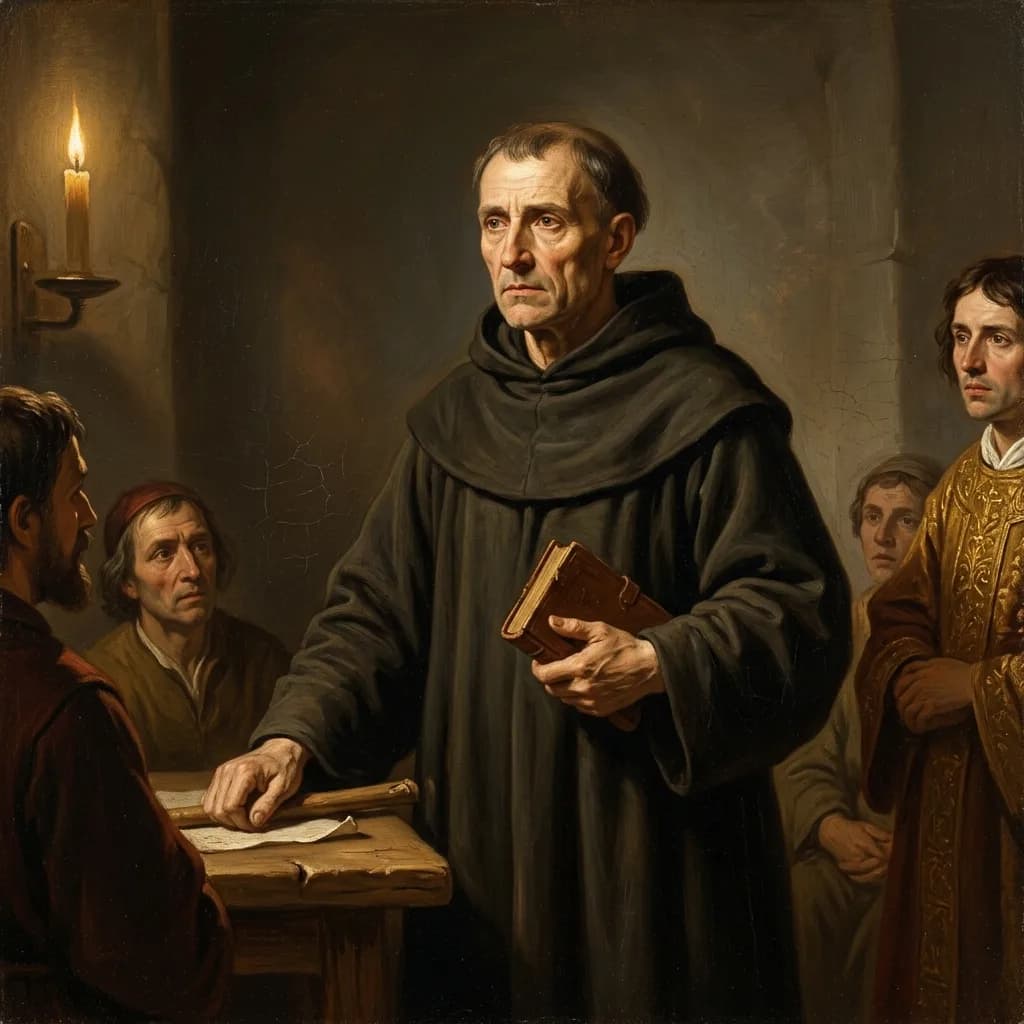
Guilhabert de Castres
hereticMedieval (9th-15th C) · c. 1165-1240 CE · Updated April 9, 2026
Biography
Guilhabert de Castres was a leading Cathar perfectus and bishop in Toulouse during the Medieval era, known for his role in the Cathar movement in Languedoc. As a prominent figure in this religious sect, he challenged the Catholic Church's authority and teachings in the region. The Cathars, considered heretical by the Church, promoted a dualistic belief system that contrasted sharply with orthodox Catholic doctrines.
In 1167, Guilhabert presided over the great Cathar council at Saint-Félix, a significant event that helped organize and solidify the movement's structure. His leadership did not go unnoticed; the Third Lateran Council in 1179 condemned Catharism, marking the sect as a target for persecution. By 1209, the Albigensian Crusade aimed to eradicate the Cathar heresy, with Guilhabert among its primary targets. Despite the Church's efforts, he continued to advocate for Cathar beliefs, which rejected the incarnation, the cross, the Old Testament, marriage, and Catholic sacraments.
Guilhabert lived during a time of intense religious conflict in medieval Europe. The rise of Catharism in Languedoc posed a substantial challenge to Catholic dominance. The Cathars' radical dualism, which posited two gods — one good and one evil — was a direct affront to Catholic monotheism. This theological divide, coupled with the Church's desire for religious and political control, fueled the violent response of the Albigensian Crusade. Guilhabert's life and mission illustrate the deep tensions of his time, a period when differing beliefs could lead to brutal suppression.
Is the material world created by God or by an evil principle — and if the body is the prison of the soul, what is the purpose of incarnation, sacrament, and earthly life?
The question
Guilhabert de Castres stood firm in his beliefs, shaped by the Cathar leaders who came before him. He saw a world divided between two forces: one of good, one of evil. For Guilhabert, the material world teemed with corruption, a creation of a malevolent power. The writings he studied and the teachings he embraced left no room for ambiguity. The physical realm, with all its pleasures and pains, was a snare for the soul. Guilhabert’s commitment to this belief wasn’t mere rebellion; it was a sincere pursuit of spiritual truth as he understood it. This dualistic view resonated deeply with him, making his stance against the Catholic Church’s teachings inevitable.
Embracing the idea that the material world was the work of an evil force led Guilhabert to reject it entirely. He saw physical existence as a barrier to salvation, demanding a life stripped of earthly ties and pleasures. This worldview cost believers their connection to conventional religious practices, including the sacraments that the Church held sacred. Marriage, wealth, and even basic comforts became symbols of spiritual bondage. Guilhabert urged his followers towards a rigorous asceticism, where the ultimate goal was spiritual purity, achieved through the consolamentum. This was the sole path to liberation, and it required nothing less than a complete renunciation of the world.
On the other side, if the material world was indeed God's creation, then it was good and worthy of participation. This perspective validated the Church's teachings, sacraments, and the sanctity of marriage. It demanded that believers embrace the physical and spiritual as intertwined parts of God’s plan. The cost here was the loss of the radical purity that Catharism cherished. Accepting the world as inherently good meant engaging fully with life's earthly aspects, seeing them as expressions of divine will. This integration offered comfort and community but at the expense of the Cathar ideal of spiritual detachment and purity.
For Guilhabert, the struggle was not merely theological; it was a lived reality that posed a profound dilemma. Accepting the material world as good would dismantle the very foundation of Catharism. Conversely, holding onto Cathar dualism meant rejecting any notion of the world’s inherent goodness. The stakes were high for ordinary believers, caught between the promise of salvation through spiritual purity and the embrace of a faith that sanctified their everyday lives. The choice affected how they lived, worshipped, and viewed their place in the world. It was a battle over the soul’s true path, one that shaped the course of their spiritual journey.
The teaching
Guilhabert de Castres taught that the material world was the creation of an evil principle, not a benevolent God. He saw the soul trapped within the body, viewing earthly existence as a diversion from true spiritual salvation. Rejecting the Catholic Church's teachings on the incarnation and sacraments, he argued that these were distractions orchestrated by the evil creator to keep souls imprisoned. Instead, he advocated for the consolamentum, a spiritual baptism that he believed could free the soul from its material chains.
Guilhabert's reasoning stemmed from the undeniable presence of evil and suffering in the world. He could not reconcile these with the idea of a loving creator. By interpreting scripture, such as John 18:36, he argued that Jesus himself pointed to a kingdom not of this world, implying the material world was not God's domain. In his speech at the Council of Saint-Félix in 1167, he declared the universe's dualistic nature, emphasizing that true salvation required turning away from the material world and its false promises.
This teaching resonated with many in the Languedoc region, especially those disenchanted with the Catholic Church's corruption and materialism. People who faced injustice and oppression found solace in a faith that promised liberation from worldly suffering. Guilhabert's ideas spread through these communities, offering a spiritual refuge and a challenge to the existing religious order. By the early 13th century, his teachings had gained substantial traction, contributing to the rise of the Cathar movement in southern France.
The counterargument
The decisive argument against Guilhabert de Castres centered on the belief that a single, benevolent God created everything, including the material world. St. Bernard of Clairvaux, a pivotal figure in this debate, argued that dividing good and evil into separate entities, as de Castres did, weakened the omnipotence and sovereignty of the one true God. In his "Sermons on the Song of Songs," Bernard emphasized that evil is not a creation of its own but a corruption of the good. He insisted that the sacraments are divine means by which God extends grace, restoring the soul to Him and sanctifying the material world. Bernard's reasoning affirmed that the material world, created by God, is inherently good, and that earthly life serves as preparation for eternal union with God.
Guilhabert de Castres relied on specific biblical texts to support his view that the material world is evil. For instance, he interpreted John 1:3 as suggesting that the material world was not created by the Word because it is inherently evil. Orthodox theologians countered this by asserting that John 1:3 states all things were made through Christ, affirming the goodness of creation. Similarly, de Castres misread 1 John 2:15-17 and Matthew 6:19-21, which warn against the sinful misuse of the world rather than condemning Creation itself. These misinterpretations revealed a critical flaw in de Castres's argument. By asserting the inherent evil of the material world, he inadvertently suggested that God lacked the power or will to create a wholly good world, contradicting the notion of an omnipotent and benevolent deity.
The orthodox counter-argument against de Castres opened a new challenge: explaining how a good and omnipotent God allows evil and suffering to exist. This required a deeper exploration of the problem of evil and theodicy, delving into why a benevolent God permits such realities in His Creation. This left theologians grappling with the enduring question of reconciling God's goodness with the presence of evil. Despite this unresolved issue, the orthodox view maintained that the sacraments and the incarnation remain vital means by which God redeems and sanctifies the world, affirming the purpose and goodness of Creation.
The resolution
In 1179, Pope Alexander III convened the Third Lateran Council in Rome, gathering Catholic bishops and representatives to address a pressing theological and political issue. The council aimed to resolve the controversy surrounding Catharism, a growing religious movement that challenged the Church's teachings. The Cathars, primarily active in the Languedoc region, espoused a dualistic belief that the material world was the creation of an evil god. This belief starkly opposed the Church's doctrine of a single benevolent Creator. Beyond theological concerns, political stakes loomed large. The French crown, eyeing control over the rebellious Languedoc region, backed the Church’s condemnation of Catharism. This alliance laid the groundwork for the Albigensian Crusade, a military campaign to crush the Cathar heresy and tighten the crown’s grip on the territory.
The debate at the council centered on the nature of God and creation. The Church defended monotheism, declaring that all things were created by a single good God. In contrast, the Cathars viewed the material world as inherently evil, a Creation of a malevolent entity. The terminology of 'dualism' versus 'monotheism' was critical, as it defined the fundamental nature of existence and divine authority. The council unequivocally condemned Catharism as heretical, branding leaders like Guilhabert de Castres as heretics and rejecting their teachings. This condemnation reinforced the Church’s stance on the goodness of Creation and the singularity of God, drawing a clear doctrinal line against the Cathar belief system.
Despite the council's decisive condemnation, the resolution did not eradicate Catharism. In the Languedoc, Cathar beliefs persisted, supported by local nobles and communities resistant to external control. The Albigensian Crusade, launched in 1209, achieved initial military victories but failed to extinguish the movement entirely. Catharism endured, challenging Church authority and requiring ongoing suppression efforts. The movement's influence waned only by the late 13th century, as persistent campaigns against heresy gradually diminished its presence. The struggle to fully suppress Cathar dualism exemplifies how deeply ingrained beliefs can resist even the most concerted efforts to eliminate them.
Legacy
After the Third Lateran Council condemned Catharism in 1179, Guilhabert de Castres emerged as a resilient leader for the Cathar community in Languedoc. Despite the Church's denunciation, he continued to preach and guide his followers, becoming a prominent figure in the region. His leadership made him a prime target during the Albigensian Crusade, a brutal campaign launched to wipe out the Cathars. In 1240, during the siege of Montségur, a critical stronghold for the Cathars, Guilhabert likely met his end. His dedication to his beliefs even in the face of persecution left a lasting impression on those who survived him.
Cathar teachings managed to linger in Languedoc until the mid-13th century, surviving through covert gatherings and the dedication of its adherents. Despite the Church's efforts to eradicate them, elements of Catharism seeped into other emerging movements. The Waldensians, who also faced persecution, shared a similar disdain for the Church's opulence and a simpler approach to Christianity, though they did not embrace Cathar dualism. As centuries passed, the echoes of Cathar thought subtly influenced the Protestant Reformation, which challenged the authority and practices of the Catholic Church, albeit without adopting the dualist perspective.
Today, Cathar dualism finds echoes in modern spiritual and esoteric beliefs. New Age philosophies often emphasize a division between the spiritual and the material, resonating with the Cathar view of the material world as a corruption. This concept also appears in certain Gnostic traditions, which see the physical realm as a prison for the soul. The persistence of these ideas demonstrates how the essence of Cathar beliefs has transcended time and continues to inspire those seeking a spiritual path distinct from established religious doctrines.
Continue reading with a Scholar plan
Upgrade to ScholarCommon questions
- Why was Catharism considered dangerous?
- Catharism was considered dangerous because it fundamentally challenged the authority and teachings of the Catholic Church. It rejected key doctrines such as the incarnation of Christ, the sacraments, and the authority of the clergy. The dualistic belief in two gods undermined the Church's monotheistic teachings, and its spread threatened the Church's influence in regions like Languedoc.
- What exactly did Guilhabert de Castres teach?
- Guilhabert de Castres taught that the material world was created by an evil god, contrasting with a good god who was responsible for the spiritual realm. He rejected the Catholic sacraments, the incarnation of Christ, and the Old Testament, advocating instead for the consolamentum, a spiritual baptism for salvation. His teachings emphasized a life of asceticism and spiritual purity.
- Why did Catharism spread so widely?
- Catharism spread widely due to its appeal to those disillusioned with the corruption and wealth of the Catholic clergy. Its emphasis on spiritual purity and asceticism resonated with many seeking a more authentic religious experience. Additionally, the political and social climate in regions like Languedoc allowed for the movement to gain traction and support.
- Who opposed Guilhabert de Castres, and what was their argument?
- Guilhabert de Castres was opposed by the Catholic Church, particularly figures like Pope Innocent III and the bishops of the region. Their argument was that Catharism was heretical, undermining the core doctrines of Christianity such as the incarnation, the sacraments, and the authority of the Church. They viewed Catharism as a threat to both religious orthodoxy and social order.
- Was Guilhabert de Castres excommunicated, exiled, or executed?
- Guilhabert de Castres was not executed, but he was a target of the Albigensian Crusade, which sought to eliminate Catharism. There is no specific record of his excommunication, but as a leading Cathar figure, he would have been considered outside the Church's communion. He likely died in hiding or exile during the crusade.
- Which council condemned Catharism, and what did it decide?
- The Third Lateran Council in 1179 condemned Catharism, declaring it a heresy. The council decided to excommunicate those who adhered to Cathar beliefs and called for secular authorities to take action against them. This condemnation laid the groundwork for subsequent actions like the Albigensian Crusade.
- Did Guilhabert de Castres ever recant?
- There is no evidence that Guilhabert de Castres ever recanted his beliefs. He remained a committed leader of the Cathar movement until his death. His steadfastness in his beliefs contributed to his status as a prominent figure in Cathar history.
- What is the difference between Catharism and orthodox Christianity?
- Catharism differs from orthodox Christianity in its dualistic belief in two gods, one good and one evil, responsible for the spiritual and material worlds, respectively. It rejects the incarnation of Christ, the sacraments, and the authority of the Catholic Church. In contrast, orthodox Christianity upholds the Trinity, the sacraments, and the Church's authority as central tenets.
- Are there modern versions of Catharism?
- There are no direct modern versions of Catharism, as the movement was largely eradicated by the Albigensian Crusade and the Inquisition. However, some contemporary spiritual movements draw inspiration from Cathar beliefs, emphasizing dualism and spiritual purity. These are not direct continuations but rather reinterpretations of Cathar ideas.
- Is there anything Guilhabert de Castres got right?
- Guilhabert de Castres' emphasis on spiritual purity and critique of clerical corruption resonated with many who were disillusioned with the Catholic Church. His call for a more authentic and ascetic spiritual life highlighted genuine concerns about the Church's wealth and power. These aspects of his teachings continue to find relevance in discussions about religious authenticity.
- Why does Catharism still matter today?
- Catharism matters today as a historical example of religious dissent and the challenges faced by movements opposing established religious authorities. It highlights issues of religious freedom, the use of force in suppressing heresy, and the complexities of medieval religious and political dynamics. Its legacy continues to inspire discussions on spiritual authenticity and resistance to institutional corruption.
- Why did Guilhabert de Castres sincerely believe his position was correct? What was he actually defending — and why did he see the alternatives as worse?
- Guilhabert de Castres sincerely believed his position was correct because he saw the material world as inherently corrupt and the Catholic Church as complicit in its evils. He was defending a vision of spiritual purity and salvation through the consolamentum, which he believed offered a true path to spiritual liberation. He viewed the alternatives, such as the Catholic sacraments and doctrines, as perpetuating a false and corrupt system that enslaved souls to the material world.