Library
Library
Early Church (2nd-3rd C) · c. 100-165 CE · Updated April 8, 2026
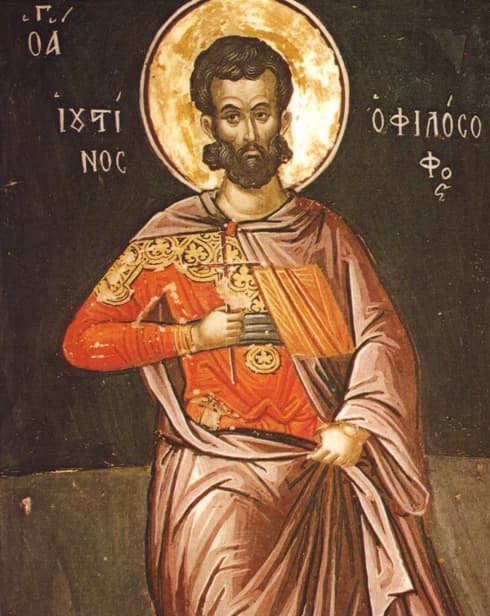
Justin Martyr was a 2nd-century Christian apologist and philosopher who engaged Greco-Roman philosophy and was martyred in Rome under Marcus Aurelius. He is known for his efforts to defend and explain Christianity to a skeptical Roman audience. His work laid the foundation for later Christian thought by bridging the gap between Christian teachings and classical philosophy.
Born around 100 CE in Flavia Neapolis, a Roman city in Samaria, Justin initially pursued a career as a philosopher, exploring various schools of thought. His journey led him to Christianity, impressed by the courage and steadfastness of Christian martyrs. This conversion sparked his mission to articulate Christianity through the lens of philosophy, leading him to write significant works like "First Apology," "Second Apology," and "Dialogue with Trypho." These writings aimed to defend Christianity using philosophical arguments familiar to the Roman intellectual elite. Justin's life came to an end around 165 CE when he was executed in Rome, a testament to his commitment to his faith.
Justin lived during a time when Christianity was still a nascent and often misunderstood movement within the vast Roman Empire. Theological debates were rampant as Christians sought to define their beliefs in contrast to both Jewish traditions and the prevailing Greco-Roman philosophical thought. Justin's engagement with philosophy was controversial because some Christians feared it might compromise their teachings. However, his introduction of the idea that divine truth existed in all human philosophy provided a means for intellectuals to approach Christianity with an open mind. This pioneering approach helped Christianity gain a foothold among the educated classes, setting the stage for its eventual growth across the empire.
Is Greek philosophy a gift preparing humanity for the gospel — and can a Christian say that Socrates was 'with Christ' before Christ came?
Justin Martyr was driven by the challenge of making Christianity comprehensible and respectable to a Greco-Roman audience steeped in philosophical traditions. He sought to demonstrate that Christianity was not just another religious sect but the ultimate truth that fulfilled the highest aspirations of human thought. His life's work revolved around bridging the perceived chasm between Christian revelation and the philosophical wisdom admired in his cultural context. By engaging with the philosophical ideas of his time, he aimed to show that Christian teachings were not only compatible with but also the culmination of philosophical inquiry.
Among Justin's most important ideas was the concept of the "Logos Spermatikos," or the "scattered seeds of the divine Reason." He argued that divine truth was not confined to Christian teachings but had been partially revealed throughout human history in various philosophical traditions. This claim countered accusations that Christianity was a novel and suspicious belief system by suggesting that Greek philosophers like Socrates had already grasped parts of the truth. Another key idea was that of "Christians before Christ," proposing that figures like Socrates and Abraham lived according to the divine Reason, or Logos, and thus were, in essence, Christians before the advent of Christ. This reinforced the notion that Christianity transcends time and culture, offering a universal framework for understanding salvation.
Justin's contributions also include his interpretation of the Incarnation, where he asserted that the divine Logos became fully incarnate in Jesus Christ. This stressed the unique divinity of Jesus, offering a stark contrast to other philosophical systems that often viewed the divine as distant and abstract. In his works, particularly the "First Apology" and the "Dialogue with Trypho," he argued that Christian Scripture fulfills the truths found in Greek philosophy, positioning Christianity as a comprehensive worldview. His subordinationist view of the Logos, where he saw the Son as a second divine being subordinate to the Father, was grounded in existing philosophical ideas about hierarchy, though it later sparked theological debates about the nature of the Trinity.
Justin Martyr's signature argument centers on the presence of the Logos, or divine Reason, throughout human history. He posited that this Logos had planted seeds of truth in all philosophical traditions, and these seeds found their fullest expression in Jesus Christ. This reasoning was compelling because it allowed Justin to present Christianity as both a continuation and a culmination of philosophical inquiry. By doing so, he changed the perception of Christianity among intellectual circles, positioning it as the ultimate truth accessible to all, thereby broadening its appeal and establishing a foundation for future theological and philosophical discourse.
Before Justin Martyr, early Christian thought was largely insular, focused on the teachings of Jesus and the apostles. Christians were often viewed as a Jewish sect, and their beliefs weren't systematically aligned with the Greco-Roman philosophies that dominated intellectual life at the time. The early church had not yet developed a formalized doctrine of the Trinity, and the relationship between God the Father and Jesus, the Son, was vague. Christian doctrine was primarily about faith and practice, not intellectual synthesis or philosophical debate.
Justin Martyr changed this landscape by actively integrating Greek philosophy with Christian theology. He argued that Greek philosophy contained seeds of truth that Christianity fulfilled, thus breaking down the barrier between these two worlds. Justin expanded the concept of the Logos, a term used in the Gospel of John, to suggest that the Logos was present in all human reason and philosophy, not just in divine revelation. He also reinterpreted pre-Christian figures like Socrates and Abraham as "Christians before Christ," due to their pursuit of truth and virtue. This reimagining opened up new ways of understanding salvation history and made room for a broader view of wisdom, both Christian and non-Christian.
The impacts of Justin Martyr's work were profound and far-reaching. His synthesis of Greek philosophy and Christian theology laid the groundwork for later developments in Christian apologetics and influenced the Alexandrian School, home to theologians like Clement of Alexandria and Origen. His ideas on the Logos were pivotal in early church debates about the nature of Christ and the Trinity, which eventually shaped Nicene orthodoxy. Without Justin Martyr, the intellectual framework that allowed for the development of these debates and doctrines might not have existed. His legacy is firmly embedded in the history of Christian thought, a testament to his pioneering role in bridging the gap between faith and reason.
Justin Martyr, an early Christian apologist, made several claims that have faced strong criticism over the centuries. One of the most contested ideas is his approach to the relationship between Christianity and Greek philosophy. Justin argued that Greek philosophers like Socrates and Plato were unwittingly Christian because they partially grasped the truth that was fully revealed in Jesus Christ. This claim, while intended to bridge gaps between pagan and Christian thought, ended up muddying the distinctiveness of Christian doctrine. By suggesting that pagan philosophy could lead to the same truths as Christian revelation, he blurred the lines between faith and philosophy, causing confusion about the unique tenets of Christianity.
The darkest chapter of Justin Martyr’s legacy involves his writings that inadvertently fueled anti-Semitic attitudes. In his "Dialogue with Trypho," Justin argued that Christians had replaced Jews as God's chosen people. He claimed that the Jewish law was obsolete and that the Jews' role in the crucifixion of Jesus was a justification for their suffering and displacement. This argument laid a foundation for centuries of Christian anti-Judaism, which later morphed into more virulent forms of anti-Semitism. The consequences were severe, as these ideas contributed to a long history of Jewish persecution in Christian-majority societies.
Some scholars have attempted to defend Justin by arguing that he was a product of his time, reflecting common attitudes rather than creating them. However, this defense does not change the impact of his writings. The criticisms of his work, particularly regarding his views on Jews and their role in Christian theology, remain valid. Despite these defenses, the verdict on Justin Martyr's errors stands firm. His contributions, while significant in some areas, are marred by ideas that have had damaging effects on interfaith relations and the understanding of Christian doctrine. His work is a reminder of the lasting power words can have, both for building bridges and for causing harm.
After his condemnation, Justin Martyr was executed in Rome around 165 CE, a victim of the persecutions under Emperor Marcus Aurelius. He was beheaded, a fate that sealed his status as a martyr for his Christian faith. His bold defense of Christianity through his writings and debates had made him a notable figure, but it also attracted the ire of Roman authorities. Justin's refusal to renounce his beliefs, even under threat of death, underscored the seriousness of his convictions and the risks early Christians faced for their faith.
Justin's teachings did not perish with him; they resonated through the centuries. His efforts to harmonize Greek philosophy with Christian doctrine found a receptive audience among early Christian thinkers such as Clement of Alexandria and Origen, who were instrumental in shaping Christian theology in the Eastern Roman Empire. His writings, particularly his concept of the Logos, influenced the development of Christian apologetics, providing a framework that helped articulate the faith in terms that were intellectually accessible to a Greco-Roman audience. This blending of faith and reason laid the groundwork for later theological developments and became a cornerstone of the Eastern Orthodox tradition.
Today, Justin's legacy endures in the ongoing dialogue between faith and reason within Christianity. His idea of the Logos as a connecting principle between divine revelation and human understanding remains relevant. The Roman Catholic Church, for instance, continues to engage with contemporary philosophical thought, echoing Justin's approach. Protestant theologians also draw on his integration of reason and faith, reflecting his influence across different Christian denominations. A testament to his enduring impact is the fact that Justin is still celebrated as a saint in both the Eastern Orthodox and Roman Catholic Churches, highlighting his lasting significance in the Christian tradition.
Continue reading with a Scholar plan
Upgrade to Scholar