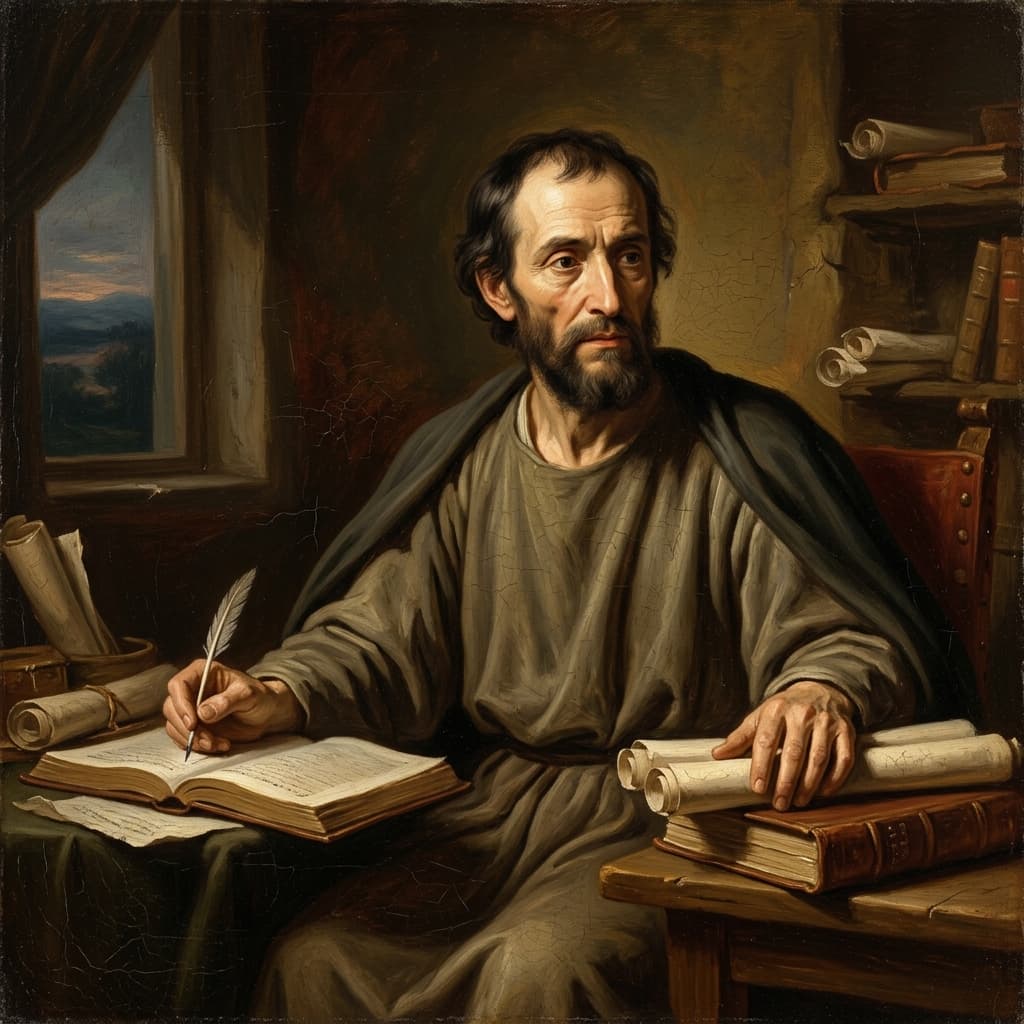
Origen
theologianEarly Church (2nd-3rd C) · c. 185-254 CE · Updated April 8, 2026
Biography
Origen was a Christian theologian and head of the Catechetical School of Alexandria in the early 3rd century CE, known for his extensive theological writings and posthumous condemnation. His intellectual prowess and innovative ideas made him one of the most influential figures in early Christian thought. Living in Alexandria, a center of learning and cultural exchange, Origen developed theological concepts that would resonate throughout Christian history, even as they sparked intense debates.
Born around 185 CE, Origen grew up in a Christian family in Alexandria. His father, Leonides, was martyred during a wave of persecution, a pivotal event that shaped Origen's devotion to his faith. He succeeded Clement of Alexandria as the head of the Catechetical School, where he taught and wrote prolifically. His major works include "On First Principles," which lays out a systematic theology, "Against Celsus," a defense of Christianity against pagan criticism, and the "Hexapla," a massive compilation of the Hebrew Scriptures in multiple translations. Origen's method of allegorical interpretation sought deeper meanings in Scripture, exploring literal, moral, and spiritual dimensions. He also proposed the idea of the pre-existence of souls, a concept that later stirred controversy.
Origen lived during a time when Christianity was still defining its doctrines amidst various interpretations and philosophical influences. His views, like the subordination of the Son to the Father and the eventual restoration of all souls (apokatastasis), challenged emerging orthodox positions. These ideas, along with others, were condemned at the Fifth Ecumenical Council in 553 CE, reflecting the church's ongoing struggle to establish doctrinal boundaries. The vibrant intellectual climate of Alexandria, combined with the theological fluidity of the period, allowed Origen's ideas to flourish, yet also set the stage for his later condemnation.
If God's love is infinite and God's power is absolute, can he allow any rational creature to be permanently lost — and does the doctrine of eternal hell limit either God's love or his power?
The ideas
Origen, an early Christian theologian, dedicated his life to bridging the gap between Christian doctrine and Greek philosophy. He sought to answer a profound question: How can all rational beings be reconciled with God? This question drove his theological pursuits, as he endeavored to explain the nature of God, the universe, and the path to salvation. Origen believed that divine love and wisdom were transformative forces capable of restoring harmony between God and creation. His work became a foundation for later debates about salvation, scriptural interpretation, and the divine-human relationship.
Among Origen's most notable ideas was his method of interpreting Scripture allegorically. He proposed that biblical texts have three layers of meaning: literal, moral, and spiritual, with the spiritual being the most insightful. This approach allowed him to align Scripture with philosophical truths and resolve apparent contradictions in the text. Influenced by Philo of Alexandria, Origen sought to harmonize Christian teachings with Greek philosophical thought. Another significant idea was the pre-existence of souls, inspired by Platonic philosophy. Origen argued that souls existed before their earthly bodies, emphasizing a divine plan for their journey toward God. This idea provided a framework for understanding the diversity of human experiences and the soul's ultimate return to God.
Beyond these, Origen made substantial contributions to early Christian theology through his writings, such as "On First Principles" and "Against Celsus." He explored the eternal generation of the Son, proposing that the Son is eternally begotten by the Father, reflecting a dynamic relationship within the Trinity. This concept was instrumental in shaping early Trinitarian thought. Origen also saw the Logos, or Word, as a mediator between God and creation, a view that helped explain the incarnation and redemption in a way that resonated with both Christian and Hellenistic audiences.
Origen's signature argument was the doctrine of universal restoration, or apokatastasis. He believed that God's infinite love and omnipotence meant that all rational creatures would eventually be purified and restored to God. This challenged the traditional view of eternal damnation, presenting an optimistic vision of Salvation where evil would ultimately be overcome by divine love. Origen's reasoning was compelling because it portrayed a God whose justice and mercy are inseparable, offering hope for complete reconciliation. His views sparked controversy and were later condemned, but they forced theologians to grapple with the nature of Salvation and the scope of God's grace.
What changed
Before Origen's contributions, Christian thought was a mosaic of Jewish traditions and Greek philosophy, still finding its shape. Many theological questions, such as the nature of Christ, the interpretation of Scripture, and the fate of souls, lacked consensus. The early Christian community leaned heavily on literal interpretations of biblical texts, focusing on the direct meanings and historical contexts. This approach left little room for exploring deeper, more abstract meanings. Debates about the ultimate destiny of souls generally revolved around a stark dichotomy: eternal salvation for the righteous and eternal damnation for the wicked. Similarly, the relationship between God the Father and Jesus the Son was not clearly defined, with various interpretations competing for acceptance.
Origen revolutionized Christian thought by introducing a threefold method of interpreting Scripture: literal, moral, and spiritual. This allegorical approach allowed Christians to explore the deeper, symbolic meanings of biblical texts, moving beyond mere literalism. He also challenged the prevailing views on the fate of souls by proposing the concept of apokatastasis, which suggested that all rational beings would eventually be reconciled with God. This idea was groundbreaking, as it introduced a more hopeful perspective on universal salvation. Additionally, Origen proposed the pre-existence of souls, a theory that added complexity to understanding human nature and origins. He further advanced the idea of the Son's eternal generation from the Father, which played a crucial role in shaping Trinitarian doctrine.
The impact of Origen's work echoed through the centuries, profoundly influencing later theological developments. His methods of allegorical interpretation laid the foundation for Christian mysticism and were carried forward by theologians like Gregory of Nyssa and the Cappadocian Fathers. Origen's ideas on the nature of the Trinity significantly influenced the debates at the First Council of Nicaea, helping to shape orthodox doctrine. Despite his posthumous condemnation, his exploration of universal Salvation and the eternal generation of the Son became integral to Christian theology. Origen's legacy is undeniable in the development of key theological concepts, with lasting effects felt even in the formation of the Nicene Creed.
Disputed legacy
Origen, a towering figure in early Christian thought, made significant contributions to theology, but not without controversy. One major area where his ideas caused considerable damage was his concept of the pre-existence of souls. Origen posited that souls existed before birth and that human beings were assigned their earthly lives based on their previous actions. This idea clashed directly with the emerging orthodox Christian teachings about creation and human nature, which emphasized that humans only came into existence at birth. His views on the pre-existence of souls were seen as undermining the doctrine of original sin and the need for Christ's redemption, placing him at odds with the developing consensus of the church.
The darkest chapter in Origen's legacy is his posthumous condemnation at the Second Council of Constantinople in 553 AD. This council declared his teachings heretical, significantly damaging his reputation. The controversy centered around his alleged advocacy of apokatastasis, the belief that all souls, including the devil, would ultimately be restored to a state of harmony with God. Such universal reconciliation was deemed too radical, threatening the church's teachings on eternal damnation and the finality of divine judgment. The council’s condemnation had long-lasting effects, effectively sidelining Origen's influence for centuries and casting a shadow over his contributions to theology.
Despite the historical condemnation, modern scholars and theologians have attempted to rehabilitate Origen's reputation, arguing that his ideas were often misunderstood or misrepresented. Some assert that he did not explicitly teach universal salvation as later claimed, but these defenses have not overturned the formal ecclesiastical judgments against him. While Origen's intellectual curiosity and pioneering thoughts have earned him a renewed interest, the verdict of heresy stands firm in the annals of church history. The Second Council of Constantinople's condemnation remains a concrete fact, shaping perceptions of Origen to this day.
Legacy
After Origen's posthumous condemnation at the Fifth Ecumenical Council in 553 CE, his teachings faced significant suppression. Church authorities sought to eliminate his influence by destroying or altering his works and officially rejecting his ideas. This effort led to a marked decline in Origen's influence within mainstream Christianity. Many of his writings were lost, and those that survived were often heavily edited. His controversial views, particularly on topics like the pre-existence of souls and the eventual restoration of all creation, were deemed heretical, casting a long shadow over his legacy.
Despite this official suppression, Origen's ideas did not entirely disappear. In the Eastern Orthodox tradition, some theologians and monastic communities continued to find value in his allegorical interpretation of Scripture. His concept of apokatastasis, the belief in eventual universal reconciliation, resonated with certain mystical thinkers who explored the spiritual depths of Christian teachings. The Cappadocian Fathers, influential theologians in the Eastern Church, were among those who engaged with Origen's ideas, albeit cautiously. His approach to Scripture inspired later Christian mystics and scholars who sought deeper, spiritual meanings in biblical texts.
Today, Origen's influence persists in various ways, especially in discussions on universal salvation. Some liberal Christian theologians explore his ideas about God's infinite love and mercy, finding them relevant to modern debates on salvation and divine justice. His allegorical method of interpreting Scripture continues to appeal to contemporary biblical scholars who emphasize the multiple layers of meaning within sacred texts. A concrete reflection of Origen's lasting impact is seen in the renewed interest in his works and ideas, with scholars revisiting his contributions to early Christian thought and their relevance for today's theological landscape.
Continue reading with a Scholar plan
Upgrade to ScholarCommon questions
- What is Origen most known for in Christian history?
- Origen is most known for his extensive theological writings and his role as a pioneering Christian scholar and theologian. He was a key figure in the development of early Christian thought, especially through his allegorical interpretation of Scripture and his philosophical approach to theology.
- What were Origen's most important works?
- Origen's most important works include 'On First Principles,' which outlines his theological system, and 'Against Celsus,' a defense of Christianity against pagan criticism. He also compiled the 'Hexapla,' a critical edition of the Old Testament in six versions, and wrote numerous biblical homilies and commentaries.
- What were Origen's most influential theological ideas?
- Origen's influential ideas include the allegorical interpretation of Scripture, the pre-existence of souls, and the concept of apokatastasis, which suggests the eventual restoration of all souls to God. He also developed the idea of the eternal generation of the Son and viewed the Logos as a mediator between God and creation.
- What controversies did Origen engage in — and what was at stake?
- Origen was involved in controversies regarding his views on the pre-existence of souls and the eventual salvation of all beings, which were seen as conflicting with orthodox teachings. These ideas led to posthumous condemnation at the Second Council of Constantinople in 553 CE, as they were perceived to undermine traditional doctrines of eternal damnation and the uniqueness of Christ's incarnation.
- How did Origen influence later Christianity — Catholic, Protestant, and beyond?
- Origen's allegorical method of interpreting Scripture influenced both Catholic and Protestant biblical exegesis. His theological ideas, though controversial, shaped early Christian thought and were revisited during the Renaissance and Reformation. His work also impacted Eastern Orthodox theology, particularly in the development of mystical and contemplative traditions.
- What did Origen get wrong, or what ideas have been seriously disputed?
- Origen's ideas on the pre-existence of souls and universal salvation (apokatastasis) have been seriously disputed and were condemned as heretical in later church councils. His allegorical interpretations were also criticized for potentially undermining the historical basis of Scripture.
- Is Origen considered a saint? By which traditions?
- Origen is not officially recognized as a saint by the Roman Catholic Church or the Eastern Orthodox Church due to the controversies surrounding his teachings. However, some early Christian writers and theologians regarded him with great respect for his contributions to theology.
- Why does Origen still matter today?
- Origen matters today because his work laid foundational ideas for Christian theology, particularly in biblical interpretation and the relationship between faith and reason. His approach to Scripture and his speculative theology continue to inspire theological inquiry and debate.
- What is the most surprising or counterintuitive thing about Origen?
- One surprising aspect of Origen is his belief in the eventual restoration of all souls to God, including the devil, which challenges traditional views on eternal damnation. This idea of universal salvation was radical for his time and remains controversial.
- What is the best place to start reading Origen?
- A good starting point for reading Origen is 'On First Principles,' as it provides a comprehensive overview of his theological system. For those interested in his biblical exegesis, his commentaries on the Gospel of John or the Song of Songs are also recommended.