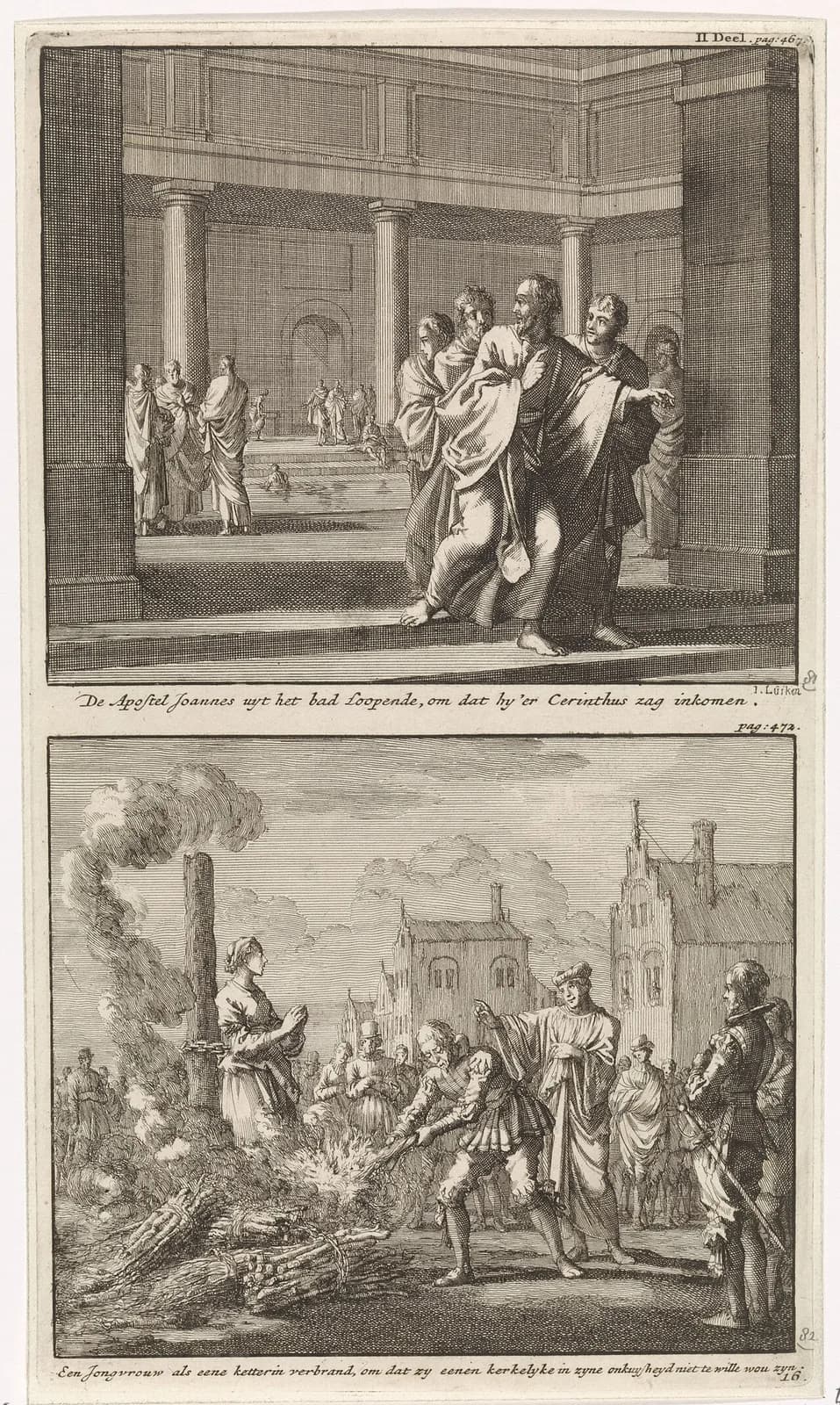
Cerinthus
hereticApostolic Fathers (1st-2nd C) · fl. c. 100 CE · Updated April 9, 2026
Biography
Cerinthus was a Jewish-Christian Gnostic teacher active in Asia Minor around 100 CE, known as a contemporary and opponent of the Apostle John during the era of the Apostolic Fathers. His teachings stirred considerable debate among early Christians as he challenged emerging orthodox views. Cerinthus's ideas, especially his views on the nature of Christ, placed him at the heart of theological controversies of the time.
Cerinthus taught that the divine Christ descended upon the human Jesus at baptism and left him before the crucifixion. This belief, known as Cerinthianism, set Jesus and Christ as separate entities, conflicting with the growing Christian understanding of Jesus as both fully human and fully divine. Cerinthus also believed angels, not the supreme God, created the material world, aligning with Gnostic cosmologies. These teachings drew condemnation from figures like Irenaeus and Polycarp, who defended the unity of Jesus and Christ. Though no formal council denounced him, his views were strongly opposed by influential leaders in the early church.
Cerinthus thrived in a world where early Christianity wrestled with defining core doctrines. The lack of a centralized authority allowed diverse interpretations to flourish. This period saw intense debate over Christ's nature and divinity, as Christians sought to reconcile Jewish traditions with their new faith. Cerinthus's controversial ideas emerged in this context of theological exploration and uncertainty. His teachings, though eventually marginalized, highlight the dynamic and contentious environment of early Christian thought.
Was Christ truly born, truly human, and truly the one who suffered on the cross — or did the divine element only temporarily inhabit a human body?
The question
Cerinthus, steeped in the mystical blend of Jewish-Christian Gnostic thought, stood firm in his belief that the divine and material worlds were inherently separate. His encounters with early Christian communities in Asia Minor only solidified this perspective. He saw a world where the divine was pure and untouchable, while the material was corrupt and transient. This conviction led him to question the nature of Christ: how could the divine fully inhabit a human body without compromising its purity? For Cerinthus, the notion that the divine could suffer and die on a cross was unthinkable. He viewed any mingling of the divine with the material as a dilution of its essence. His stance was not born of malice or rebellion but from a genuine attempt to preserve the sanctity of the divine.
If Christ was truly born, truly human, and truly the one who suffered on the cross, then the divine must fully embrace the material world. This position demanded the acceptance that the divine could suffer, die, and be subject to human limitations. Such a view directly challenged the Gnostic belief in an impassible God. It meant acknowledging that the divine and human natures were inseparably united in Christ. The cost was high: the purity of the divine seemed at risk, tainted by the material world's inherent corruption. Accepting this would mean that God was not distant and untouched but intimately involved in the human condition, sharing in its frailties and pains.
If the divine element only temporarily inhabited a human body, then the divine Christ remained untouched by human suffering and death. This view preserved the divine's transcendence and aligned perfectly with Gnostic dualism. The divine and human remained fundamentally separate, ensuring the divine's purity. But this perspective came with its own cost. It denied the full incarnation, suggesting a Christ who was not truly human and, therefore, could not fully redeem humanity. The divine Christ, departing before the crucifixion, left a purely human Jesus to face death alone. This division implied that salvation was incomplete, as the divine had not fully entered into the human experience.
Cerinthus's commitment to dualism ensnared him in a trap that neither position could resolve. The separation between the divine and material, so central to his beliefs, could not accommodate a fully incarnate Christ. For ordinary believers, this debate was not mere theological wrangling. It touched the core of their faith, shaping their understanding of salvation and their relationship with God. The nature of Christ influenced how they prayed, how they approached the sacraments, and how they perceived their own place in the divine plan. To them, Christ's true nature was not an abstract concept but a reality that affected their daily lives and eternal hope.
The teaching
Cerinthus taught that Jesus and the divine Christ were two distinct entities. He believed that the divine Christ did not inhabit Jesus until his baptism and departed before the crucifixion. In his view, Jesus was merely human, while the divine Christ was a separate spiritual being. This teaching addressed the question of whether Christ was truly born and suffered on the cross by proposing that the divine aspect only temporarily united with the human.
Cerinthus based his beliefs on the idea that a supreme God could not directly interact with the flawed material world. He argued that the divine Christ could not suffer or die, which meant separating from Jesus before the crucifixion. Cerinthus used scriptures like Matthew 3:16 and John 1:32 to support his claims, suggesting that the divine Christ descended upon Jesus at baptism. He interpreted Mark 15:34 as evidence of the divine Christ's departure before the crucifixion. His key claims were compiled in a treatise known as "Cerinthian Teachings" around 100 CE.
Cerinthus's ideas resonated with those uncomfortable with the notion of a suffering divine being. His teachings gained traction among communities influenced by Gnostic thought, which often saw the material world as lesser and corrupt. This dualistic view of separating the divine from the human appealed to those questioning traditional understandings of Jesus's nature. Cerinthus's teachings spread among early Christian communities, but they were eventually deemed heretical by mainstream Christianity. This divide highlighted the early church's struggle to define the nature of Christ.
The counterargument
The decisive argument against Cerinthus centered on the unity of Jesus Christ's personhood. This argument drove a wedge into Cerinthus's belief that the divine Christ only temporarily inhabited the human Jesus. Irenaeus, the Bishop of Lyons, championed this argument in his work "Against Heresies" around 180 CE. He insisted that only a Christ who was both fully divine and fully human from conception to crucifixion could reconcile humanity with God. For Irenaeus, The Incarnation was not a fleeting event but a permanent fusion of divine and human natures. This unity was essential because only a truly incarnate God could experience human life and death fully, thereby defeating sin and death. Without this permanent union, the redemption of humanity would be impossible.
Cerinthus found support for his views in certain scripture passages, but the orthodox response dismantled his interpretations. He saw the Spirit's descent at Jesus' baptism in Mark 1:10-11 as the moment the divine Christ entered Jesus. The orthodox reply was that this event publicly affirmed Jesus' divine mission, with his divinity present from conception, as stated in Luke 1:35. In John 1:32-34, Cerinthus interpreted John the Baptist's testimony as evidence of a separate divine entity entering Jesus. The orthodox camp countered that John's words confirmed Jesus as the Word made flesh, not a separate being. Cerinthus pointed to Jesus' cry on the cross in Matthew 27:46 to argue that the divine Christ left him before death. The orthodox answer was that this cry expressed deep human suffering, fulfilling Psalm 22, not a divine separation. The trap in Cerinthus's argument was clear: if the divine Christ could not suffer or die, the crucifixion lost its power to atone for sin, leaving redemption incomplete.
The orthodox counter-argument demanded a deeper exploration of how divine and human natures coexisted in one person without confusion or division. This need for clarification led to further theological development, especially in understanding the mystery of The Incarnation. The concept of the hypostatic union emerged to articulate this complex theological idea, though it left some scratching their heads. Despite this complexity, the argument against Cerinthus held firm. The Church maintained that an undivided Christ was essential for true salvation, anchoring this belief in the bedrock of scripture and the wisdom of early theologians like Irenaeus.
The resolution
In the late 1st to early 2nd century CE in Asia Minor, a significant theological meeting unfolded among early Christian leaders. Irenaeus and Polycarp, along with others from the Johannine tradition, convened to address a pressing issue: the nature of Jesus Christ. They faced Cerinthus, who proposed a dualistic view where the divine Christ temporarily inhabited the human Jesus. This gathering, rooted deeply in ecclesiastical rather than political power, aimed to preserve the core tenets of Christian belief. The stakes were high, as the outcome would shape the early church's understanding of salvation and the identity of Jesus as the Son of God.
The debate centered around whether Jesus and the Christ were one or separate. Cerinthus argued for a temporary divine presence within Jesus, suggesting that Christ left before the crucifixion. In contrast, his opponents, drawing from the Johannine tradition, argued for the full divinity and humanity of Jesus Christ as a single entity. Language held immense power here; terms like 'incarnation' and 'divine indwelling' were not mere theological jargon but the foundation of how believers understood Christ's role in salvation. The condemnation of Cerinthianism by figures such as Irenaeus and Polycarp established the orthodox position that Jesus Christ was inseparable in his divinity and humanity.
Despite this resolution, the controversy did not vanish. Gnostic influences and ideas similar to Cerinthianism lingered, challenging the orthodox stance. Movements like Docetism, which claimed Christ's physical form was an illusion, persisted, keeping the debate alive well into the early centuries of Christianity. These theological battles continued, culminating in the Council of Nicaea in 325 CE, which further clarified Christ's divine and human nature. The struggle for a unified understanding of Christ's identity persisted, but Nicaea marked a pivotal moment in solidifying orthodox Christology.
Legacy
After early church figures like Irenaeus and Polycarp condemned Cerinthus, his teachings fell out of favor with the mainstream Christian community. He faced no formal exile, but his ideas were pushed to the margins. Cerinthus likely continued his work within small, isolated groups that gathered outside the dominant church structure. His influence diminished as church leaders unified around a more orthodox set of beliefs. The lack of any formal rehabilitation indicates that Cerinthus remained a controversial figure, unable to regain a foothold in the growing Christian movement of his time.
Despite his marginalization, Cerinthus's teachings found a new home among some early Gnostic sects. These groups, particularly in regions like Egypt and Syria, embraced the notion of a separation between the divine Christ and the human Jesus. Cerinthianism contributed to the rich tapestry of Gnostic thought, which flourished in environments open to diverse interpretations of Christianity. This influence persisted through various movements that questioned mainstream Christian doctrines, keeping Cerinthus's ideas alive even as they evolved into different forms.
Today, echoes of Cerinthus's teachings appear in modern spiritual movements, especially those that draw a line between the divine and human aspects of Jesus. Certain New Age interpretations mirror this distinction, showing how Cerinthus's ideas have endured. Additionally, the concept of a non-divine creation of the material world resonates with some secular or philosophical perspectives that see the universe as the product of impersonal forces. These perspectives suggest that Cerinthus's legacy, though not mainstream, still finds relevance in contemporary thought.
Continue reading with a Scholar plan
Upgrade to ScholarCommon questions
- Why was Cerinthianism considered dangerous?
- Cerinthianism was considered dangerous because it challenged the core Christian belief in the unity of Jesus Christ as both fully divine and fully human. By separating Jesus and the Christ into two distinct entities, it undermined the doctrine of the Incarnation and the redemptive significance of Jesus' death and resurrection.
- What exactly did Cerinthus teach?
- Cerinthus taught that Jesus was a mere human upon whom the divine Christ descended at his baptism. He believed that the Christ departed from Jesus before the crucifixion, meaning that the divine did not suffer or die. Additionally, Cerinthus claimed that the material world was created by lesser angels, not the supreme God.
- Why did Cerinthianism spread so widely?
- Cerinthianism spread widely due to its appeal to those who were uncomfortable with the idea of a suffering divine being. It also resonated with Gnostic tendencies prevalent in the region, which emphasized secret knowledge and a dualistic view of the material and spiritual worlds.
- Who opposed Cerinthus, and what was their argument?
- Cerinthus was opposed by early church figures such as Irenaeus, Polycarp, and the Apostle John. They argued that his teachings distorted the true nature of Christ and contradicted the apostolic witness of Jesus as both fully God and fully man, essential for salvation.
- Was Cerinthus excommunicated, exiled, or executed?
- There is no historical evidence that Cerinthus was excommunicated, exiled, or executed. His teachings were condemned by early church leaders, but there are no records of formal ecclesiastical actions taken against him personally.
- Which council condemned Cerinthianism, and what did it decide?
- Cerinthianism was not condemned by any formal council. Instead, it was denounced by early church fathers like Irenaeus and Polycarp, who upheld the apostolic tradition against Cerinthus' teachings.
- Did Cerinthus ever recant?
- There is no historical record of Cerinthus ever recanting his teachings. He remained a controversial figure whose ideas were consistently opposed by early church leaders.
- What is the difference between Cerinthianism and orthodox Christianity?
- The main difference is that Cerinthianism separates Jesus and the Christ into two distinct entities, whereas orthodox Christianity teaches that Jesus Christ is one person who is both fully divine and fully human. This distinction affects the understanding of the Incarnation, atonement, and resurrection.
- Are there modern versions of Cerinthianism?
- While no major modern religious movements directly identify with Cerinthianism, some contemporary interpretations of Christianity that emphasize a separation between Jesus' humanity and divinity may echo Cerinthian ideas. However, these are generally considered outside mainstream Christian orthodoxy.
- Is there anything Cerinthus got right?
- Cerinthus' emphasis on the distinction between the divine and human aspects of Jesus highlights the complexity of Christological debates. While his conclusions were rejected, his questions contributed to the early church's exploration of the nature of Christ.
- Why does Cerinthianism still matter today?
- Cerinthianism matters today as it represents an early challenge to Christian orthodoxy, prompting the church to clarify and articulate its doctrines. Understanding such historical debates helps modern Christians appreciate the development of their theological beliefs.
- Why did Cerinthus sincerely believe his position was correct? What was he actually defending — and why did he see the alternatives as worse?
- Cerinthus likely believed his position was correct because it aligned with Gnostic views that valued spiritual knowledge and saw the material world as flawed. He may have been defending a view of divinity that could not suffer or die, seeing the orthodox position as diminishing the transcendence of the divine by associating it too closely with human suffering.