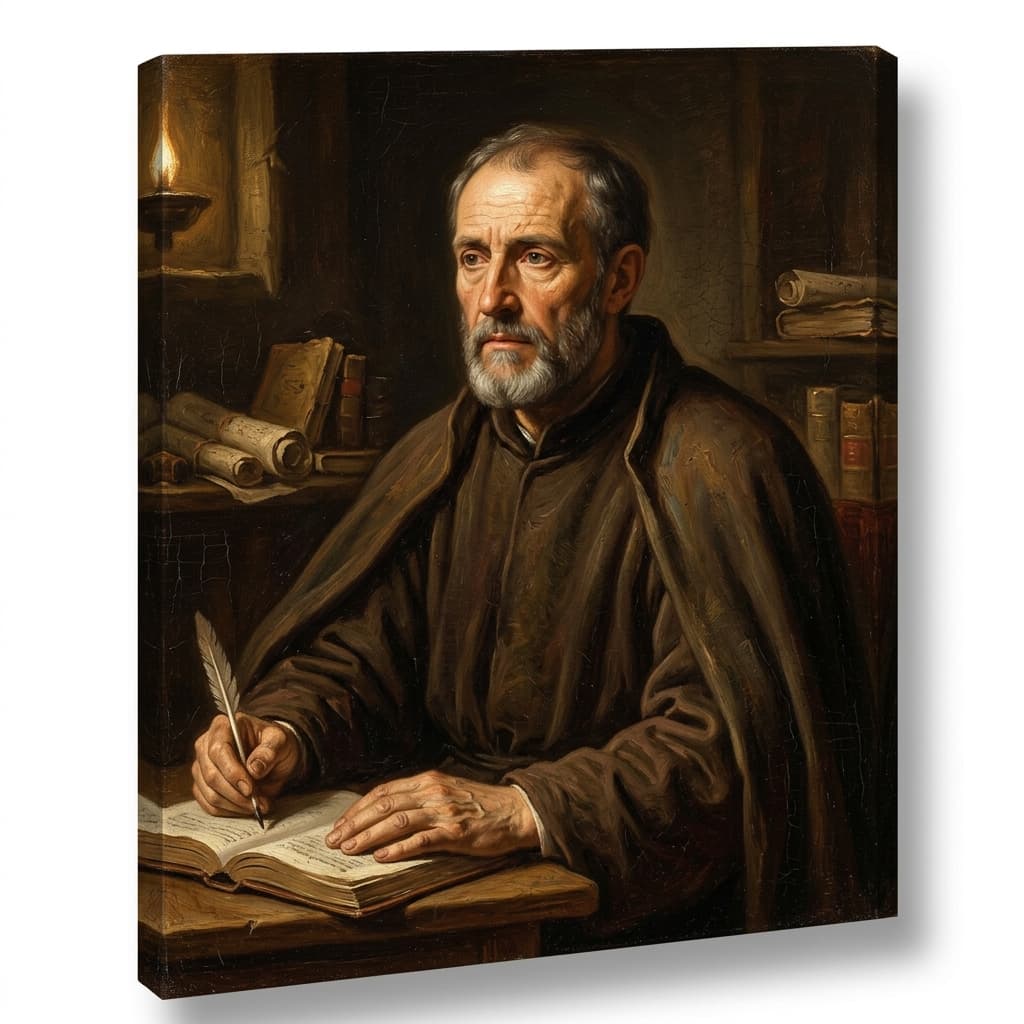
Sabellius
hereticEarly Church (2nd-3rd C) · fl. c. 210-220 CE · Updated April 9, 2026
Biography
Sabellius was a theologian in Rome during the early 3rd century, known for being the most systematic early proponent of Modalist Monarchianism. This movement sought to maintain the oneness of God by arguing that the Father, Son, and Holy Spirit are not distinct persons but rather different modes of a single divine being. Sabellius's ideas, later dubbed Sabellianism, challenged emerging orthodox views on the Trinity and left a lasting impact on Christian theological debates.
Sabellius flourished around 210-220 CE. He articulated his ideas in a time when Christians were grappling with how to describe the nature of God and Christ’s relationship to the Father. His teachings suggested that the Father, Son, and Holy Spirit are simply different appearances of the same God, a view that led to the implication known as Patripassianism, which holds that the Father himself suffered on the cross. This controversial stance drew condemnation from Pope Callixtus I around 220 CE. Sabellius faced strong opposition from notable theologians like Tertullian and Hippolytus, who argued for the distinct persons of The Trinity, thus setting the stage for his rejection by the developing church hierarchy.
The early 3rd century was a fertile ground for theological exploration within Christianity. Without a formalized doctrine, diverse interpretations of The Trinity, such as Sabellius's Modalism, could flourish. This era was marked by intense efforts to define orthodoxy, with church leaders working to establish clear boundaries around accepted beliefs. Such theological diversity led to frequent conflicts and condemnations, as the church sought to unify its teachings. Sabellius's rejection by the church illustrates the growing insistence on a doctrine that emphasized the eternal distinctions within God, a cornerstone of what would later become orthodox Trinitarian theology.
Are the Father, Son, and Holy Spirit three distinct persons of one God, or three successive modes of a single divine actor — and if three modes, did the Father himself die on the cross?
The question
Sabellius saw the swirling debates in Rome and felt a deep conviction that Christianity’s core belief in one God was under threat. Influenced by Noetus of Smyrna, he embraced the idea that God’s unity needed to be preserved at all costs. He believed that the Father, Son, and Holy Spirit were not separate persons but rather different manifestations of the same divine being. This view seemed to maintain the essential oneness of God, aligning with the monotheistic roots of the faith. Sabellius acted out of a desire to protect this fundamental principle and offer a clear, accessible understanding of God to believers who struggled with more complex theological constructs.
The notion of three distinct persons within the Godhead risks fragmenting divine unity. If the Father, Son, and Holy Spirit are separate, then Christianity stands on shaky ground, perilously close to tritheism. Such a view forces believers to juggle an incomprehensible mystery, straining the limits of monotheism. It paints a picture of a divided God, introducing a hierarchy or separation that could fracture the divine essence. This understanding demands an intellectual leap that many ordinary believers could not make, potentially alienating them from their faith and leading them to accusations of worshipping multiple gods.
Claiming that the Father, Son, and Holy Spirit are merely modes of one divine actor resolves the unity issue but at a cost. It insists that God’s single essence manifests in different roles at different times. This perspective, however, leads to the contentious idea that the Father himself endured the crucifixion. Such a belief undermines the relational dynamics within the Godhead. It strips away the distinctiveness of each role, flattening the rich narrative of salvation into a monologue. Early church leaders rejected this as heresy, fearing it diluted the mystery of the incarnation and the redemptive work attributed to each divine person.
The struggle between unity and distinction left the early church in a bind. Both positions threatened to distort essential truths: the indivisible oneness of God and the real, personal relationships within the Godhead. Ordinary believers found themselves caught in this theological tug-of-war, impacting how they understood their faith. Their prayers, their view of Jesus’s sacrifice, and their sense of salvation’s meaning all hung in the balance. The debate forced the church to grapple with questions that reached beyond doctrine, touching the very heart of how individuals connected with the divine in their daily lives.
The teaching
Sabellius taught that the Father, Son, and Holy Spirit are not separate persons but different modes of one God. He believed that God presented Himself in different forms at different times, like an actor playing multiple roles. In this view, the Father, not just the Son, experienced the suffering of the cross since they are the same divine being. Sabellius rejected the idea of eternal distinctions within God, insisting that such distinctions would divide God's essence and threaten the unity of the divine nature.
Sabellius rooted his teachings in the need to preserve monotheism. He argued that portraying God as three distinct persons diluted the concept of one God. In his treatise "On the Unity of God" around 215 CE, he outlined that God is a single entity manifesting in different modes, rejecting the notion of multiple persons. Sabellius used scriptures like John 10:30, where Jesus says, "I and the Father are one," to argue that Jesus and the Father are not distinct entities but one essence. He also pointed to Isaiah 9:6, which uses titles interchangeably for the child born, to support his view that the Father and Son are the same.
Sabellius's teachings found traction among those worried about diluting Christianity's monotheistic roots. His ideas appealed to believers who sought a more straightforward understanding of God's nature without the complexity of three separate persons. This modalist perspective spread, particularly in regions where Christians faced pressure to defend their faith against accusations of polytheism. Sabellianism persisted as a significant theological viewpoint until it faced condemnation by church authorities, but it remains a point of interest for those exploring early Christian views on the nature of God.
The counterargument
The decisive argument against Sabellius centered on the eternal distinction within the Godhead. Sabellius proposed that the Father, Son, and Holy Spirit were not distinct persons but merely different modes or roles of one God. His view failed to account for the relational dynamics within the Trinity. Hippolytus of Rome, a theologian and presbyter, tackled this in "Contra Noetum." He pointed to the baptism of Jesus as evidence of distinct persons: the Father speaks from heaven, the Son undergoes baptism, and the Holy Spirit descends as a dove. This scene illustrates simultaneous and distinct actions, underscoring co-eternal and co-equal persons within the Trinity. Sabellianism could not offer such a coherent framework for understanding these interactions.
Sabellius attempted to use certain scripture passages to support his view. He cited John 10:30, where Jesus says, "I and the Father are one," to argue for no distinction between Father and Son. The orthodox response clarified that "one" refers to unity of essence, not personhood, thus allowing for distinct persons. In John 14:9, Jesus says, "Whoever has seen me has seen the Father," which Sabellius took as indicating no distinction. The orthodox interpretation explained that Jesus reveals the Father not by being the same person but as the perfect image of the Father. Sabellius also pointed to Isaiah 9:6, arguing that the title "Everlasting Father" for the Son indicated no distinction. The orthodox answer maintained that this title speaks to the Son's role and eternal nature, not identity with the Father. The trap in Sabellius's view was the logical conclusion that if the Father, Son, and Holy Spirit were mere modes, then the Father suffered and died on the cross, contradicting God's unchanging nature.
The orthodox counter-argument required embracing a more complex understanding of The Trinity. This approach maintained one essence in three distinct persons without dividing the Godhead or veering into tritheism. This complexity posed the challenge of explaining the coexistence of three distinct persons within one essence. The mystery of The Trinity became a cornerstone of orthodox theology, demanding faith and careful articulation. Despite these complexities, this view preserved the integrity of divine attributes. The Nicene Creed, formulated later, would encapsulate this orthodox stance, cementing the rejection of Sabellianism.
The resolution
Around 220 CE in Rome, Pope Callixtus I convened a critical assembly to address a divisive theological question: the nature of the relationship between the Father, Son, and Holy Spirit. At the heart of the debate was Sabellius, a theologian advocating for Modalism. This view suggested that God was a singular entity appearing in three forms rather than distinct persons. This theological dispute lacked direct political entanglement, focusing instead on maintaining ecclesiastical unity. However, the Roman Church's efforts to assert doctrinal consistency indirectly supported the broader political stability that the Roman Empire valued.
Sabellius faced opposition from figures like Tertullian and Hippolytus, who argued for the distinct personhood of each member of The Trinity. The terminology was crucial: were the Father, Son, and Holy Spirit the same in substance or distinct in personhood? The council's decision condemned Sabellius and his Modalistic views as heretical, affirming the emerging orthodox position that each part of The Trinity was a distinct person. This condemnation reinforced a growing consensus on a Trinitarian doctrine that would shape Christian orthodoxy.
Despite this resolution, the precise nature of The Trinity remained unsettled. The controversy continued, with figures like Marcellus of Ancyra and the later Arian debates probing the intricacies of the Trinity's nature. These disputes persisted well into the 4th century. The Nicene Creed of 325 CE attempted to clarify some issues, yet debates about the Trinity's nature lingered. These theological discussions only reached a broader consensus after the Council of Constantinople in 381 CE, which further defined and solidified Trinitarian doctrine.
Legacy
After his condemnation around 220 CE, Sabellius likely faced excommunication from the Roman Church. Pope Callixtus I took a firm stand against his teachings, seeking to preserve the traditional understanding of The Trinity. Sabellius's personal fate remains unclear, but his ideas faced strong opposition from influential theologians like Tertullian and Hippolytus. They criticized his view that God is a single entity who manifests in three different modes — Father, Son, and Holy Spirit — rather than being three distinct persons. This belief, known as Modalism, clashed with the emerging orthodox doctrine of the Trinity.
Despite the official rejection, Sabellianism continued to find followers. It spread in North Africa and parts of the Eastern Roman Empire, where alternative theological interpretations often thrived. During the Arian controversy of the fourth century, debates about the nature of Christ and The Trinity brought Sabellian ideas back into discussions. Although the mainstream church condemned these views, elements of Sabellianism persisted in various communities. Some groups, unwilling to accept the complex formulations of Trinitarian doctrine, found Modalism a simpler and more appealing explanation of God's nature.
In modern times, Sabellianism lives on, especially within certain Oneness Pentecostal groups. These groups reject the traditional doctrine of the Trinity, aligning instead with a modalistic understanding of God. They view God as a single person who reveals Himself in different ways, rather than as three distinct persons. This belief occasionally surfaces in broader religious discourse, where misunderstandings about the Trinity lead to simplified interpretations. Today, Oneness Pentecostal churches represent a concrete example of Sabellius's enduring legacy, showing how his ideas continue to shape religious thought.
Continue reading with a Scholar plan
Upgrade to ScholarCommon questions
- Why was Sabellianism (Modalism) considered dangerous?
- Sabellianism was considered dangerous because it undermined the doctrine of the Trinity by denying the distinct personhood of the Father, Son, and Holy Spirit. This view was seen as a threat to the understanding of Jesus' relationship with God and the Holy Spirit, potentially leading to confusion about the nature of salvation and the incarnation.
- What exactly did Sabellius teach?
- Sabellius taught that God is a single person who manifests in three different modes or aspects: as the Father in creation, the Son in redemption, and the Holy Spirit in sanctification. He denied any eternal distinction between these modes, suggesting that they are simply different expressions of the same divine person.
- Why did Sabellianism (Modalism) spread so widely?
- Sabellianism spread widely because it offered a simple and easily understandable explanation of the Godhead, appealing to those who struggled with the complex doctrine of the Trinity. Its emphasis on the unity of God resonated with believers who were wary of polytheistic interpretations of Christianity.
- Who opposed Sabellius, and what was their argument?
- Sabellius was opposed by theologians like Tertullian and Hippolytus, who argued that his teachings compromised the distinct personhood of the Trinity. They contended that Sabellianism failed to account for the relational dynamics between the Father, Son, and Holy Spirit as depicted in the New Testament.
- Was Sabellius excommunicated, exiled, or executed?
- Sabellius was excommunicated by Pope Callixtus I around 220 CE. There is no historical evidence to suggest that he was exiled or executed.
- Which council condemned Sabellianism (Modalism), and what did it decide?
- Sabellianism was condemned by a synod in Rome under Pope Callixtus I around 220 CE. The council decided that Sabellianism was heretical because it denied the distinct persons of the Trinity, affirming instead the orthodox understanding of three co-equal and co-eternal persons.
- Did Sabellius ever recant?
- There is no historical record of Sabellius recanting his teachings. He remained committed to his views despite opposition and condemnation.
- What is the difference between Sabellianism (Modalism) and orthodox Christianity?
- The primary difference is that Sabellianism denies the distinct personhood of the Father, Son, and Holy Spirit, viewing them as modes of one God. In contrast, orthodox Christianity teaches that the Trinity consists of three distinct persons who are co-equal and co-eternal, sharing one divine essence.
- Are there modern versions of Sabellianism (Modalism)?
- Yes, modern versions of Sabellianism exist, most notably in some Oneness Pentecostal groups. These groups maintain a similar view of God as a single person who manifests in different modes, rejecting the traditional doctrine of the Trinity.
- Is there anything Sabellius got right?
- Sabellius emphasized the unity of God, which is a core tenet of Christian theology. His insistence on the oneness of God was a corrective against any interpretations that might suggest a division or separation within the Godhead.
- Why does Sabellianism (Modalism) still matter today?
- Sabellianism matters today because it challenges theologians and believers to articulate and defend the doctrine of the Trinity. It serves as a reminder of the importance of maintaining a balance between the unity and diversity within the Godhead in Christian theology.
- Why did Sabellius sincerely believe his position was correct? What was he actually defending — and why did he see the alternatives as worse?
- Sabellius believed his position was correct because he sought to preserve the absolute unity of God, which he saw as compromised by the doctrine of the Trinity. He was defending the monotheistic principle of Christianity, viewing the alternatives as potentially leading to tritheism or a division within the Godhead.