Library
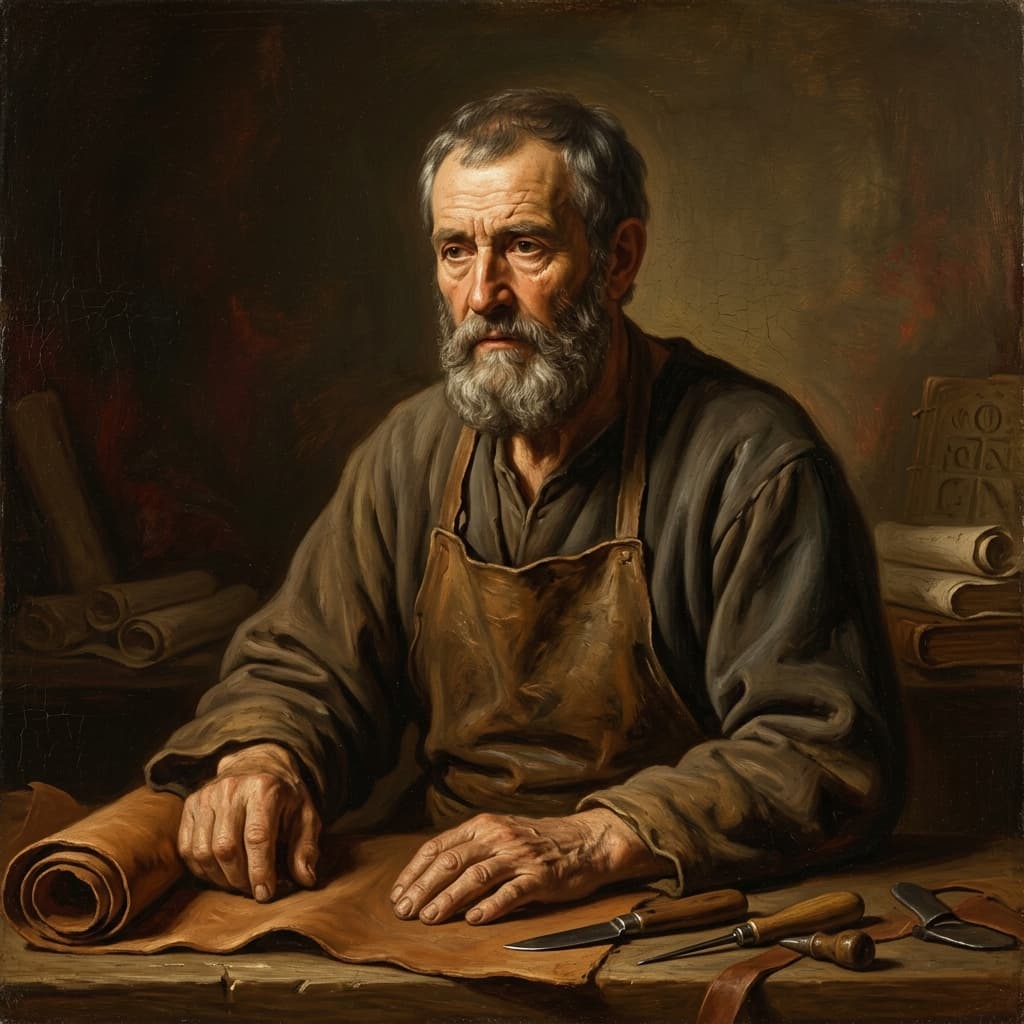
AI-generated illustration
Library
Early Church (2nd-3rd C) · fl. c. 190 CE · Updated April 9, 2026
Theodotus of Byzantium was a leather merchant from Byzantium who became a prominent figure in early Christian theology as the founder of Dynamic Monarchianism, also known as Adoptionism, in Rome during the late 2nd century CE. He challenged the traditional understanding of Jesus' nature, proposing that Jesus was not divine from birth but became divine at his baptism. This controversial stance set Theodotus apart as a significant and contentious figure in the early Church.
Originally from Byzantium, a city that would later become Constantinople, Theodotus moved to Rome and immersed himself in theological debates. His background as a leather merchant did not prevent him from engaging in complex theological discussions. Around 190 CE, his views on Jesus' divinity led to his excommunication by Pope Victor I. Theodotus argued that Jesus was a mere human who received divine status when the Holy Spirit descended upon him at his baptism. This belief, known as Adoptionism, directly opposed the emerging orthodox view that Jesus was divine from birth.
Theodotus lived during a formative period for Christianity, when the early Church was striving to define its core doctrines. The question of Jesus' divinity was a hot topic, as early Christians wrestled with understanding the relationship between the human and divine aspects of Christ. Theodotus' teachings highlighted the diversity of early Christian thought and the fierce debates over orthodoxy. His excommunication underscored the Church's efforts to consolidate its teachings. The controversy he stirred persisted, influencing later theological discussions and councils.
Was Jesus divine from conception and birth, or did he become divine at his baptism through adoption — and what does each answer mean for the meaning of the incarnation?
Theodotus of Byzantium found himself captivated by the Gospel accounts of Jesus' baptism. He saw the descent of the Holy Spirit upon Jesus as a pivotal moment. This event, for Theodotus, marked the adoption of Jesus into divinity. He believed this interpretation reconciled the human experience of Jesus with his divine mission. By focusing on this profound moment, Theodotus argued for a faith that embraced the idea of progression towards divinity, a concept he found both logical and spiritually fulfilling. His reading of Scripture led him to conclude that Jesus' baptism was not just a ceremonial act but the very instance of divine adoption.
Accepting Jesus as divine from conception and birth demands adherence to a complex doctrine. This position, known as the hypostatic union, insists Jesus was fully divine and fully human from the start. Such a belief requires acceptance of the incarnation as an unfathomable mystery, one that defies simple logic. It costs the simplicity of perceiving Jesus' divinity as something that develops over time. The blunt conclusion is that Jesus' divine nature is inherent and independent of earthly events. His divinity is not a result of his life or actions but a pre-existing truth, making Jesus' role in salvation an eternal given rather than a human journey.
Conversely, if Jesus' divinity began at his Baptism, his life reflects a journey towards divine status. This view allows believers to see Jesus' early life as a period of moral and spiritual development. It emphasizes Jesus' growth and the grace that led to his adoption as divine. This understanding costs the traditional belief in Jesus' eternal pre-existence and his co-equal status with God. Jesus' divinity is seen as a reward for his righteousness, not an innate quality. Such an interpretation reshapes the narrative of Jesus' life, presenting it as a model of human potential for divine grace rather than an inscrutable divine mystery.
The commitment to the unity of God as co-eternal and indivisible presented a formidable barrier. Both interpretations threatened this foundational belief. To deny Jesus' eternal divinity challenged the coherence of Christian doctrine. For ordinary believers, the stakes were personal and profound. Their understanding of Jesus determined the nature of their prayers and their path to salvation. Were they following a divine being from birth or aspiring to emulate one who achieved divinity through life's journey? This debate shaped their faith, influencing whether they saw Salvation as a divine gift or a model to emulate. Theodotus' challenge was not merely theological but touched the core of Christian identity and devotion.
Theodotus of Byzantium taught a unique perspective on the nature of Jesus. He believed that Jesus was a human being born of a virgin and that he became divine at his baptism. According to Theodotus, Jesus became the Son of God not because he was eternally pre-existent, but through his moral perfection and the divine grace bestowed upon him. This meant that Jesus' divinity was not inherent but was granted to him due to his exemplary life and actions.
Theodotus backed his teaching with scripture and logical reasoning. He pointed to the account in Matthew 3:16-17, where the Spirit of God descends upon Jesus at his baptism, as the moment Jesus was adopted as the Son of God. In Acts 2:22, he highlighted Jesus' humanity and God's endorsement of his mission through miracles, arguing that this showed divine approval rather than inherent divinity. Romans 1:4, which speaks of Jesus being appointed the Son of God, further supported his view of adoptionism. Theodotus laid out these arguments in his "Treatise on the Nature of Christ," written around 190 CE.
Theodotus' ideas resonated with those who valued the human aspect of Jesus and the possibility of divine grace elevating a person to divine status. His teaching attracted followers who found the concept of Jesus' exaltation due to his moral perfection appealing. This idea of human potential and divine interaction offered a compelling model for many Christians, particularly those in Byzantium. The adoptionist view gained ground, influencing early Christian debates about the nature of Jesus and his divinity.
Theodotus of Byzantium argued that Jesus became the Son of God at his baptism, a view that challenged the early Church's understanding of Christ's nature. Pope Victor I decisively countered this by asserting that Jesus' divinity was not an acquisition at baptism but inherent from conception. Victor relied on the Gospel of John, particularly its prologue, which spoke of the eternal nature of the Logos, or Word. This suggested that the divinity of Jesus was inherent and eternal, not a status conferred later. Victor's argument, likely communicated through ecclesiastical correspondence around 190 CE, led to Theodotus' excommunication. The Church maintained that the divine and human natures in Jesus were unified from the start, essential for the belief that Jesus was both fully God and fully man, integral to the Christian understanding of salvation.
Theodotus used scripture to support his claims, but the Church systematically dismantled his interpretations. He pointed to Matthew 3:16-17, claiming the Spirit's descent marked Jesus' adoption. The Church responded that this event was a public declaration of Jesus' inherent divine sonship, not its inception. In Acts 10:38, Theodotus saw the anointing of the Holy Spirit as a sign of adoption. The orthodox response clarified it as a demonstration of divine power in Jesus' ministry. Romans 1:4, according to Theodotus, showed Jesus' sonship declared at resurrection. The Church argued this was a proclamation of an existing truth, not the beginning of his divinity. Theodotus' reasoning led to an internal contradiction: if Jesus' divinity was conditional on moral perfection and grace, it suggested divinity could be earned. This directly opposed the idea of a divine nature as inherently eternal and unearned, a point that decisively undermined his position.
In opposing Theodotus, the Church faced the challenge of articulating how Jesus could be fully divine and fully human from conception without confusion or division. This demanded deeper exploration of the incarnation's mystery, a complex theological task that would preoccupy Christian thinkers for centuries. The drive to resolve this tension contributed to the development of the doctrine of the hypostatic union, which sought to explain the coexistence of two natures in Christ. This theological journey, sparked by the need to counter arguments like those of Theodotus, shaped much of the early Church's doctrinal evolution. Pope Victor I's defense of Jesus' inherent divinity led to Theodotus' excommunication, a decisive move that highlighted the importance of maintaining the unity of Jesus' divine and human natures as a cornerstone of Christian faith.
Around 190 CE, a theological storm gathered in Rome. Pope Victor I called a meeting with the Roman clergy to address a brewing controversy sparked by Theodotus of Byzantium. Theodotus, a leather merchant turned theologian, challenged the Church's understanding of Christ's nature. He argued that Jesus was a mere human until the divine Christ descended at baptism, a view known as Adoptionism. This clashed with the Church's belief that Jesus was divine from conception, emphasizing the eternal existence of the Word. While secular powers largely stayed out of this debate, the Church's ruling carried weight in a region where Roman stability was paramount. The Church’s decision was not just about theology; it was about maintaining a unified religious front in a vast empire.
The arguments were fierce. Theodotus insisted Jesus became the Son of God through divine adoption at his baptism. In contrast, the Roman Church upheld that Jesus was divine from birth, with the Logos existing eternally. The language used was not mere semantics; it shaped the understanding of who Jesus was and the nature of his incarnation. At the meeting, the clergy condemned Theodotus's view as heretical. Pope Victor I excommunicated him, reinforcing the belief in Jesus's divine pre-existence. This decision aimed to protect the Church's teachings from what it saw as a dangerous distortion of Christian doctrine.
Theodotus's excommunication did not end the debate. Adoptionist ideas lingered and resurfaced. In the 3rd century, Paul of Samosata revived similar views, leading to further disputes. The 8th century saw another wave in Spain, where Adoptionism re-emerged and caused significant controversy. Despite the Roman Church's efforts, the question of Christ's nature continued to provoke discussion and disagreement. It wasn't until the Church councils in the early Middle Ages, particularly the Second Council of Nicaea in 787, that the debate began to subside, though echoes of it still ripple through theological discussions today.
After his excommunication by Pope Victor I around 190 CE, Theodotus of Byzantium did not retreat quietly. Instead, he remained active in Rome, where he continued to spread his Adoptionist teachings. These teachings asserted that Jesus was born a mere human and was later adopted as the Son of God at his baptism. Theodotus attracted a number of followers who shared his views, forming a distinct community that operated outside the boundaries of the orthodox Christian church. This community challenged the established doctrine and maintained its presence in Rome, fostering a sense of identity separate from mainstream Christianity.
Theodotus's influence did not fade with his death. His followers, known as Theodotians, carried his teachings into the future, leaving a mark on religious thought. Their ideas found resonance with others who questioned the nature of Jesus, contributing to a wider Adoptionist movement. One notable figure influenced by these ideas was Paul of Samosata, a third-century bishop whose teachings reflected similar themes. Theodotus's doctrines also reached into the 8th century, impacting the Adoptionist controversies in Spain, where debates about the nature of Christ's divinity and humanity continued to stir theological discussions.
Today, traces of Theodotus's Adoptionist ideas appear in some Unitarian and liberal Christian groups that focus on the human aspects of Jesus, viewing him primarily as a moral teacher. These groups often emphasize the humanity of Jesus over his divinity, echoing the core of Theodotus's teachings. The notion of Jesus being 'adopted' as divine aligns with certain secular perspectives, seeing him as a remarkable human figure rather than a divine being. This enduring legacy illustrates how Theodotus's once-controversial views have subtly permeated modern interpretations of Jesus, shaping discussions on his nature and role.
Continue reading with a Scholar plan
Upgrade to ScholarAI-generated illustration