Library
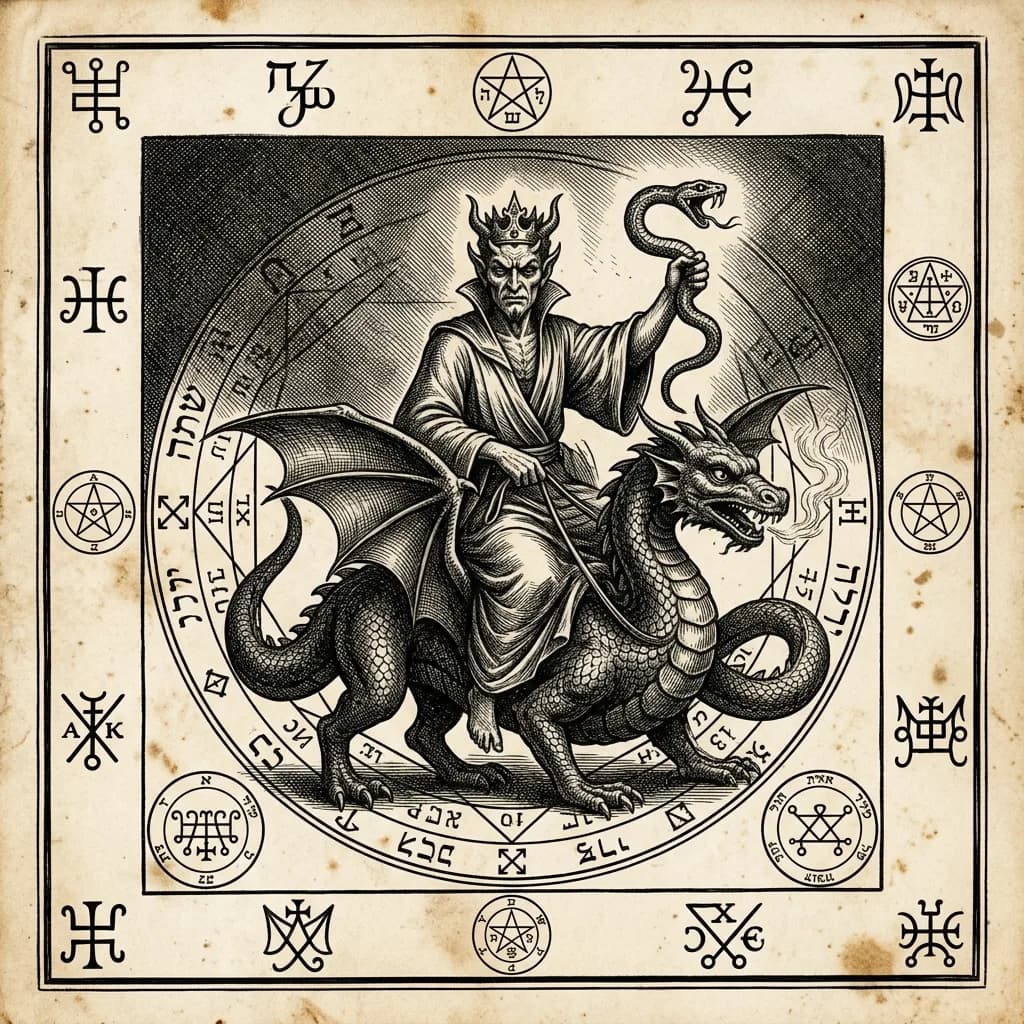
Astaroth
DukeSpirit #29 of the Ars Goetia · 40 legions
Description
Astaroth is the 29th Spirit, a great Duke of Hell who commands forty legions of spirits. He appears as a hurtful angel riding a dragon and carrying a viper in his right hand. He answereth truly of things past, present, and to come. He can discover all secrets. He will declare wittingly how the spirits fell and the reason of his own fall. He can make men wonderfully knowing in all liberal sciences. He was of the Order of Thrones and of the Cherubim before his fall.
Symbolic interpretation
The power to answer truly of things past, present, and to come is total temporal cognition - the capacity to perceive time as a single unified structure rather than as a sequence of discrete moments. The operative mechanism is not prophecy in the vulgar sense of guessing at futures, but rather access to the whole timeline as a static field in which past and future are equally readable. What this produces in those who receive it is a fundamental restructuring of their relationship to uncertainty. The person who gains this knowledge loses the experiential boundary between what has happened and what will happen; causality becomes fully visible to them, and with that visibility comes both the power of anticipation and the burden of inevitability. Nothing remains contingent. This is not a comfortable power - it is the removal of the psychological shelter that ignorance of the future provides.
The capacity to discover all secrets is the ability to dissolve the distinction between public and concealed information. Its mechanism is the negation of privacy as a structural category - every piece of knowledge that has been withheld, encoded, buried, or suppressed becomes accessible. This is not inference or deduction working through evidence; it is direct access to the hidden as such. The effect on those who receive this power, or on those it is turned against, is total exposure. For the recipient, no question remains open; for the target of its use, no protected interior space remains. Secrets are not merely the content of what is hidden but the social and psychological infrastructure of identity itself, and the power to discover all secrets is therefore a power over personhood at its foundation.
The willingness to declare how the spirits fell - and to speak of the reason for his own fall - is a specific kind of cognition that can only belong to one who has lived through the mechanism of catastrophic descent from a position of supreme elevation. The operative capacity here is self-reflexive metaphysical testimony: Astaroth does not merely know the fact of the fall but comprehends its architecture from the inside, as a participant who retained his understanding even through the transformation. What this produces is a unique form of instruction unavailable from any unfallen source. The knowledge of how corruption, exile, and loss of divine standing operate - as structural phenomena, not moral judgments - can only be transmitted by one who fell and knows why. The consequence for those who receive this teaching is access to the logic of dissolution itself, the mechanics by which order becomes chaos and proximity to the divine becomes its opposite.
The power to make men wonderfully knowing in all liberal sciences is the conferral of comprehensive intellectual mastery across the entire domain of formal human knowledge. The liberal sciences - the trivium and quadrivium, encompassing logic, rhetoric, grammar, arithmetic, geometry, music, and astronomy - constitute the full structure of reasoned inquiry as classically understood. To be made wonderfully knowing in all of them simultaneously is not to acquire each one sequentially but to receive the underlying cognitive architecture that makes all of them penetrable at once. What this produces is a person whose relationship to knowledge has been qualitatively transformed rather than merely expanded. They do not know more of the same thing; they operate differently within the entire domain of structured inquiry. The consequence is a kind of intellectual sovereignty - mastery not just of content but of the forms of understanding themselves.
Astaroth's appearance as a hurtful angel riding a dragon and carrying a viper performs a precise functional description of his operating nature. He remains angelic in form - this is not a demon who has shed his original nature but one who carries it visibly, damaged and dangerous. The designation "hurtful" is not a warning label but a specification: the knowledge he carries is real, accurate, and injurious precisely because it is real and accurate. The dragon is the ancient carrier of overwhelming, pre-rational force - what Astaroth rides is not contained or tamed but directed, and the riding posture says he controls forces that others cannot approach. The viper in the right hand - the active, operative hand - is the instrument of delivery. Viper venom works on the nervous system; it is the precision instrument of the serpent archetype, the same figure present at the original transmission of forbidden knowledge. What Astaroth carries in his dominant hand is the mechanism by which knowledge enters a person and changes them irreversibly. Together the appearance signals a figure who is simultaneously elevated and fallen, angelic and lethal, authoritative and catastrophically honest.
Archetype
Astaroth's derived sign is Gemini, produced by the combination of Mutable modality and Air element. The Air element follows from Direct expression meeting Collective orientation: Astaroth's operations name a specific, locatable act - answering truly, discovering secrets, declaring the reason for the fall - while those operations run on whoever occupies the relevant position rather than targeting a particular person. The knowledge is available to any who invoke; the mechanism does not customize itself to an individual but opens the same door to all comers. That is Direct + Collective, which yields Air as the operative medium. The Mutable modality is visible in what Astaroth actually does with knowledge: he reads and translates between states rather than founding new ones or holding existing ones. He does not install a doctrine or break open a new epistemic order - he moves through the existing structure of what is knowable and renders it legible. His capacity to speak of past, present, and to come is not the Cardinal act of inaugurating a new temporal awareness but the Mutable act of reading a terrain that already exists as a unified field and reporting its contents. His willingness to explain the mechanics of the fall - including his own - is self-reflexive translation, bridging the interior logic of catastrophic descent into communicable form. The conferral of mastery across all liberal sciences operates the same way: he does not create a new cognitive architecture but moves through the existing one and makes it navigable. Mutable Air at work is a force that flows through the structure of knowledge, mapping it as it goes, and Astaroth's mechanism is precisely that: a reader of the total epistemic field who transmits what he finds without founding or fixing anything.
In popular culture
Astaroth appears as a boss character in The Binding of Isaac: Rebirth (Nicalis), representing one of the many demonic entities Isaac must confront in the game's dungeon-crawling structure. In Darksiders (THQ Nordic), Astaroth is depicted as a powerful demon lord who plays a significant role in the game's storyline. The manga and anime series Blue Exorcist (Shueisha) portrays Astaroth as a demon king and one of the primary antagonists. In the Soulcalibur fighting game series (Bandai Namco Entertainment), Astaroth is a recurring character known for his immense physical strength and demonic origins, appearing across multiple entries in the franchise.