How Did Judas Iscariot Die? Two Accounts and One Field of Blood
The New Testament gives two irreconcilable accounts of Judas's death. Both cannot be true.
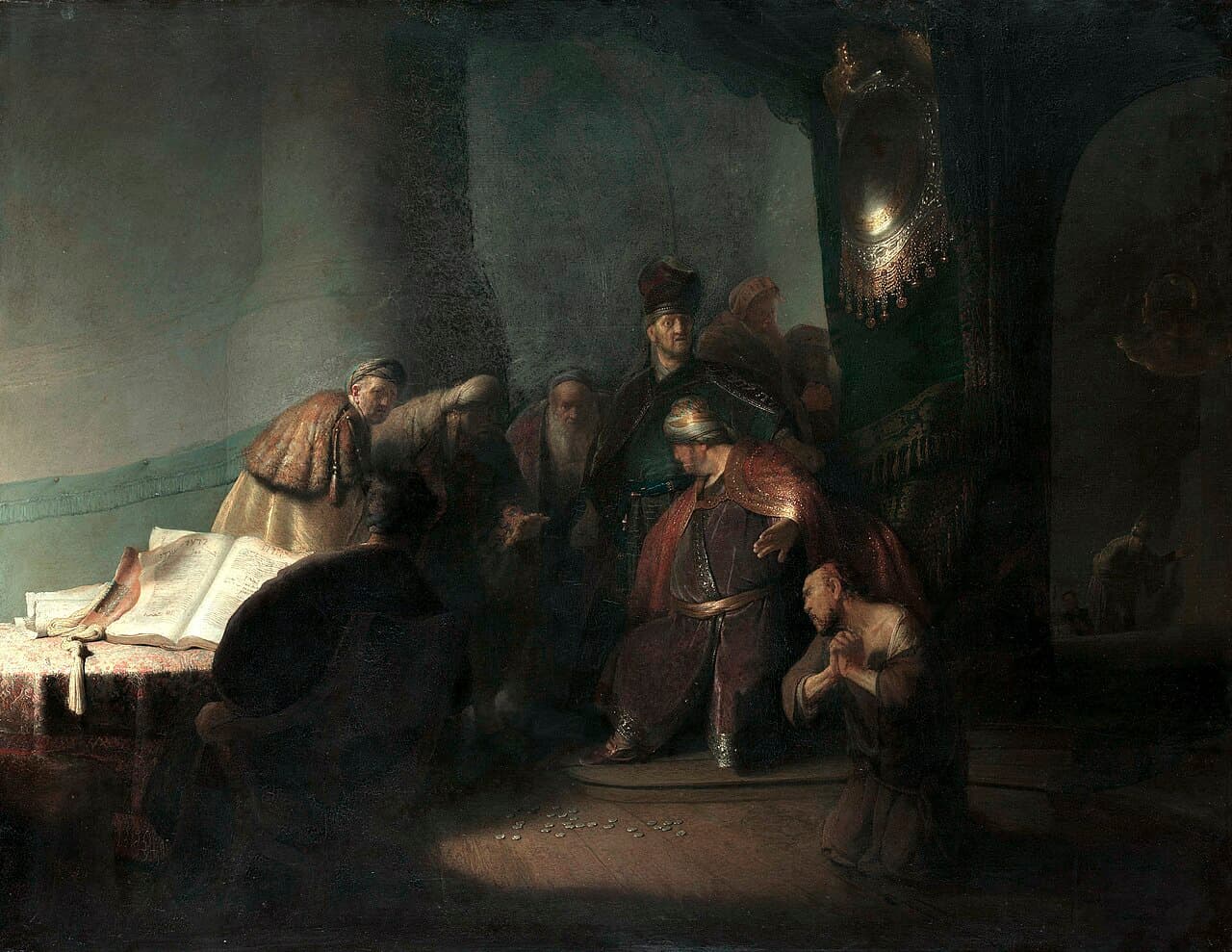
Judas Iscariot is the only apostle whose death is recorded in more than one New Testament source — and those sources directly contradict each other. Matthew 27 says Judas hanged himself after returning the thirty pieces of silver to the chief priests. Acts 1 says he bought a field with the money, fell headlong, and his body burst open. Both accounts agree that the site became known as the Field of Blood (Akeldama), but for different reasons. The discrepancy has been noted since antiquity, and no fully satisfying harmonization has been produced.
Who Was Judas Iscariot?
Judas was one of the twelve, named in every apostle list as the last, always with the notation that he was 'the betrayer' or 'the one who betrayed him.' He served as the group's treasurer and, according to John 12:6, embezzled from the common fund. He is identified in the Synoptics as the one who arranged with the chief priests to hand Jesus over in exchange for thirty pieces of silver. On the night of Passover, he led a detachment of temple guards and soldiers to the Garden of Gethsemane and identified Jesus to them with a kiss. The betrayal is the defining fact of his record.
The Two Accounts
Matthew 27:3-10 states that when Judas saw Jesus had been condemned, he was 'seized with remorse,' returned the thirty pieces of silver to the chief priests and elders, threw the coins into the temple, and went and hanged himself. The priests, unwilling to put the blood money into the treasury, used it to buy the potter's field as a burial place for foreigners. This field, Matthew says, was called the Field of Blood — because it was purchased with blood money. Matthew connects the events to a prophecy he attributes to Jeremiah (the quotation actually appears in Zechariah 11:12-13 and possibly Jeremiah 32:6-9).
Acts 1:18-19 gives a summary attributed to Peter: 'With the payment he received for his wickedness, Judas bought a field; there he fell headlong, his body burst open and all his intestines spilled out. Everyone in Jerusalem heard about this, so they called that field in their language Akeldama, that is, Field of Blood.' In this account, Judas himself purchased the field, and the name Field of Blood derives from Judas's gruesome death there, not from the blood money.
What Ancient Sources Say
Matthew 27:3-10 (approx. 80-90 AD) — hanging; field purchased by priests; named for blood money.
Acts 1:18-19 (approx. 62-85 AD) — Judas himself buys the field; falls and bursts open; named for death.
Papias of Hierapolis (approx. 130 AD), cited by Apollinarius of Laodicea — describes a graphic death consistent with some elements of Acts: Judas swells grotesquely, his bowels burst, he emits 'a great flow of pus.' Papias claims to have received this account from those who knew the apostles.
The Historical Assessment
The contradiction between Matthew and Acts has generated a substantial body of scholarly literature attempting to harmonize the accounts. The most common harmonization proposes that Judas hanged himself (Matthew) and his body, left unburied, eventually fell and decomposed catastrophically (Acts) — but this reading requires Acts to be describing the state of his corpse rather than the cause of death, a reading the text does not naturally support.
Most textual scholars treat the two accounts as independent traditions that have not been reconciled. Historian Raymond Brown, in The Death of the Messiah, analyzes the accounts in detail and concludes that the discrepancies cannot be harmonized without forcing both texts. The convergence on the name Akeldama and the connection to the thirty pieces of silver suggests a shared historical core — that Judas did die abruptly and violently, that a specific field in Jerusalem was named in connection with him, and that the money paid for the betrayal was somehow associated with that field. The specific details of the death may represent two different traditions built on that core.
Historical Confidence Rating: DISPUTED. The fact of Judas's sudden and violent death is attested by two independent New Testament sources and by Papias. The specific manner of death cannot be determined because the primary sources are irreconcilably contradictory.
Key Ancient Sources
Matthew 27:3-10 — hanging; field purchased by priests with blood money.
Acts 1:18-19 — Judas buys field himself; falls and bursts open.
Papias of Hierapolis (approx. 130 AD) via Apollinarius — graphic account of bodily dissolution; claims apostolic source.
Further Reading
Raymond E. Brown, The Death of the Messiah (1994) — exhaustive scholarly analysis of the passion narratives including the Judas traditions.
William Klassen, Judas: Betrayer or Friend of Jesus? (1996) — reassessment of Judas including critical examination of the death accounts.
This article is part of our series on the deaths of the apostles: Peter, Andrew, James son of Zebedee, John, Philip, Matthew, Thomas, James son of Alphaeus, Thaddaeus, Simon the Zealot, Matthias, Bartholomew, and Paul.