Library
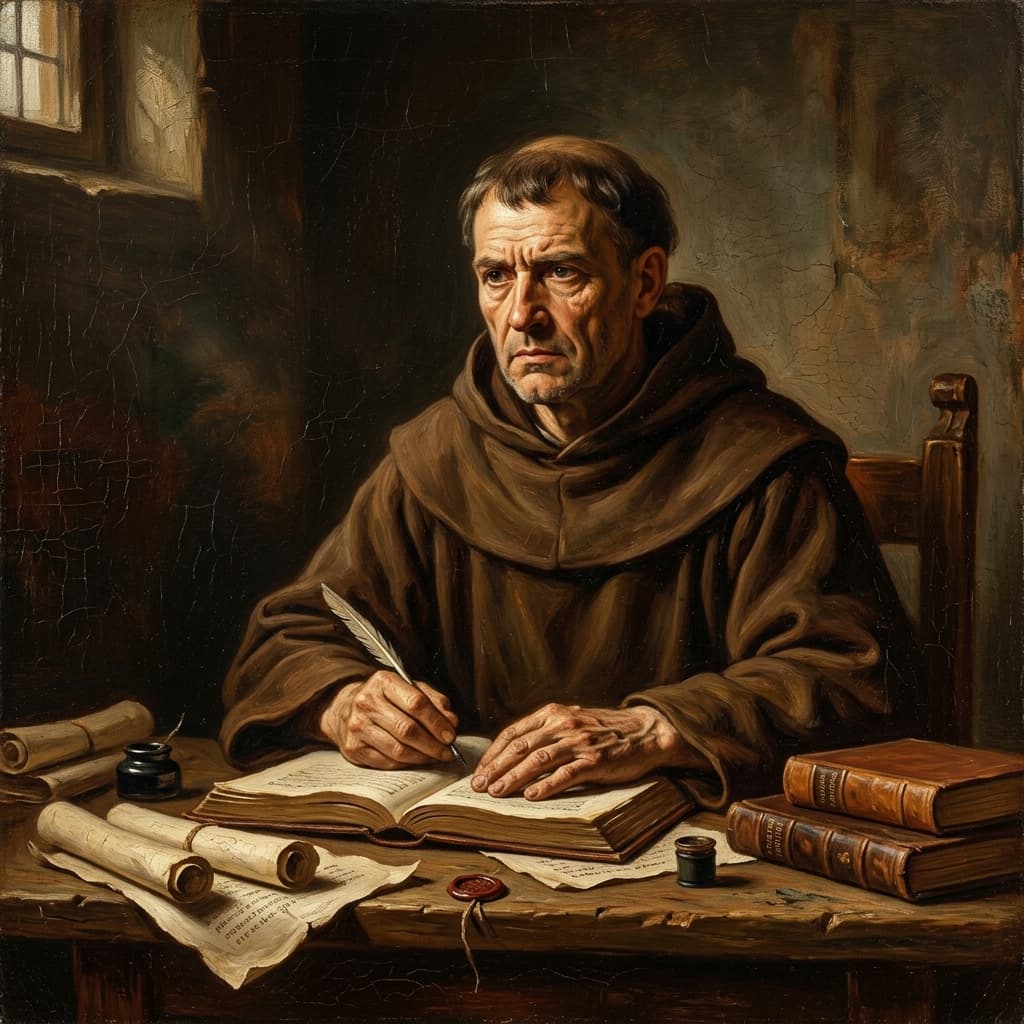
AI-generated illustration
Library
Post-Nicene Patristic (4th-5th C) · d. c. 405 CE · Updated April 9, 2026
Jovinian was a Roman monk in the Post-Nicene Patristic era, known for opposing ascetic elitism in the Western church around the late 4th and early 5th centuries. He challenged the widespread belief that ascetic practices like celibacy and fasting were spiritually superior to marriage and normal eating habits. This stance set him apart in a church increasingly dominated by monastic ideals and a hierarchy that valued asceticism as a path to greater holiness.
Jovinian argued that all baptized Christians who kept their faith were equal before God, regardless of their lifestyle choices concerning marriage or fasting. He claimed that Scripture did not support the idea that celibacy was superior to Marriage, a bold assertion in his time. Around 390 CE, his views led to his condemnation at synods in Rome and Milan, marking him as a controversial figure. Despite his condemnation, Jovinian's challenge to the church's growing asceticism left a mark on the religious discussions of his era. He died around 405 CE, leaving behind a legacy that questioned established spiritual hierarchies.
Jovinian lived in a world where the Western church increasingly emphasized ascetic practices as a means of achieving spiritual superiority. The growing trend towards monasticism and Celibacy during this time was fueled by the belief that such practices brought individuals closer to God. Jovinian's opposition to this notion sparked controversy because it challenged the established order that ranked Christians based on ascetic achievement. His views, condemned by church authorities, highlighted the tension between traditional teachings and emerging monastic ideals. This controversy underscored a pivotal moment in church history, where debates over spiritual merit and practice shaped the future of Christian doctrine.
Is celibacy spiritually superior to marriage, and do ascetic practices earn greater favor with God — or are all baptized Christians equal in standing before him?
Jovinian saw a troubling trend in the Western church. Ascetic practices gained prominence, pushing concepts of spiritual superiority. He saw fellow Christians arguing that celibacy and rigorous fasting brought them closer to God. Jovinian knew Scripture called the faithful to live in freedom and grace. He read the same texts yet understood them differently. His stance challenged the growing belief that abstaining from marriage and embracing self-denial made one holier. He argued for a faith that welcomed all believers equally, no matter their personal choices regarding marriage or diet.
To argue celibacy and asceticism as spiritually superior demands a high price. It insists Christians renounce Marriage and its joys, sacrificing companionship and the comfort of shared life. Self-denial becomes the path to holiness, measured by fasting and solitude. This view creates a spiritual hierarchy, elevating ascetics above those who choose a different path. It divides the church into tiers of holiness, with celibates and ascetics at the top. Ordinary believers, then, are seen as lower, their faith somehow less. This costs the community unity, as it values outward practices over inner faith.
Asserting all baptized Christians are equal before God costs the prestige of asceticism. This view rejects any hierarchy based on lifestyle, denying celibates and ascetics any special spiritual status. It asserts that faith, not personal sacrifice, determines one's standing with God. This perspective demands humility from those who might otherwise claim spiritual superiority. It levels the playing field, insisting that a married Christian, living a faithful life, stands as close to God as a lifelong celibate. It costs the allure of spiritual elitism, grounding the church in equality.
The trap lies in Scripture itself, which neither clearly elevates Celibacy over Marriage nor dismisses asceticism's value. Both sides claim biblical backing, yet neither fully satisfies all scriptural teachings. The authority of Scripture binds both views, unable to reconcile entirely with either. For ordinary Christians, this debate shaped their lives. It influenced decisions about Marriage and Fasting, and it altered perceptions of spiritual worth. The question of equality before God impacted daily choices and formed their hopes for salvation, making this controversy deeply personal and inescapably real.
Jovinian taught that celibacy and ascetic practices do not hold higher spiritual status than marriage and eating. He believed that all baptized Christians who maintain their faith stand equal before God, regardless of whether they live as virgins or partake in regular meals. Jovinian challenged the notion that living an ascetic life automatically brought greater favor with God. Instead, he emphasized the core of Christian life lies in baptism and maintaining faith.
Jovinian's reasoning rested on scriptural interpretations. He referenced Paul's words in 1 Corinthians, which recognize different gifts among believers, suggesting that marriage is as valid and honorable as celibacy. Jovinian also turned to Galatians, pointing out the equality of all Christians in Christ, regardless of their lifestyle choices. In his treatise "Against the Superstition of the Monks," he argued that spiritual merit isn't tied to dietary restrictions or abstinence. Romans supported his view by emphasizing that the kingdom of God focuses on righteousness and joy in the Holy Spirit, not on external practices.
His teachings resonated with those feeling sidelined by the ascetic elitism of the Western church. Many Christians, who valued faith and Baptism over monastic ideals, found solace in Jovinian's message. Though his ideas clashed with the prevailing church hierarchy, they spread among those seeking a more inclusive spiritual understanding. Jovinian's arguments posed a direct challenge to monastic authority, sparking discussions that would echo through church history, even as his views led to his condemnation as a heretic.
The decisive argument against Jovinian centered on the belief that ascetic practices, like celibacy and fasting, offer a path to greater spiritual discipline and closeness to God. This stance drew strength from the examples set by Christ and the apostles. While acknowledging that all baptized Christians share equal salvation, the Church argued that pursuing holiness through asceticism signified a deeper commitment to the Christian life. Jerome, a prominent theologian and Church Father, became the key figure in this debate. In his treatise "Against Jovinianus" (c. 393 CE), Jerome contended that celibacy and asceticism are superior because they free Christians from marital distractions, allowing complete focus on spiritual matters.
Jovinian's interpretation of scripture provided specific proof texts, which orthodox defenders methodically countered. When Jovinian cited 1 Corinthians 7:7 to claim marriage and Celibacy were equally valid, Jerome pointed out that Paul himself preferred Celibacy, advocating it as a better path for undivided devotion to the Lord. Jovinian also referenced Genesis 1:28, arguing marriage's divine ordination equaled Celibacy; however, orthodoxy emphasized Jesus's teaching in Matthew 19:12, which praised celibacy as a voluntary renunciation for the Kingdom of Heaven. Jovinian used 1 Timothy 4:3 to criticize enforced celibacy as demonic, but the Church clarified that celibacy is honored, not enforced, aligning with scripture's broader context. Jovinian’s position inadvertently suggested the Church’s tradition of honoring celibacy was misguided, thus undermining the authority of the Church Fathers and apostolic tradition, exposing a contradiction that weakened his stance.
The orthodox counter-argument demanded a nuanced understanding of Christian liberty and personal choice in spiritual practices. While it defended the tradition of asceticism, it also opened a new challenge: balancing individual freedom with communal tradition in pursuing holiness. This tension remained unresolved, illustrating the complex interplay between personal and communal religious life. The debate highlighted a broader question of how individual choices fit within the collective journey of faith, demonstrating the Church's ongoing struggle to reconcile these elements.
Around 390 CE, Pope Siricius convened the Synods of Rome and Milan. Bishops and church leaders from the Western Church gathered to address a pressing theological debate. At the heart of the matter lay the question of whether celibacy and ascetic practices conferred greater spiritual merit than marriage and regular living. Jovinian, a Christian monk, challenged the prevailing view by arguing that all baptized Christians, if faithful, stood equal before God regardless of their lifestyle choices. His stance clashed with influential church figures, like Jerome, who argued for the superiority of celibacy and asceticism. The Roman Empire, led by Christian emperors keen on maintaining religious unity, backed the church's authority to define orthodoxy. The political stakes were high; the Empire aimed to prevent dissent and reinforce the growing monastic ideals as a stabilizing force.
The debates were intense. Jovinian's opponents argued that Celibacy and asceticism were not only spiritually superior but essential for a devout Christian life. They believed these practices aligned with the sacrifice and discipline central to Christian teachings. The language of the synods' resolution mattered because it would dictate the church's official stance. Ultimately, Jovinian was condemned as a heretic. The synods declared his teachings contrary to the church's understanding of spiritual hierarchy, reinforcing the view that ascetic practices held a higher spiritual standing. This formal condemnation aligned the Western Church more closely with monastic ideals, giving church leaders a unified stance to promote.
The resolution, however, did not lay the debate to rest. Jovinian's ideas continued to resonate in certain Christian communities, sparking ongoing discussions about the value of asceticism versus marriage. This tension persisted and resurfaced in later theological debates, notably influencing the Reformation centuries later. During the Reformation, figures like Martin Luther questioned the necessity of Celibacy and monasticism, echoing Jovinian's arguments. Despite the synods' efforts, the debate over lifestyle and spiritual merit remained unresolved, with the controversy lingering into the modern era, highlighting the enduring complexity of balancing personal faith with institutional doctrine.
After being condemned at the synods in Rome and Milan around 390 CE, Jovinian faced harsh repercussions. The church excommunicated him, and his writings were ordered to be destroyed. Authorities wanted his ideas erased from the collective memory of the church. Jovinian's rejection of the ascetic life as spiritually superior was seen as a threat to the established norms of his time. His exile followed, and he spent his remaining years ostracized from the church community, dying around 405 CE. Jovinian's challenging of the status quo left him marginalized, overshadowed by the dominant voices of the church.
Jovinian's teachings did not disappear with his condemnation. While they lay dormant for a time, the seeds of his ideas would resurface. His belief in the equality of all baptized Christians found a foothold in later reform movements. The Protestant Reformation, for instance, echoed Jovinian's ideas by challenging the spiritual hierarchy and advocating for the priesthood of all believers. Figures like Martin Luther, who criticized the church's emphasis on celibacy, inadvertently carried forward the spirit of Jovinian's thought. Regions across Europe, particularly those influenced by the Reformation, slowly integrated aspects of his teachings into their evolving religious frameworks.
Today, Jovinian's legacy endures subtly but profoundly. Many Protestant denominations reject clerical celibacy and embrace the notion that all believers share equal spiritual standing. This reflects Jovinian's vision of a church where personal life choices do not determine one's spiritual status. Additionally, in secular circles, the idea that marriage and Celibacy hold equal value persists, echoing Jovinian's challenge to the traditional hierarchy. His influence can be seen in the modern understanding that diverse life paths deserve equal respect, a concept that continues to shape contemporary thought on personal freedom and equality.
Continue reading with a Scholar plan
Upgrade to ScholarAI-generated illustration